



Which Liquid Filter Media Is Suitable for Fine Hydraulic Oil Filtration?
Fine hydraulic oil filtration becomes a material-selection problem when a system begins showing the familiar signs of contamination control limits: servo valves respond inconsistently, proportional valves stick, pump wear accelerates, or filter elements reach differential-pressure limits sooner than expected. In these situations, the suitable liquid filter media is usually a graded synthetic or glass-fiber-based depth medium supported by a durable backing layer, selected according to the required cleanliness target, fluid condition, flow pattern, and operating environment.
There is no single “fine” media that fits every hydraulic circuit. A low-viscosity fluid in a high-pressure mobile system, a water-containing fluid in a humid facility, and a heavily loaded industrial hydraulic unit place different demands on the media. The right choice is not simply the medium with the smallest stated pore size. It must retain damaging particles efficiently while maintaining acceptable pressure drop, resisting fluid exposure, and holding contamination without premature blockage.
Start with the particles that actually damage the system
Hydraulic components do not react equally to all contamination. Larger debris may be captured by a suction strainer or coarse return-line element, but fine particles can enter the narrow clearances found in servo valves, proportional valves, pumps, and precision actuators. These particles contribute to abrasive wear, erosion, sticking, and unstable control behavior.
Fine filtration is therefore generally installed where it can protect sensitive components before contamination reaches them. Depending on the circuit, this may be in a pressure line, an off-line kidney-loop unit, or a dedicated polishing loop. Media selection should follow the protection objective. A filter intended to remove large wear debris from a return flow does not necessarily need the same efficiency or media structure as an element protecting a high-response valve bank.
Before selecting media, define the practical filtration target:
- Which components are most sensitive to contamination?
- Is the filter removing ingressed dust, wear particles, manufacturing residue, or degraded oil by-products?
- Does the system need continuous fine control or periodic cleanup of an existing contamination load?
- What flow rate, peak flow, viscosity range, and allowable pressure drop will the element experience?
- Will the oil face water ingress, temperature cycling, oxidation products, or intermittent operation?
These questions prevent a common purchasing mistake: choosing a very fine nominal rating without considering whether the element can deliver stable efficiency and service life in the actual circuit.
Why depth media is often preferred for fine hydraulic oil filtration
For fine hydraulic oil filtration, depth media is commonly more suitable than a simple surface-screen construction. A surface medium captures most particles at or near its upstream face. This can be useful when particles are relatively uniform and the process requires predictable size exclusion, but it may load rapidly when the oil carries a broad mix of particle sizes.
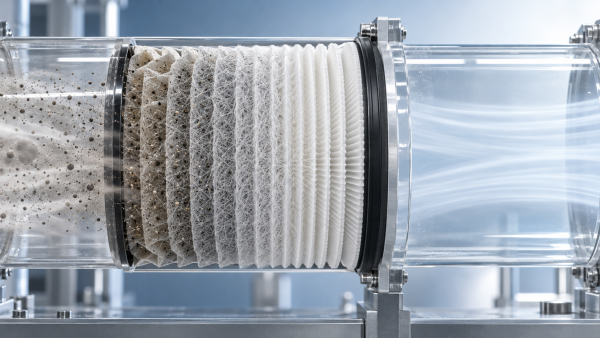
Depth media has a three-dimensional fiber network. Larger contaminants are often captured near the inlet side, while smaller particles are retained progressively through the media thickness. This graded loading behavior can provide greater dirt-holding capacity and help avoid a sharp early rise in differential pressure. In a hydraulic circuit where contamination enters continuously through seals, breathers, maintenance activity, or component wear, this loading profile is highly valuable.
Fine depth media should not be interpreted as loosely defined or imprecise. Its performance depends on controlled fiber diameter, pore structure, thickness, density gradient, resin or binder system, and the support layers that maintain geometry under flow. A medium can appear fine in a static examination yet perform poorly if its structure compacts, sheds fibers, channels flow, or loses integrity under cyclic pressure.
Absolute versus nominal efficiency
A nominal rating broadly indicates that a medium captures a portion of particles around a stated size. It does not, by itself, show how consistently the medium controls the particle population that matters to the hydraulic components. For critical systems, engineers usually need efficiency information that reflects particle retention across repeated passes, along with pressure-drop and contamination-loading behavior.
When comparing filter media, ask whether the stated micron value is supported by a defined test method and whether efficiency is expressed at a relevant particle size. Two elements carrying the same micron label may behave very differently because their fiber structures and test bases differ. A high-efficiency medium may be appropriate for clean, stable oil conditions, but it must still have adequate area and dirt capacity for the expected contamination load.
Comparing common media families
Cellulose, glass fiber, and synthetic nonwoven media can all appear in hydraulic filtration designs. Their suitability depends less on a simple ranking and more on the fluid environment, desired efficiency, mechanical loading, and element construction.
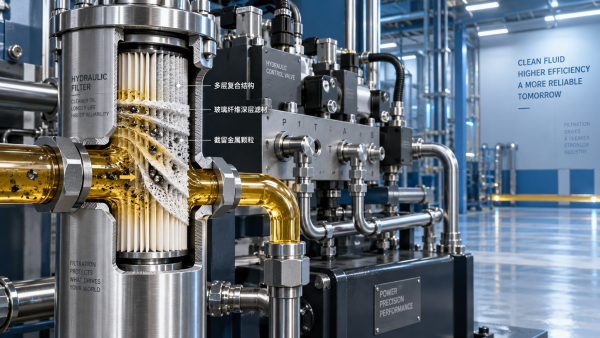
Glass fiber remains a well-established choice where very fine particle control is needed. Its fine fibers can create effective tortuous flow paths and high capture efficiency. Yet the media should never be judged in isolation. The finished filter element must also control fiber release, retain its pleat geometry, tolerate differential pressure, and maintain stable sealing with the intended hydraulic fluid.
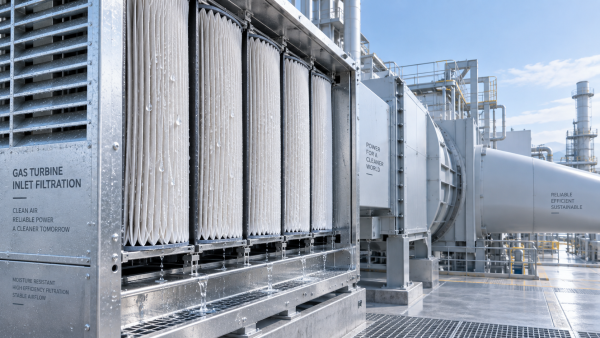
Synthetic media can be especially attractive where moisture resistance and mechanical durability are important. The question, “Can synthetic filter media replace glass fiber in high-humidity gas turbine intakes?” is not identical to a hydraulic oil application, but it raises a useful material-selection principle. Replacement is possible only when the synthetic construction provides the required filtration efficiency, airflow or liquid-flow behavior, strength, environmental resistance, and service stability for that specific duty. A synthetic medium is not automatically better merely because it resists moisture, just as glass fiber is not automatically the best answer merely because it can achieve fine filtration.
Water changes the selection decision
Water contamination is one of the reasons a media choice that works in clean laboratory oil may disappoint in field operation. Water can enter through damaged seals, poorly controlled reservoir breathers, condensation, washdown exposure, or contaminated makeup oil. Its effect depends on whether it is dissolved, emulsified, or present as free water, but persistent moisture can affect both the lubricant and the filter element.
In a system where water exposure is credible, media must be evaluated for wet strength, dimensional stability, compatibility with the oil and additives, and the likelihood of retaining sludge-like contamination. Some cellulose-containing constructions may lose desirable characteristics when exposed to excessive water. Synthetic media often offer advantages in moisture tolerance, but the whole element still needs assessment: adhesives, potting compounds, support tubes, end caps, and seals must tolerate the same environment.
Fine particulate media should also not be expected to solve a significant free-water problem by itself. A particle filter may trap contaminants associated with water, but it is not necessarily a water-removal device. Where free water or persistent emulsification is present, investigate the source first and consider whether separation, dehydration, reservoir management, or breather improvements are needed alongside particulate filtration.
Pressure drop is a system constraint, not a secondary specification
A highly efficient medium with insufficient area can create excessive restriction, particularly during cold starts or when oil viscosity rises. High differential pressure can trigger bypass operation, reducing effective contamination control at the moment protection may be most needed. It can also deform pleats, stress bonds, or shorten service intervals.
Media permeability, thickness, fiber packing, and pleat arrangement all affect flow resistance. Fine media generally brings a pressure-drop tradeoff, so filtration performance should be considered alongside available filter area and expected viscosity. A pressure-line element must be sized differently from an off-line unit that operates at a relatively stable, lower flow rate. Do not use room-temperature viscosity alone; consider the fluid at startup, at normal operating temperature, and under the highest flow condition.
When an element clogs unusually quickly, avoid assuming that a finer medium is automatically at fault. Check whether contamination ingress has increased, whether the reservoir is generating oxidation debris, whether maintenance practices are introducing particles, or whether the filter was undersized for the actual flow. An early differential-pressure increase can be a useful diagnostic signal rather than only a replacement reminder.
Match the media structure to the installation point
Fine filtration media performs differently depending on where it is placed in the circuit. Pressure-line filtration often requires strong media support because the element may experience high differential pressure and flow pulsation. A medium designed only for gentle off-line polishing may not be suitable without reinforcement in a pressure housing.
Return-line filtration handles contamination before oil returns to the reservoir. It can be effective for collecting system-generated wear debris, but it may see fluctuating flow caused by actuator movement. The medium requires adequate dirt capacity and pleat stability to prevent rapid restriction during peak return events.
Off-line filtration offers a more controlled environment. Because flow is often steady and independent of the main circuit’s rapid changes, it can support very fine polishing media with less concern about sudden flow peaks. It does not replace the need for point-of-use protection where sensitive components require it, but it can steadily reduce the overall contamination burden in the reservoir.
Practical signs that the current media is mismatched
A media review is warranted when filter changes are frequent without a corresponding increase in known contamination, when bypass indicators activate during normal operation, or when sensitive components show contamination-related symptoms despite apparently regular maintenance. Another warning sign is a large gap between filter performance on paper and cleanliness results observed in the oil.
Start by reviewing the removed element. A visibly uneven dirt pattern may suggest poor flow distribution, collapsed pleats, channeling, or bypass-related concerns. Gel-like deposits can point toward water, oxidation, or incompatible fluid conditions. Metallic debris may indicate active wear that requires investigation beyond filter replacement. The media should be part of the diagnosis, not a substitute for finding the contamination source.
- Confirm the hydraulic fluid type, viscosity range, additive package, and expected operating temperatures.
- Identify the protected components and the cleanliness level their clearances and control functions demand.
- Review element location, normal and peak flow, housing pressure capability, and bypass settings.
- Compare candidate media using efficiency, pressure-drop behavior, dirt capacity, wet strength, and structural stability.
- Check whether water, oxidation products, or unusual wear debris require a separate corrective action.
- Validate the complete element construction rather than approving media based on micron rating alone.
The most suitable liquid filter media for fine hydraulic oil filtration is therefore usually a high-efficiency depth medium engineered for the system’s fluid, loading pattern, and mechanical conditions. Glass-fiber media may be the right choice where fine capture efficiency is paramount; synthetic or composite media may be preferable where moisture resistance, strength, and durable multilayer construction are equally important. The decisive factor is whether the medium maintains controlled particle retention throughout its service interval without imposing unacceptable restriction or losing integrity in the real hydraulic environment.
Recommendation
 Oct 10, 2026
How Can Air Filter Media Increase Dust Holding Capacity Without Higher Pressure Drop?
Which liquid filter media is suitable for hydraulic oil fine-particle filtration? Discover how advanced air filter media increases dust holding capacity with low pressure drop.- Oct 10, 2026
Which Liquid Filter Media Is Suitable for Fine Hydraulic Oil Filtration?
Can synthetic filter media replace glass fiber in high-humidity gas turbine intakes? Explore media choices for fine hydraulic oil filtration, balancing efficiency, moisture resistance, pressure drop, and service life. - Oct 10, 2026
Can Synthetic Filter Media Replace Glass Fiber in Humid Turbine Intakes?
Is ePTFE filter media suitable for pulse-cleaned construction equipment air filters? Explore synthetic vs. glass fiber performance in humid turbine intakes.