Can Automotive Air Filter Media Handle Quarry Dust Conditions?
Yes, automotive air filter media can handle quarry dust conditions, but only when the media, filter construction, intake layout, and maintenance interval are matched to the actual dust load. A standard passenger-vehicle filter designed for paved-road exposure is not automatically suitable for vehicles operating near crushing, screening, blasting, haul roads, or aggregate transfer points. Quarry dust contains a persistent mix of coarse grit, fine mineral particles, and abrasive silica-bearing material. It can load a filter rapidly, raise intake restriction, and damage an engine if contaminated air bypasses the media or enters through an imperfect seal.
The question is therefore not simply whether a filter has a high filtration efficiency. For quarry service, the filter must retain fine particles while holding a large mass of dust without an early, disruptive loss of airflow. Its pleats must remain open under vibration and pulsating intake flow, its media must resist moisture-related distortion, and its sealing system must remain stable when exposed to heat, dust, and repeated housing service.
What makes quarry dust harder to filter?
Dust around a quarry is rarely uniform. Material released at a primary crusher behaves differently from dust lifted by tire traffic on dry haul roads. Larger particles settle quickly and can build a heavy surface layer on the inlet side of the filter. Finer particles remain airborne longer, travel farther through the intake path, and are more likely to penetrate weak areas of the filtration system.
Abrasiveness is especially important. Mineral dust can erode compressor wheels, cylinders, piston rings, and other air-path components after repeated exposure. A small amount of intake leakage can therefore create a much larger problem than the visible amount of dust suggests. Fine dust that passes through gaps at the end cap, gasket, housing cover, or damaged pleat pack is not controlled by the nominal efficiency of the filter media.
Humidity changes the loading pattern as well. Dry powder usually forms a relatively loose dust layer. When humid air, rainwater, washdown mist, or condensation is present, mineral fines can form a denser deposit. That deposit may block the media surface sooner and can be difficult to remove without damaging the filter. A media selection that performs well in dry laboratory loading may show a shorter usable interval when wet, sticky contamination is common.
Efficiency alone is not enough
Fine-particle efficiency matters because quarry dust often includes particles small enough to pass deep into an engine intake system. However, selecting the highest initial efficiency without considering restriction can be counterproductive. Dense media may capture very fine particles effectively but reach its allowable pressure drop too soon if it lacks adequate depth, pore structure, or effective filtration area.
Dust-holding capacity describes how much contaminant the media can retain before airflow restriction becomes unacceptable. In severe dust service, this characteristic is often as important as initial efficiency. A filter with greater usable dust capacity can maintain engine airflow for longer, reduce premature change-outs, and avoid the temptation to operate a heavily restricted filter.
Airflow stability also deserves attention. As dust accumulates, restriction rises. Engine control systems may compensate within a limited range, but high restriction can reduce available air, alter fuel-air behavior, and affect performance under load. In turbocharged engines, restriction ahead of the compressor can change the operating conditions at the inlet. The practical target is not the lowest possible initial pressure drop at any cost; it is a controlled restriction curve throughout the intended service interval.
Media construction determines whether the filter remains usable
Cellulose-based media remains common in automotive filtration because it can provide useful dust capacity and a rigid pleated structure. In harsh dust exposure, its limits must be understood. The material can lose strength or change shape when exposed to repeated moisture, and heavy surface loading may cause restriction to rise quickly when the pore structure is not designed for the dust distribution present.
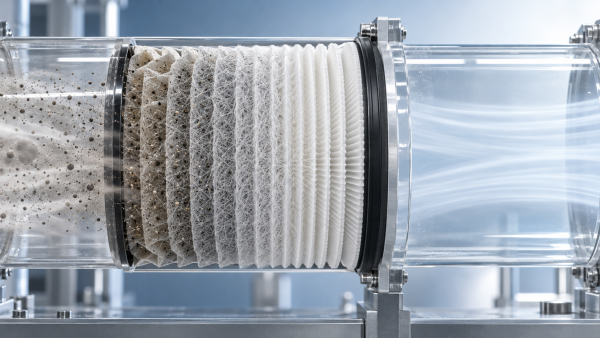
Fully synthetic wet-laid media offers a different balance. Fiber diameter, fiber blend, pore structure, thickness, and basis weight can be adjusted to build depth loading into the material. Rather than forcing most particles to remain only on the outer surface, a graded structure can distribute portions of the contaminant through the media depth. That can extend usable loading capacity while retaining fine-particle control. The design must still avoid a structure that is too open at the clean-air side or too restrictive at the dirty-air side.
Composite media can combine a supporting substrate with a fine filtration layer, but layer bonding has to be robust. A weak lamination interface may separate under thermal cycling, vibration, moisture exposure, or repetitive air pulses. Adhesive selection and application uniformity affect more than appearance: excess adhesive can close pores locally, while insufficient bonding can create delamination or uneven stiffness across the pleat pack.
Surface treatments can change water repellency, dust release behavior, and resistance to handling damage. They do not replace sound media design. A hydrophobic treatment may reduce wetting, for example, but a filter still needs sufficient structural support, reliable pleat spacing, and a housing seal that prevents water and dust from reaching unintended paths.
Why pleat geometry often limits field performance
Filter media is tested as a flat sheet during development, yet an installed automotive element operates as a pleated structure. Pleat depth, spacing, count, pack width, and support configuration determine how much of the theoretical media area remains available once dust loading begins.
Very tight pleat spacing can increase nominal area, but it can also create narrow channels that bridge over with coarse dust. When neighboring pleats touch or become blocked near their openings, part of the media pack stops contributing airflow. Restriction then rises faster than expected. Conversely, widely spaced pleats may stay open but provide too little total area for a high-load application. The appropriate geometry depends on the particle-size distribution, air volume requirement, allowable element dimensions, and expected vibration.
Pleat stabilization is particularly relevant on equipment that travels over uneven quarry roads. Hot-melt beads, separators, wire support, mesh, or formed ribs may be used to keep pleats separated. The support method should not create concentrated stress points or obstruct too much flow area. Media stiffness also needs balance. Excessively soft media can flutter and deform; excessively stiff media can crack at fold lines or resist efficient packing into the required shape.
End caps and potting compounds are part of the same structural system. If the bond between the media edge and end cap is incomplete, dust can bypass the filter even though the visible face of the media looks intact. Inspection should include the full circumference of the bond, particularly after service events involving vibration, impact, or elevated temperature.
Where a good filter can still fail
Many apparent media failures originate outside the media. A distorted housing cover, hardened radial seal, damaged clamp, missing locating feature, or debris trapped on the sealing surface can create a bypass path. The engine then ingests dust that never passed through the filter. Replacing the element with a finer grade will not solve this problem.
Incorrect installation can cause a similar result. The sealing face should be cleaned with a method that does not push loose dust into the clean-air side of the housing. The element must seat squarely, and the cover must close without forcing or twisting the gasket. Lubricants, sealants, or compressed-air cleaning practices should not be used unless they are specifically compatible with the filter design, because they can swell elastomeric seals, damage fibers, or leave contaminant behind.
Attempting to extend service life by blowing out a disposable filter is another frequent source of damage. High-pressure air can puncture the media, weaken bond lines, enlarge pores, or drive embedded dust farther into the structure. A filter can look cleaner after such treatment while providing poorer protection. External dust removal methods have different implications for reusable heavy-duty assemblies, but they should never be assumed appropriate for a standard automotive element.
Choosing media for the actual duty cycle
The air filter requirement should begin with the vehicle's operating pattern rather than its engine size alone. A light vehicle that briefly enters a quarry each day faces a different condition from a pickup used continuously for inspection routes, or a service vehicle idling beside crushers and conveyors. Dust concentration, exposure duration, vehicle speed, intake location, engine air demand, and maintenance access all change the loading challenge.
- Dust generated close to crushing and screening equipment tends to include dense fine material that can increase restriction rapidly, especially when the vehicle is stationary or moving slowly.
- Haul-road exposure often produces a mixed load of coarse grit and suspended fines. A pre-separation stage or protected intake location can reduce the burden on the main element.
- Wet aggregate areas can produce mud-like contamination. Media must retain shape after intermittent moisture exposure, and the airbox drainage path must remain clear.
- Long service intervals require enough reserve capacity for periods of unusual dust loading, not merely average conditions.
A two-stage arrangement is often appropriate where dust concentration is consistently high. A pre-cleaner, cyclonic separator, or serviceable outer element can remove a portion of coarse contamination before it reaches the final filter. The final element then focuses on fine-particle protection. This arrangement is only effective when the upstream component is correctly sized and regularly emptied or serviced. A neglected pre-cleaner can become a flow restriction of its own.
Intake location can be as influential as media grade. An intake positioned low in the wheel-wake zone draws more resuspended road dust than one located in cleaner moving air. Poorly routed ductwork can collect dust or water at low points. A revised intake path, effective dust pre-separation, and a properly specified main element may deliver better results than increasing media density alone.
How to assess whether the current element is adequate
Field assessment should look for a pattern rather than rely on visual darkness. A filter can appear heavily discolored while still maintaining acceptable airflow and integrity. Another element may look relatively clean but have high restriction because fine dust has filled its pore structure. Restriction indication, engine performance observations, and controlled inspection of the clean side provide more useful evidence together than any one sign alone.
When an element is removed, inspect the dirty side for unusually localized deposits. A single heavily loaded area may indicate uneven inlet flow, an intake leak upstream, or water entry rather than an overall media-capacity problem. Examine pleat spacing for collapse, bridging, split folds, and areas where adhesive has migrated into the media. On the clean side, look for dust tracks around seals, end caps, and housing joints. These tracks point toward bypass paths.
Maintenance records should distinguish between replacement caused by normal loading and replacement caused by damage, contamination, or sealing defects. Combining all changes into one interval can conceal the real cause. If filters repeatedly plug early, the next investigation should include intake routing, pre-cleaner function, housing drainage, and dust source proximity before simply changing to a denser material.
Practical specification points
A quarry-duty automotive air filter specification should describe the operating environment, expected air demand, available package space, temperature range, exposure to moisture, target service interval, and installed restriction limit. It should also identify whether the element will face substantial vibration or pressure pulsation. These conditions guide the choice of media basis weight, fiber structure, resin treatment, pleat geometry, support layer, end-cap system, and gasket material.
For supplied media rather than a finished element, consistency matters across the roll. Variation in thickness, permeability, fiber distribution, moisture content, or cure condition can lead to uneven pleat formation and inconsistent filter performance after conversion. During lamination or coating, excessive thermal exposure and nonuniform adhesive deposition can alter pore structure. Converting parameters should be validated with the intended pleat depth and bonding process, because a media that handles well in flat-sheet testing may crack, curl, or bridge when formed into a compact automotive element.
Automotive air filter media can therefore withstand quarry dust conditions when it is engineered as part of an intake-filtration system rather than treated as an interchangeable sheet material. Fine-particle capture, capacity under heavy loading, stable pleats, moisture tolerance, and leak-free installation must work together. Where the dust burden exceeds the practical capacity of a single element, pre-separation and intake design become part of the required protection.
Recommendation
 Oct 10, 2026
How Can Air Filter Media Increase Dust Holding Capacity Without Higher Pressure Drop?
Which liquid filter media is suitable for hydraulic oil fine-particle filtration? Discover how advanced air filter media increases dust holding capacity with low pressure drop.- Oct 10, 2026
Which Liquid Filter Media Is Suitable for Fine Hydraulic Oil Filtration?
Can synthetic filter media replace glass fiber in high-humidity gas turbine intakes? Explore media choices for fine hydraulic oil filtration, balancing efficiency, moisture resistance, pressure drop, and service life. - Oct 10, 2026
Can Synthetic Filter Media Replace Glass Fiber in Humid Turbine Intakes?
Is ePTFE filter media suitable for pulse-cleaned construction equipment air filters? Explore synthetic vs. glass fiber performance in humid turbine intakes.