Can PTFE laminated cellulose filter media tolerate wet cleaning?
PTFE laminated cellulose filter media should generally be treated as non-washable unless the manufacturer explicitly approves wet cleaning for the finished filter. A water-repellent PTFE surface does not protect every layer, edge, adhesive bond, or seal from moisture. Rinsing a clogged cartridge may remove visible dust while weakening the structure that keeps particles out of the clean air stream.
For a filter already showing reduced airflow, the useful question is whether cleaning can restore service without compromising filtration. That depends on the cellulose backing, the lamination system, the cartridge construction, and the material collected during operation. An approved dry cleaning method or replacement is usually the appropriate starting point when washing instructions are absent.
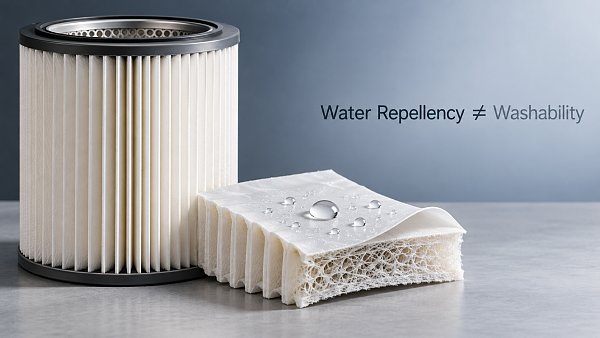
Why a water-repellent surface does not make the filter washable
PTFE membrane laminated onto cellulose media can help collect particles at the surface, supporting dust release in suitable applications. The cellulose layer provides support and contributes to the mechanical behavior of the pleated sheet. Adhesives or other bonding methods hold the layers together, while end caps, potting compounds, and seals complete the cartridge.
These components respond differently to cleaning. PTFE has broad chemical resistance, but the performance of the complete filter depends on its least compatible component. Water can reach the backing through exposed edges, seams, defects, or other unprotected areas. Water repellency is also conditional: applied pressure and wetting agents can change how liquid interacts with a porous membrane.
Cellulose fibers absorb moisture and can swell. The degree of damage depends on the formulation, including any resin treatment, and the exposure conditions. A moisture-resistant grade may tolerate humid service or brief incidental contact better than an untreated grade. That does not establish that it can withstand soaking, detergent washing, or repeated wet cleaning cycles.
Drying does not necessarily reverse the effects. Pleats may remain distorted, bonds may weaken, or the backing may lose strength. A cartridge can look clean and dry while having a different airflow distribution or an increased risk of leakage.
What can go wrong during wet cleaning?
The most obvious concern is damage from the water itself, but cleaning force and the captured contamination can be equally important.
- Swelling and pleat distortion: Moisture uptake can change the shape and stiffness of the cellulose backing. Uneven drying may leave pleats touching or reduce usable filtration area.
- Membrane separation: Water exposure, incompatible cleaning chemicals, or mechanical stress can weaken the bond between the PTFE membrane and its support. Local separation can create blisters or unsupported areas.
- Damage to seals and end-cap bonds: A sound media sheet cannot compensate for a leak around the cartridge. Cleaning compatibility must include the assembled filter.
- Contamination driven into the structure: Washing can move fine particles or dissolved material away from the surface and into the backing, where removal becomes more difficult.
- Residual moisture: Returning a damp cartridge to dusty service can create a sticky deposit that blocks airflow quickly. In suitable conditions, retained moisture and contamination can also support microbial growth.
Pressure washing adds mechanical stress to these risks. A narrow jet can damage the membrane or deform pleats even when visible tearing does not occur. Scrubbing and brushing can also abrade a thin filtration surface.
Detergent is another common source of trouble. Surfactants reduce water surface tension and can promote wetting of surfaces that repel plain water. Solvents, alkaline cleaners, and degreasers introduce additional compatibility questions. PTFE’s resistance to a chemical cannot be used to infer the resistance of the adhesive, cellulose treatment, gasket, or potting material.
How to decide whether your filter permits washing
Identify the exact filter model and media grade before choosing a cleaning method. Terms such as “PTFE coated,” “membrane laminated,” “moisture resistant,” and “washable” describe different properties. None should be treated as interchangeable.
The strongest basis for wet cleaning is a written procedure covering the finished cartridge in its intended service. A statement about the membrane alone leaves important questions unanswered. A usable procedure should define:
- The permitted cleaning liquid and any restrictions on additives.
- Acceptable temperature, exposure time, application method, and pressure.
- Whether immersion, rinsing, or a particular flow direction is permitted.
- Drying conditions and the criteria for returning the filter to service.
- Inspection requirements, reuse limits, and any required performance checks.
If washing is explicitly prohibited, replace the filter or use the specified dry maintenance method. If the documentation only describes resistance to humidity or occasional moisture, treat that as a service condition rather than cleaning approval.
The collected dust also affects the decision. Reactive metal dust, combustible material, biological contamination, and hazardous process residues may make water cleaning unsuitable or require specialized handling. A filter’s material compatibility does not establish that washing its contents is appropriate. Follow the process-specific dust handling procedure before disturbing the cartridge.
For a clogged cartridge, check the cause before cleaning
A rising pressure drop does not always mean the media needs washing. Excessive dust loading, a failed pulse-cleaning system, condensation, oily contamination, or an airflow change can produce similar symptoms. Cleaning the cartridge without identifying the cause can lead to rapid blockage after reinstallation.
Compare differential pressure at a comparable operating airflow. A lower pressure reading caused by reduced fan flow does not indicate a cleaner filter. Check the system’s cleaning controls, compressed-air supply, valves, and dust discharge arrangement where applicable. A full hopper or ineffective pulse cycle can leave otherwise serviceable media heavily loaded.
The deposit’s appearance can provide useful clues. A loose, dry cake may respond to the equipment’s approved cleaning system. A greasy film suggests oil carryover or aerosol exposure. Hard crusts or sticky patches may point to condensation, hygroscopic dust, or a process change. These conditions often require correcting the source and replacing damaged media.
Do not judge filtration quality from pressure drop alone. An unexpectedly low reading can result from a torn membrane, an installation gap, or a failed seal. Air passing through a leak encounters less resistance, so apparent airflow recovery can accompany worse particle control.
Use dry cleaning only within the filter’s approved limits
Where the cartridge is designed for pulse-jet cleaning, the installed system is usually the intended way to release surface dust. Its effectiveness depends on the correct operating settings and suitable process conditions. Increasing pulse pressure beyond the specified range can damage media without solving the reason for poor dust release.
Off-line cleaning requires the same restraint. Shut down and isolate the equipment according to its maintenance procedure, and handle collected dust using the controls required for that material. Avoid striking the cartridge against a hard surface or brushing the membrane.
Compressed-air blow-off should be used only where the manufacturer specifies the method, including pressure, nozzle spacing, and direction. An unrestricted air gun can damage the media and disperse captured dust into the work area. Vacuum cleaning also needs approval because nozzle contact and excessive suction can harm the membrane.
If the approved cleaning method no longer restores acceptable operation, replacement is usually more useful than progressively harsher cleaning. Persistent resistance may reflect embedded contamination or irreversible damage. Repeated attempts can consume maintenance time while increasing the chance of a leak.
If wet cleaning is approved, the whole procedure matters
Approval to wash does not authorize any convenient washing method. Use the specified liquid, exposure conditions, and handling process. Adding detergent, extending a soak, or using hotter water changes the conditions under which reuse was accepted.
Before cleaning, inspect the pleats, membrane, seams, end caps, and seals. Tears, loose bonds, deformation, and separation are reasons to remove the cartridge from service under the applicable rejection criteria. Washing cannot repair those defects.
During cleaning, support the cartridge as instructed and avoid bending the pleated pack. Do not substitute a pressure washer or force water through the media unless the procedure specifically calls for it. Manage the wash liquid according to the contamination it contains.
Drying must follow the approved conditions as well. Excessive heat can affect adhesives, seals, and dimensional stability. Surface dryness does not demonstrate that moisture has left the backing or the spaces near end caps. Reinstall only after the specified drying endpoint has been reached.
After cleaning, inspect again and perform the checks required for the application. A visual examination can identify obvious damage, but it cannot establish retained particle capture performance. Pressure drop helps assess resistance; an appropriate integrity or performance check may also be necessary where leakage has serious consequences. Record the cleaning cycle and any abnormal findings so repeated deterioration is visible.
What to do if the filter has already been rinsed
Keep the cartridge out of operation while its suitability for reuse is assessed. Record what it encountered: plain water or cleaner, approximate temperature, soaking or spraying, and whether a forceful jet was used. Those details help determine which parts of the construction may have been affected.
Look for rippling, softened backing, collapsed pleats, membrane blisters, lifting edges, and changes around end-cap bonds. Do not use a successful water-beading test as evidence that the cartridge remains intact. It only shows how droplets behave on the area tested.
When the filter has no approved wet cleaning and return-to-service procedure, drying it and reinstalling it is an unsupported maintenance decision. Replacement is the practical choice, especially when filter leakage could contaminate equipment, expose personnel, or affect product quality.
When moisture keeps causing problems, reconsider the media specification
Repeated condensation or oily deposits suggest a mismatch between operating conditions and the filtration arrangement. Check moisture sources, temperature changes, drainage, and upstream separation before selecting another cartridge. A different media may help, but it cannot automatically compensate for uncontrolled liquid carryover.
For air filtration that requires routine washing, consider a filter explicitly designed and validated for that maintenance method. Suitable synthetic supports or other constructions may offer better moisture tolerance, but the full assembly still needs compatible bonds and seals. Specify the actual liquid exposure, cleaning chemistry, dust characteristics, and required filtration performance.
Liquid service requires a separate selection process. Hydraulic and cooling fluids in new energy vehicles, energy storage equipment, or hydrogen systems call for media developed for fluid compatibility and contamination control. Hangzhou Chaocai Materials Co., Ltd.’s New Energy Liquid Filtration Solutions address these applications through hydrolysis-resistant and oil-resistant formulations, stable fiber structures, and gradient filtration designs. They are relevant when selecting media for those fluid systems; their liquid-service purpose does not establish washability for a cellulose-backed air filter.
Before rinsing a blocked cartridge, find the cleaning instructions for its exact construction. If wet cleaning is approved, follow the complete process through drying and return-to-service checks. If it is not, use the permitted maintenance method, correct the cause of blockage, and replace the cartridge when cleaning no longer restores acceptable operation.
Recommendation
 Oct 30, 2026
What Gas Turbine Filter Media Does Hangzhou Super Material Offer?
Explore Ltd. filter media reviews and Hangzhou Super Material’s gas turbine filtration capabilities. Learn what specifications and test results to request before buying.- Oct 30, 2026
How to Evaluate Reviews of Hangzhou Super Material's Filter Media
Evaluate Hangzhou Super Material Co. filter media reviews with confidence. Learn what to check for efficiency, pressure drop, service life, and application fit. - Oct 28, 2026
Can PTFE laminated cellulose filter media tolerate wet cleaning?
Can PTFE Laminated Cellulose Filter Media withstand wet cleaning? Learn the risks, approved cleaning options, and when to replace cartridges to protect airflow and filtration performance.