Can self-supporting synthetic filter media replace wire backing?
When a filter assembly is being redesigned, wire backing is often treated as a fixed requirement: it protects the media during pleating, supports the pack under airflow, and helps the finished element survive handling. Yet wire can also add weight, complexity, bonding steps, corrosion concerns, and potential restrictions in disposal or recycling. The question becomes urgent when a project needs a lighter filter, a simplified construction, or a media design that can be processed without a separate metal support layer.
Self-supporting synthetic filter media can replace wire backing in some applications, but not as a direct one-for-one substitution in every filter design. The decision depends on whether the media can maintain pleat geometry, resist deformation at the actual pressure differential, tolerate the intended conversion process, and retain adequate strength through the service environment. A material that feels stiff on a roll may still buckle in a deep pleat, creep under heat, or fail near a poorly supported outlet face. The correct question is not simply whether synthetic media is strong; it is whether the entire filter construction remains stable after the wire is removed.
Start with the function of the existing wire backing
Wire backing may perform more than one job in the current design. Removing it without separating these functions is a common source of unsuccessful trials. In some panel filters, wire mainly protects the media from handling damage. In a pleated cartridge, it may prevent pleat collapse or media ballooning under reverse flow. In other designs, the wire also provides a bonding surface, holds a drainage layer in place, or limits movement during potting and assembly.
Before selecting a self-supporting synthetic filter media, identify where the wire is located and what happens when pressure rises, falls, or reverses. A support layer on the downstream side generally responds to a different mechanical risk than one embedded in the media pack. Likewise, a wire used only during conversion may be replaceable through a process adjustment, while a wire that protects the element during pulsed cleaning may require a more substantial redesign.
A useful early review should answer these questions:
- Does the wire prevent media stretching, pleat collapse, flutter, or rupture?
- Is the load steady, cyclic, pulsed, or occasionally reversed?
- Does the wire support the full filter pack, or only exposed sections near the outlet face?
- Is the current wire needed for pleating, frame assembly, adhesive bonding, or transport protection?
- Does the media have an independent downstream scrim, reinforcement layer, or rigid separator?
This functional review often shows that “wire backing” is not a single performance requirement. One project may need a stiffer base layer; another may need a different pleat count, closer pleat support, or a stronger method of fixing the pack into the frame.
Where self-supporting media is most likely to work
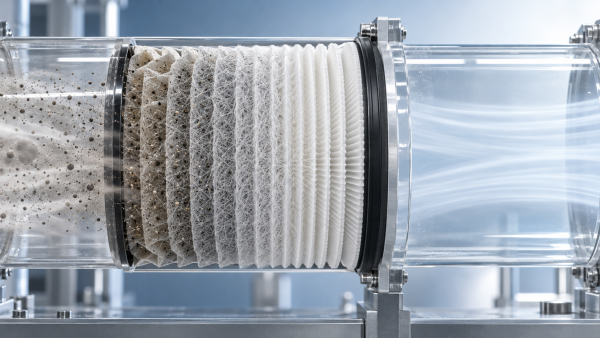
Synthetic media is a realistic replacement candidate when the filter structure already provides meaningful mechanical support or when the required airflow load is moderate and predictable. Multi-layer nonwoven constructions can be designed with a filtration layer for particle capture and a structural layer for stiffness, tensile strength, or pleat retention. Thermally bonded fibers, spunbond support layers, and engineered composite structures can provide resistance without introducing metal into the media assembly.
Applications with relatively stable airflow, controlled temperature, limited moisture exposure, and no aggressive reverse-pulse cleaning are generally easier starting points. A self-supporting construction may also be suitable where the filter has a shallow pleat geometry, a rigid frame, a protective grille elsewhere in the assembly, or closely spaced separators that reduce unsupported span.
The opportunity is especially relevant when wire backing creates a practical problem rather than merely adding cost. Examples include filters where metal increases weight during installation, where wire edges complicate safe handling, where corrosion exposure is a concern, or where the converting line has multiple manual operations associated with metal reinforcement. In these situations, the material evaluation should focus on whether the synthetic structure can take over the required load while simplifying the assembly.
Conditions that usually require more caution
Removing wire becomes more difficult as the unsupported area grows and the operating conditions become less controlled. Deep pleats can place high bending demand on the media. Large-format filters may develop visible deflection even when the media itself has good tensile strength. High face velocity increases aerodynamic loading, and elevated pressure differential may compress pleat channels until airflow distribution becomes uneven.
Pulse-cleaned dust collection systems deserve particular attention. A media pack that survives normal forward flow may react very differently to rapid pressure pulses. Repeated flexing can fatigue fiber bonds, open weak points around pleat tips, or cause gradual loss of pleat spacing. In severe service, wire may not be the only support needed; the design may require a combination of reinforced media, a suitable inner core, controlled pleat geometry, and robust end-cap attachment.
Temperature and chemical exposure also matter. Synthetic fibers respond differently to heat, humidity, oils, cleaning agents, and process gases. Material stiffness can change as temperature rises, while certain contaminants may affect bonding layers or create a deposit that raises pressure drop. A media sample should therefore be assessed after relevant conditioning, not only in its dry, newly manufactured state.
Stiffness is not the same as strength
A frequent selection mistake is to compare only basis weight or simple tensile values. These measurements are useful, but they do not fully predict behavior in a finished filter. Tensile strength indicates resistance to pulling force in a defined direction. A self-supporting medium also needs bending stiffness, compressive resistance, tear resistance, and stable behavior at the pleat fold.
For a pleated element, the most revealing failure mode may occur at the fold rather than across the flat media. A very rigid construction can crack or develop a weak crease when pleated. A softer construction can pleat cleanly but relax after exposure to airflow. The converter must therefore examine the material in its actual form: pleated, bonded, framed, and subjected to the expected loading direction.
Machine direction and cross direction should be reviewed separately. Fiber orientation and reinforcement architecture can produce different stiffness or elongation values along each axis. If the material is fed into a pleater in the wrong orientation, the resulting pack may have lower stability than expected. This is not a minor manufacturing detail; it can determine whether wire removal succeeds.
Evaluate the filter as a system, not as a roll good
A reliable decision process starts with the current filter design and works backward to the media requirements. Obtain the existing operating envelope: normal and maximum airflow, clean and loaded pressure differential, temperature range, humidity or liquid exposure, particulate type, expected loading pattern, and any abnormal flow events. Then document the physical construction, including media area, pleat height, pleat pitch, frame rigidity, adhesive locations, support components, and exposed unsupported spans.
Next, define the acceptance criteria before samples are requested. “No wire” is not an acceptance criterion. The project team should decide what evidence is needed to confirm that the replacement construction is acceptable. Typical criteria include maintained filtration efficiency, manageable initial pressure drop, stable airflow channels, no visible media rupture, no excessive permanent deflection, no separation at bonds, and no damage after handling or environmental conditioning.
It is often helpful to compare several construction paths rather than forcing one material to do every job:
- Fully self-supporting media: the synthetic composite replaces the wire and carries the necessary structural load on its own.
- Self-supporting media with redesigned geometry: the wire is removed, but pleat depth, spacing, panel dimensions, or frame support is adjusted.
- Hybrid support reduction: heavy wire is eliminated, while a lighter non-metal support, localized protection, or rigid housing feature remains where loads are concentrated.
The second and third paths are often more practical than expecting a drop-in media replacement. A small change in pleat height or support spacing may reduce the structural demand enough to permit a lighter, metal-free media construction without sacrificing filter performance.
Conversion compatibility can decide the project
Even when a synthetic medium performs well in laboratory testing, it must run consistently through converting equipment. Pleating equipment may create heat, compression, or sharp folding stress. Some media surfaces are prone to slipping during feed; others retain static charge or react differently to adhesive. Lamination and bonding steps may require controlled temperature, dwell time, and pressure so that structural layers remain intact.
Review the complete route from roll handling to finished filter. Check unwind tension, web tracking, pleat formation, crease quality, adhesive wet-out, cure conditions, trimming, pack insertion, and final inspection. If a wire-backed version masked small process variations, the wire-free design may expose them. For example, uneven adhesive application at the pleat tips may allow gradual movement that was previously restrained by metal support.
Functional advanced materials can be engineered through wet-laid, lamination, hot-melt, spray, or ultrasonic bonding approaches, and the manufacturing route influences the resulting balance of filtration and mechanical properties. The relevant issue is not which bonding method sounds strongest in isolation. It is whether the final composite remains stable through the customer’s actual pleating and assembly process.
Test sequence for a decision with fewer surprises
Testing should move from material screening to finished-filter validation. Beginning with a simple flat-sheet comparison is sensible, but stopping there can create false confidence. The following sequence helps expose problems at the stage where they are most likely to appear.
- Material screening: compare thickness, basis weight, air permeability, tensile behavior in both directions, stiffness, elongation, and visible uniformity.
- Pleating trial: inspect fold integrity, pleat consistency, spring-back, cracking, and dimensional retention after the pack rests.
- Assembly trial: confirm compatibility with adhesive, potting compound, frame materials, seals, and cutting operations.
- Airflow loading: inspect deformation under increasing pressure differential and observe whether pleat channels remain open.
- Conditioned evaluation: repeat critical checks after exposure relevant to service, such as temperature, moisture, or expected contaminants.
- Dynamic assessment where applicable: evaluate cyclic loading or pulse conditions rather than relying only on static pressure.
During these trials, inspect not only for obvious rupture. Early warning signs include gradual pleat leaning, uneven pack thickness, permanent waviness, edge lifting, delamination, local whitening at folds, or a rise in resistance caused by compressed flow channels. These symptoms may appear before a complete failure and are valuable indicators that the design needs adjustment.
Cost comparison should include the whole construction
Wire-free media may reduce material handling and eliminate a reinforcement component, but the economic result depends on the whole assembly. A synthetic replacement that needs a more complex lamination structure, slower processing, tighter pleating tolerances, or a redesigned frame may not lower total cost. Conversely, a media with a higher roll cost can still improve the overall process if it removes wire handling, reduces assembly steps, lowers shipping weight, or decreases scrap caused by sharp wire edges.
Project decisions are stronger when the comparison includes material consumption, conversion yield, cycle time, labor touchpoints, packaging protection, logistics, and expected filter life. The service consequence of a premature deformation event should also be considered. A low-cost construction is not economical if it causes unstable pressure drop, reduced usable media area, or frequent replacement.
Making the replacement decision
Self-supporting synthetic filter media is a credible route away from wire backing when the media’s structural role is matched to the actual filter load, geometry, conversion method, and service environment. It is most successful when treated as a construction redesign rather than a material swap. Start by defining exactly what the wire currently does, identify the most demanding load case, and validate the proposed media in the finished filter format.
Where the media passes static, dynamic, environmental, and processing checks without loss of pleat stability or filtration performance, wire removal may simplify the product. Where risks remain concentrated in large unsupported areas, deep pleats, pulse service, or high-temperature exposure, retaining targeted support or changing the filter geometry may be the more reliable engineering choice.
Recommendation
 Oct 10, 2026
How Can Air Filter Media Increase Dust Holding Capacity Without Higher Pressure Drop?
Which liquid filter media is suitable for hydraulic oil fine-particle filtration? Discover how advanced air filter media increases dust holding capacity with low pressure drop.- Oct 10, 2026
Which Liquid Filter Media Is Suitable for Fine Hydraulic Oil Filtration?
Can synthetic filter media replace glass fiber in high-humidity gas turbine intakes? Explore media choices for fine hydraulic oil filtration, balancing efficiency, moisture resistance, pressure drop, and service life. - Oct 10, 2026
Can Synthetic Filter Media Replace Glass Fiber in Humid Turbine Intakes?
Is ePTFE filter media suitable for pulse-cleaned construction equipment air filters? Explore synthetic vs. glass fiber performance in humid turbine intakes.