Does ISO 16890 Apply to Heavy-Duty Air Filter Media?
The Short Answer: Sometimes, but Often Not by Itself
ISO 16890 can be relevant to heavy-duty air filter media, but it should not automatically be treated as the governing test standard for every demanding filtration application. Its primary purpose is to classify air filters used in general ventilation according to their ability to remove particle fractions such as ePM1, ePM2.5, and ePM10.
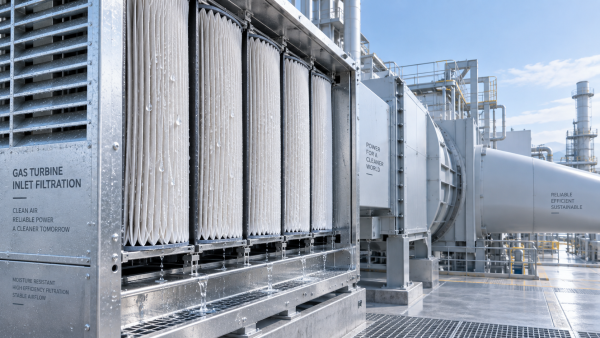
That framework is useful when a heavy-duty filter will operate in an HVAC, industrial make-up air, equipment enclosure, or similar ventilation system. It is less sufficient when “heavy-duty” means engine intake, gas turbine inlet protection, off-road equipment, high-pulse dust collection, or another application where durability, dust loading, water exposure, pressure stability, and structural integrity can be as important as initial particle efficiency.
There is a second distinction that buyers and media developers should make early: ISO 16890 evaluates finished air filter elements under defined laboratory conditions. It does not simply certify a roll of filter media. A media supplier may provide laboratory efficiency data, basis weight, thickness, permeability, or tensile strength, but the final ISO 16890 classification depends on the complete filter design, including pleat geometry, media area, frame construction, sealing, and airflow distribution.
For heavy-duty applications, the practical question is therefore not “Can this media be associated with ISO 16890?” It is “Does ISO 16890 describe the operating risk we need to control, and what additional validation is required?”
Where ISO 16890 Fits Well
ISO 16890 is a useful reference when the filter’s job is to protect indoor environments, ventilation equipment, production spaces, or process air systems from atmospheric particulate contamination. This can include industrial buildings with elevated dust exposure, commercial facilities near roads or construction zones, battery and electronics production support areas, and ventilation systems serving sensitive manufacturing operations.
In these cases, “heavy-duty” may describe an extended service-life target, a high airflow rate, a dusty installation location, or the need for robust media handling during filter manufacture. The system may still be fundamentally a general ventilation system. ISO 16890 then offers a common language for comparing filters by particle-size efficiency rather than relying on older broad descriptions such as coarse, medium, or fine filtration.
For a purchaser, the classification can help answer several practical questions:
- Will the filter provide meaningful efficiency against fine ambient particles, rather than only visible dust?
- Is the selected efficiency class aligned with the contamination sensitivity of the downstream equipment or occupied space?
- Can two proposed finished filters be compared on a consistent basis?
- Does a prefilter stage reduce loading on a more efficient downstream filter?
For filter-media manufacturers, ISO 16890 also provides a relevant development direction for synthetic wet-laid media, composite media, and laminated structures intended for ventilation filters. Media design can influence the balance between initial resistance, fractional efficiency, dust loading behavior, mechanical strength, and compatibility with pleating or downstream processing. Still, a promising media result is not the same as a final filter classification.
Why “Heavy-Duty” Changes the Evaluation
The term “heavy-duty air filter” is commercially common but technically imprecise. A filter used on a high-capacity HVAC unit may face a very different duty cycle from an engine intake filter on construction equipment or a turbine inlet filter exposed to moisture, salt, and fine dust. Applying ISO 16890 without defining the actual application can create a false sense of comparability.
A finished filter can achieve an appropriate ISO 16890 classification and still fail to meet the real requirements of a severe-duty system. The issue is not that the standard is flawed. It is that particle-efficiency classification answers only part of the engineering question.
Consider a few common situations:
The table does not mean that ISO 16890 data should be discarded in severe-duty applications. It can be useful evidence about fine-particle capture. The mistake is using that single result to infer service life, survivability, or suitability for a completely different operating regime.
Media Performance Is Not Finished-Filter Performance
This point matters particularly for B2B sourcing discussions. Filter media is often specified before the full filter design is finalized, especially when converters, filter manufacturers, and end users are working across separate organizations. It is tempting to ask for “ISO 16890 media” as though the standard assigned a stable class to the material itself. In practice, the finished filter element is what is assessed.
A media’s intrinsic properties still matter greatly. Fiber diameter and distribution, electrostatic charge, pore structure, resin or binder system, surface treatment, thickness, basis weight, and multilayer construction all influence performance. So do the manufacturing processes that join the media to support layers, wire mesh, scrim, or protective facings. Lamination quality can affect airflow uniformity, stiffness, delamination resistance, and pleat stability.
But once that material becomes a filter, the housing and geometry change the result. A larger media area may lower face velocity and reduce pressure drop. Pleat spacing can influence whether dust is distributed evenly or bridges rapidly across the pleat openings. An inadequate seal can bypass the media altogether. A design that performs well in a clean laboratory configuration may show very different behavior after vibration, humidity cycling, water contact, or sustained loading.
For this reason, a technically sound media specification should separate material-level requirements from finished-filter requirements.
Material-level requirements may include:
- Basis weight, thickness, and air permeability ranges
- Initial filtration behavior under an agreed media test method
- Tensile strength, burst resistance, stiffness, or elongation
- Resistance to moisture, heat, chemicals, or hydrolysis when relevant
- Bond integrity for laminated or multilayer constructions
- Consistency across production lots
Finished-filter requirements should cover the applicable system standard, pressure drop at the operating airflow, integrity of seals and frame, dust-loading performance, and any application-specific mechanical or environmental tests.
Efficiency Alone Can Lead to the Wrong Choice
Fine-particle efficiency is important, especially where downstream components are sensitive to contamination. Yet high initial efficiency does not automatically make a filter media suitable for severe-duty service. It may be achieved with a structure that develops excessive resistance under loading, loses performance after exposure to water, or lacks sufficient strength for aggressive pleating and handling.
Conversely, a lower-efficiency prefilter may be the correct first stage in a dusty environment if it captures larger particles economically and protects a downstream fine filter from early blockage. In multi-stage systems, the best result comes from matching each stage to its task, not from maximizing the stated efficiency of every component.
Dust-holding capacity deserves particular attention. A filter that retains a large amount of test dust is not necessarily the best choice if its pressure drop rises too quickly, if the dust cake destabilizes under vibration, or if the test dust does not represent the site contaminant. Real dust may contain abrasive mineral particles, fibers, oil mist, soot, moisture, salt, or sticky process residues. Each can alter the loading pattern and the practical replacement interval.
Pressure drop must also be evaluated at the actual flow rate and filter configuration. An apparently efficient media can impose a substantial energy penalty when it is made into a compact filter with insufficient effective area. For systems with fixed fans or limited intake capacity, rising resistance may reduce delivered airflow before the filter has reached its intended service limit.
Application-Specific Standards May Take Priority
When the heavy-duty application has an established sector-specific qualification method, that method normally deserves priority over ISO 16890. Engine intake filtration, turbine inlet systems, cleanroom filtration, and dust collection each involve operating conditions that may not be represented by a general ventilation efficiency classification.
The correct standard depends on the equipment, the contaminant, the consequence of failure, and the contractual or regulatory requirement. An OEM may specify its own test sequence in addition to recognized standards. A power-generation site may require evidence related to moisture management and corrosion protection. An off-road equipment manufacturer may focus on contaminant capacity, restriction behavior, and sealing under vibration. A pharmaceutical or semiconductor facility may require a filtration approach tied to process cleanliness rather than an ordinary ventilation class.
That does not require a buyer to become a standards specialist. It does require asking the supplier and filter manufacturer a more precise question: Which test method demonstrates fitness for this operating duty, and which results are being used only as supporting information?
Where an ISO 16890 result is presented in a heavy-duty proposal, clarify whether it applies to:
- the exact finished filter model,
- a similar design using the same media,
- the media itself under an internal or separate laboratory method, or
- a proposed target rather than a completed qualification result.
These are materially different claims. Treating them as interchangeable can lead to incorrect specifications and difficult responsibility discussions later.
Questions to Resolve Before Specifying the Media
A concise technical brief will usually produce better results than a broad request for “high-efficiency heavy-duty media.” Start with the system rather than the material. Define the airflow range, target filter dimensions, available installation depth, expected contaminant type, maximum acceptable pressure drop, environmental exposure, and required service interval.
Then determine whether the filter is disposable, periodically replaced, or pulse-cleaned. A media designed for a disposable pleated panel may not tolerate repeated cleaning cycles. A construction suitable for dry dust may behave poorly when exposed to condensation or oil aerosols. Where high humidity or intermittent wetting is possible, the water resistance of the media, adhesive system, and final assembly all deserve review.
The following questions are particularly useful during supplier evaluation:
- Is the requested ISO 16890 class required for the finished filter, or is it being used as a general performance reference?
- What is the expected particle-size distribution and concentration at the installation point?
- What pressure-drop limit governs replacement or maintenance action?
- Will the filter see vibration, pulsation, moisture, temperature cycling, or chemical exposure?
- What mechanical properties are needed for pleating, corrugation, lamination, and assembly?
- Is electrostatic efficiency acceptable for the end use, or must performance remain stable after conditioning?
- Which characteristics must be verified on every production lot, and which are validated during product development?
These questions bring the discussion back to performance evidence that can support a real purchase decision. They also prevent an ISO 16890 label from becoming a shorthand for requirements it was never intended to cover.
A Better Way to Use ISO 16890 in Heavy-Duty Projects
ISO 16890 is most valuable in heavy-duty projects when it is used as one layer of a broader specification. It can define the desired particle-filtration behavior for general ventilation-type duties or for a prefiltration stage. Separate requirements can then address loading, structural strength, moisture resistance, bonding durability, environmental exposure, and the performance limits of the finished assembly.
For media developers and filter manufacturers, this often points toward a balanced construction rather than a single-minded efficiency target. Fully synthetic wet-laid media and engineered laminated structures, for example, may be evaluated for how they combine filtration performance with strength, processability, and resistance to demanding service conditions. The appropriate construction depends on the final filter architecture and duty cycle, not on an efficiency class alone.
So, does ISO 16890 testing apply to heavy-duty air filter media? It can apply when the intended use falls within general ventilation or when its fractional-efficiency information is relevant to the filter design. It should not be used as a universal proof of heavy-duty suitability. The final decision should rest on the actual application, the complete filter assembly, and the additional tests needed to show that the media will remain effective throughout its working life.
Recommendation
 Oct 10, 2026
How Can Air Filter Media Increase Dust Holding Capacity Without Higher Pressure Drop?
Which liquid filter media is suitable for hydraulic oil fine-particle filtration? Discover how advanced air filter media increases dust holding capacity with low pressure drop.- Oct 10, 2026
Which Liquid Filter Media Is Suitable for Fine Hydraulic Oil Filtration?
Can synthetic filter media replace glass fiber in high-humidity gas turbine intakes? Explore media choices for fine hydraulic oil filtration, balancing efficiency, moisture resistance, pressure drop, and service life. - Oct 10, 2026
Can Synthetic Filter Media Replace Glass Fiber in Humid Turbine Intakes?
Is ePTFE filter media suitable for pulse-cleaned construction equipment air filters? Explore synthetic vs. glass fiber performance in humid turbine intakes.