How Do Synthetic and Cellulose Media Compare in Dust Holding Capacity?
Synthetic media can offer higher dust holding capacity than cellulose, particularly when engineered for depth loading. However, material labels alone cannot predict usable filter life.
For manufacturers sourcing custom pleatable filter media, the meaningful comparison is dust retained at a defined pressure drop, while maintaining required efficiency and structural stability.
Fiber architecture, dust characteristics, humidity, and pleat design all influence that result. Understanding these variables helps buyers balance airflow resistance, maintenance frequency, and total operating cost.
Does Synthetic Media Always Hold More Dust?
No. A well-designed synthetic medium may outperform a comparable cellulose grade, but a poorly matched synthetic product can load faster or restrict airflow sooner.
The strongest advantage usually comes from an engineered pore structure that distributes particles through the medium instead of concentrating deposits near its upstream surface.
Cellulose remains competitive where operating conditions are stable, acquisition cost matters, and the required efficiency can be achieved without excessive resistance or frequent replacement.
Comparisons become misleading when one material captures fewer fine particles. It may appear to load slowly because more contamination passes downstream rather than being retained.
Buyers should therefore compare media at equivalent application requirements, including particle capture performance, airflow, available filtration area, and the pressure limit that triggers replacement.
What Does Dust Holding Capacity Actually Measure?
Dust holding capacity generally describes the mass of test dust retained before a specified endpoint, commonly a terminal pressure drop under defined airflow conditions.
For media samples, results may be expressed per unit area. Finished filters may instead report total retained mass, which also reflects their effective media area.
Neither figure is meaningful without the test conditions. Dust composition, feed rate, face velocity, conditioning, and endpoint can substantially change the reported capacity value.
It also matters whether a report measures dust fed, dust retained, or another loading quantity. These values are related but should never be treated interchangeably.
Most importantly, laboratory capacity is not a direct service-life forecast. Actual replacement intervals depend on site dust concentration, operating hours, moisture, and changing airflow requirements.
Why Fiber Structure Often Matters More Than the Material Name
Cellulose fibers generally have irregular shapes and dimensions. Their packing, refining, resin treatment, and sheet formation determine the resulting pore network and mechanical properties.
Synthetic media can use selected fiber diameters, lengths, and blends to create targeted structures. This flexibility supports control over permeability, thickness, strength, and particle capture.
A graded structure can place a more open region upstream and a finer region downstream, helping distribute collected particles across the thickness of the medium.
That distribution may delay local pore blockage. However, greater thickness alone does not guarantee better capacity if the added material contributes little useful collection volume.
Likewise, a high-permeability sheet is not automatically superior. Its value depends on whether it also delivers the required efficiency and survives conversion into stable pleats.
Depth Loading or Surface Loading: Which Fits Your Application?
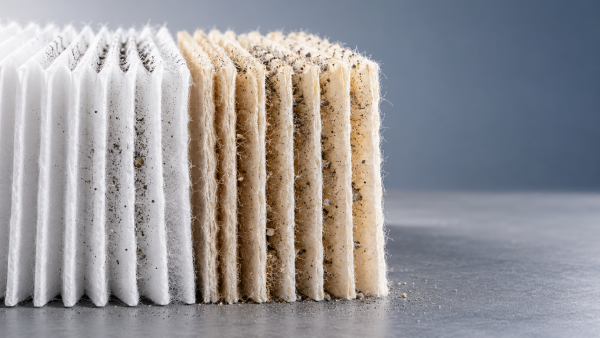
Depth loading captures particles within the internal fiber network. It can provide useful storage volume when the pore structure and particle distribution are well matched.
Surface loading concentrates deposits near the upstream face, often forming a dust cake. That cake increases resistance but can also improve capture as loading progresses.
Both synthetic and cellulose-based constructions can exhibit either behavior. Fine-fiber layers, coatings, membranes, and underlying support structures strongly influence where particles accumulate during filtration.
For disposable filters, internal dust storage may extend the interval before terminal resistance. For cleanable filters, a surface layer may support more effective dust release.
These objectives require different designs. A medium optimized for maximum retained mass in a single loading cycle may perform poorly under repeated pulse cleaning.
How Do Synthetic and Cellulose Compare in Practice?
The following comparison describes common design tendencies, not guaranteed product rankings. Actual performance depends on fiber selection, treatments, layer construction, and the finished filter geometry.
Blended and multilayer products also deserve consideration. Combining structural support with a dedicated capture layer can balance requirements that a single homogeneous sheet struggles to satisfy.
Which Operating Conditions Can Change the Result?
Particle size distribution is a major variable. Coarse mineral dust, fine combustion particles, and mixed industrial aerosols interact differently with the same pore structure.
Sticky or oily particles may bridge pores and coat fibers quickly. A material that performs well with dry test dust may behave differently under these conditions.
Humidity can alter both the dust deposit and the medium. Moisture-sensitive particles may swell or become adhesive, increasing resistance even when fibers remain stable.
Many synthetic fibers absorb less moisture than cellulose, but that does not make every synthetic construction waterproof. Binders, laminates, treatments, and adhesives also affect performance.
Higher face velocity often increases resistance and can alter particle deposition. Evaluate the actual airflow per effective media area, including peaks during normal equipment operation.
Why a Better Flat Sheet Can Produce a Worse Pleated Filter
A flat-sheet test isolates material behavior, but a finished element introduces pleat spacing, channel resistance, seals, supports, and manufacturing variation that influence usable capacity.
Adding more media area can reduce nominal face velocity. However, packing pleats too closely may restrict airflow channels and prevent uniform use of that area.
Dust can bridge narrow pleat openings, causing a rapid pressure increase while deeper sections remain underused. This limits the practical benefit of higher sheet capacity.
Insufficient stiffness can also allow pleats to deform under load. Excessive stiffness or unsuitable processing conditions may create cracking, damage, or inconsistent pleat geometry.
For custom pleatable filter media, validate thickness, stiffness, forming behavior, and pleat spacing together. Final element testing should confirm that material advantages survive conversion.
What Should You Require From a Fair Comparison Test?
Start by defining the application and acceptance criteria. Specify required particle efficiency, operating airflow, initial resistance, maximum resistance, environmental conditions, and any structural constraints.
Then compare candidates using the same dust, loading procedure, exposed area, and endpoint. Request the complete pressure-drop-versus-loading curve rather than only the final capacity.
That curve reveals when resistance begins rising sharply. Two media can reach similar endpoints while creating different airflow restrictions through most of their service interval.
Ask for efficiency measurements throughout relevant conditioning and loading stages. If electrostatic charge contributes to capture, assess whether expected exposure or conditioning changes that performance.
Use standards appropriate to the application: ISO 16890 or ASHRAE 52.2 for relevant ventilation filters, and ISO 5011 for applicable engine air-cleaning equipment evaluations.
These methods address different applications and reporting requirements. Confirm the exact procedure and measured quantity before comparing results across suppliers or converting data into purchasing specifications.
When Is a Higher-Priced Synthetic Medium Worth Buying?
A higher purchase price can be justified when verified performance reduces changeouts, supports required airflow, or lowers the consequences of filter-related downtime and maintenance.
Evaluate cost over the operating period, including filter purchases, installation labor, disposal, and energy. Include downtime where it has a credible, measurable business impact.
Energy savings require particular care. Lower resistance can reduce fan power in suitable controlled systems, but savings depend on operating strategy, airflow, and fan efficiency.
Capacity alone is insufficient for this calculation. A filter with greater terminal dust capacity may still operate at higher average resistance throughout its useful life.
Cellulose may remain the better choice when replacement is inexpensive, conditions are dry and predictable, and validated performance already meets the required maintenance interval.
For uncertain applications, a controlled field trial can resolve the decision. Track pressure drop, airflow, operating hours, environmental conditions, and replacement reasons for each candidate.
What Should You Specify When Ordering Custom Pleatable Filter Media?
A useful specification begins with the process problem: premature clogging, unstable airflow, moisture exposure, insufficient efficiency, or pleat deformation. Each points toward different design priorities.
Provide the supplier with dust characteristics, operating airflow, housing dimensions, target efficiency, pressure limits, temperature, humidity, and the intended replacement or cleaning strategy for evaluation.
Also identify conversion requirements, including pleat height, forming equipment, processing temperature, bonding method, and compatibility with adjacent components. These details reduce development cycles and avoid mismatches.
Hangzhou Chaocai Materials Co., Ltd. develops functional filtration materials using fully synthetic wet-laid production and multiple lamination platforms, supporting the evaluation of different media constructions.
Its PUR, hot-melt adhesive, solvent-based emulsion spray, and ultrasonic lamination capabilities provide manufacturing options for combining layers. Application-specific performance still requires suitable testing and validation.
Ask suppliers to explain how the proposed construction addresses your constraints, then verify samples and finished elements against agreed criteria before committing to production volumes.
Choose the Medium That Delivers Usable Capacity in Your Filter
Synthetic media often offer valuable design flexibility and potential dust storage advantages. Cellulose can deliver dependable, economical performance when its properties match the operating environment.
The strongest purchasing decision compares equivalent efficiency, resistance development, environmental durability, and finished-filter behavior. No material category replaces evidence from a relevant and repeatable evaluation.
When selecting custom pleatable filter media, prioritize usable capacity at your actual operating limits. That is what connects material performance to reliable airflow and maintenance economics.