What Should Suppliers Validate for Custom Pleatable Filter Media?
What Should Suppliers Validate for Custom Pleatable Filter Media?
Custom pleatable filter media must do more than meet a laboratory filtration target. It must survive converting, assembly, and service without losing the properties that made it suitable in the first place. For suppliers developing hydraulic oil filter media, validation should connect particle retention and pressure drop with fluid compatibility, mechanical strength, and pleat stability.
A flat-sheet sample can look promising while the finished element performs inconsistently. Creasing may damage the filtration layer, adhesive may restrict flow, or tightly packed pleats may leave less usable area than the design assumes. Qualification therefore needs to follow the material from the production roll to the operating filter—not stop at a favorable laboratory result.
Start with the operating envelope, not a micron label
Before selecting fibers, binders, or reinforcement layers, suppliers need a written application brief. “Hydraulic filtration” is not specific enough: a return-line element, a high-pressure element, and an offline filter can expose the media to different flow conditions, pressure cycles, and contamination loads.
The brief should identify the actual fluid, viscosity range, minimum startup temperature, normal operating temperature, flow range, and allowable differential pressure. It should also describe expected contamination, water exposure, bypass settings where applicable, and the intended element geometry. These inputs determine which properties require tight control and which trade-offs are acceptable.
Cold starts deserve particular attention. Higher oil viscosity can increase resistance through a medium that performs comfortably at normal operating temperature. Conversely, a low clean pressure drop does not establish adequate particle retention. Neither property should be accepted without the conditions under which it was measured.
Validate retention, restriction, and dirt capacity together
A nominal micron rating is an incomplete purchasing specification. Suppliers and element manufacturers should agree on the efficiency definition, particle sizes of interest, test method, and reporting conditions. Otherwise, apparently similar materials may have been evaluated on different bases.
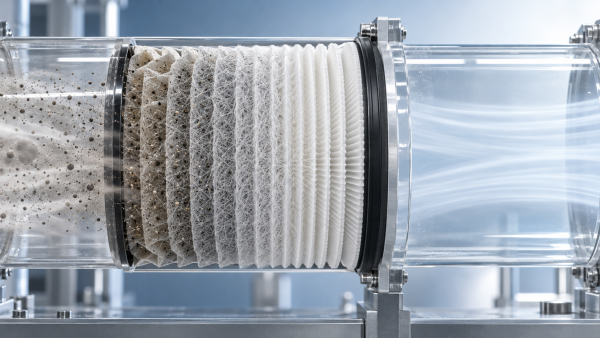
For hydraulic filter elements, ISO 16889 provides a multipass method for evaluating filtration performance. Beta ratios express the relationship between upstream and downstream particle counts at a stated particle size. A beta value without its associated size and test context is not a useful comparison. Flat-sheet screening can guide development, but it should not be presented as equivalent to finished-element qualification.
Three results need to be considered together:
- Particle retention: whether the medium achieves the required separation performance under the agreed conditions.
- Pressure-drop behavior: resistance when clean and how it changes as contamination accumulates.
- Dirt-holding capacity: contaminant loading at a defined terminal differential pressure, using a specified test procedure.
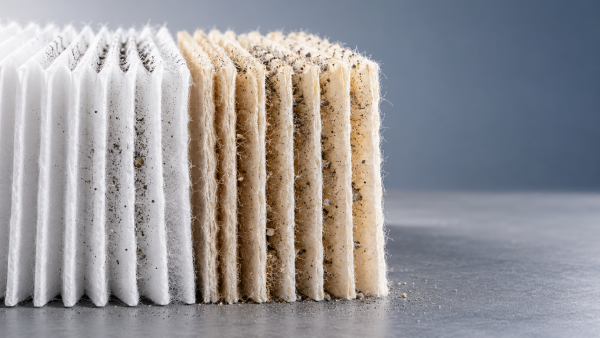
Higher capacity is not automatically better if it comes with unacceptable restriction or requires an impractical pleat geometry. Similarly, adding nominal media area does not guarantee a proportional improvement. Pleat crowding and uneven flow can prevent the finished element from using that area effectively.
Treat pleatability as a process window
“Pleatable” should describe repeatable behavior on the intended converting equipment, not simply the ability to fold a hand sample. Blade and rotary pleating processes can stress a composite differently. Pleat depth, pitch, line speed, tooling, and any thermal treatment all influence the result.
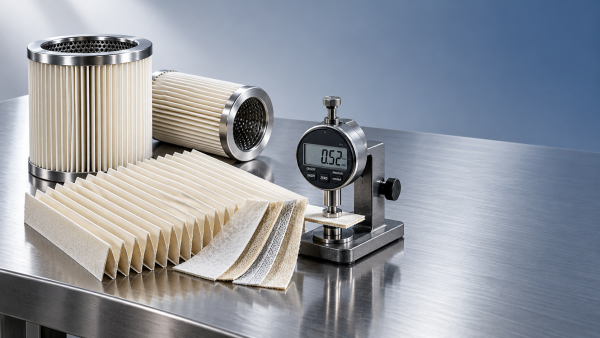
Suppliers should measure thickness under a defined contact pressure, basis weight, and bending behavior in both machine and cross directions. Tensile properties and elongation help explain how the web handles tension, but they do not replace a pleating trial. A strong sheet can still crack at a sharp fold or spring back excessively after forming.
During trials, inspect fold roots for cracking, surface damage, layer separation, and distortion. Check whether pleats remain open and consistent after handling and oil conditioning. If processing conditions need constant adjustment across a roll, the material may lack a sufficiently robust manufacturing window.
The right acceptance criteria depend on the element design. Excessive stiffness can make tight pleats difficult to form; insufficient stiffness can allow channels to close under load. The objective is not maximum stiffness, but adequate support without sacrificing formability or usable filtration area.
Check the complete composite against the actual fluid
Compatibility involves more than the main filtration fiber. Binders, adhesives, support layers, surface treatments, and assembly materials may respond differently to oil, additives, water, and temperature. A composite can retain its appearance while losing bond strength or becoming more brittle.
Testing should use the specified hydraulic fluid or an agreed representative formulation. Compatibility with one mineral-oil formulation should not be generalized to water-glycol fluids, phosphate esters, or biodegradable hydraulic fluids. Exposure temperature and duration need to reflect the project’s service requirements rather than a convenient laboratory schedule.
After conditioning, compare relevant properties with unexposed controls. Depending on the construction, these may include dimensional change, tensile strength, interlayer adhesion, flexibility, and flow resistance. Where the application is sensitive to released fibers or extractable material, cleanliness and shedding also need defined evaluation methods and limits.
ISO 2943 addresses verification of hydraulic filter-element material compatibility with fluids. Its scope should be distinguished from a supplier’s internal coupon immersion test. The parties should agree which evidence supports material selection and which evidence is needed for finished-element approval.
Lamination deserves its own validation
Bonding stabilizes a multilayer structure, but it can also introduce restrictions and stress concentrations. Adhesive distribution, coat weight, cure conditions, and bond pattern can change permeability and bending behavior. Too little bonding may allow separation; excessive or uneven bonding may obstruct flow or create stiff regions that crease poorly.
Hangzhou Chaocai Materials Co., Ltd. combines functional-material R&D with fully synthetic wet-laid production and several lamination platforms, including PUR, hot-melt adhesive, solvent-based emulsion spray, and ultrasonic lamination. These capabilities provide different development routes, but process availability alone does not establish suitability for hydraulic oil service. Each proposed construction still requires fluid, converting, and performance validation.
The practical question is whether the chosen bond remains stable after pleating, oil exposure, and loading without compromising the filtration layer. That evidence is more useful than describing one lamination technology as universally superior.
Separate material strength from element integrity
Media strength and element strength are related, but they are not interchangeable. In service, pressure loads interact with support meshes, cores, seams, end caps, and pleat spacing. Strong flat-sheet material cannot compensate for a weak seam or poorly supported pleat pack.
ISO 2941 addresses verification of collapse or burst pressure ratings for hydraulic filter elements. These are element-level assessments, not ratings that can be assigned from media tensile results alone. Where fluctuating differential pressure is relevant, the qualification plan should also address repeated loading rather than relying exclusively on a single static pressure test.
Validation should therefore have clear ownership. The media supplier characterizes the web and composite; the converter verifies that pleating and assembly preserve those properties; the element manufacturer confirms performance in the completed design. Sharing failed samples and test conditions is often more productive than debating responsibility from separate certificates.
Prove consistency beyond the development sample
A successful development sheet does not demonstrate production readiness. Wet-laid formation, bonding, drying, lamination, and winding can introduce variation across the web and along the roll. Qualification needs to establish whether that variation remains inside the converter’s usable process window.
Production controls should distinguish routine release tests from periodic qualification tests. Basis weight, thickness, permeability, and selected mechanical properties may be suitable for routine monitoring when supported by defined methods. More involved fluid-aging and filtration tests can follow an agreed verification schedule. A convenient surrogate property should not replace performance testing unless its relationship to performance has been demonstrated.
Sampling location matters. A roll-average result can hide edge variation or localized bonding defects. Inspection and sampling should reflect the manufacturing risks, with traceability linking raw materials, production conditions, test results, and delivered rolls.
Delivery specifications also need to cover slit width, winding direction, roll dimensions, splice identification, packaging, and storage conditions. These details affect converting stability even when filtration properties are acceptable. A material is not production-ready if every shipment requires sorting or special handling.
Close qualification with an agreed evidence package
Before scaling custom hydraulic oil filter media, supplier and customer should document the approved construction, test methods, acceptance limits, and responsibility for each validation step. Any remaining gap should be visible: for example, successful coupon aging does not close an unfinished element durability assessment.
The release package should include representative production-roll results, converting trial observations, and the applicable finished-element evidence. It should also define which changes require notification or requalification. Fiber, binder, adhesive, support-layer, and process changes may affect performance even when routine measurements remain within specification.
The decisive question is whether the approved material can be manufactured, pleated, assembled, and operated consistently within the agreed limits. If the evidence covers only a flat-sheet filtration result, qualification is not yet complete.
Recommendation
 Oct 20, 2026
What Should Suppliers Validate for Custom Pleatable Filter Media?
Qualify custom hydraulic oil filter media with confidence. Discover key checks for filtration, pleat stability, fluid compatibility, and production consistency before scaling up.- Oct 20, 2026
How Do Synthetic and Cellulose Media Compare in Dust Holding Capacity?
Choosing custom pleatable filter media? Compare synthetic and cellulose dust holding capacity, airflow resistance, and costs to find the right fit for your filtration needs. - Oct 10, 2026
How Can Air Filter Media Increase Dust Holding Capacity Without Higher Pressure Drop?
Which liquid filter media is suitable for hydraulic oil fine-particle filtration? Discover how advanced air filter media increases dust holding capacity with low pressure drop.