How Do You Test Air Filter Media After Pleating and Curing?
How Do You Test Air Filter Media After Pleating and Curing?
How do I test air filter media after pleating and curing? The short answer is: test the finished filter element, not only the flat media. Pleating, adhesive application, frame assembly, and curing can all change how the material behaves. A roll of media may show good efficiency and acceptable air permeability in the laboratory, yet the finished filter can develop uneven airflow, excessive pressure drop, weak bonds, distorted pleats, or leakage around the pack.
This distinction matters most in demanding filtration work. Automotive intake systems, gas turbine filtration, semiconductor environments, biopharmaceutical facilities, new-energy equipment, and industrial air handling systems each place different demands on the filter. Some prioritize dust-holding capacity and low restriction; others cannot tolerate bypass leakage, particle shedding, or a small loss of structural stability. The post-pleating test plan should therefore confirm both filtration performance and manufacturing integrity.
In practice, the best approach is staged. Start with a visual and dimensional check, then measure airflow resistance and filtration performance, inspect the cured bond system, and finally use application-relevant durability tests where the operating environment justifies them. Trying to treat every filter with one generic pass/fail test is usually where problems begin.
Why Flat-Media Results Are Not Enough
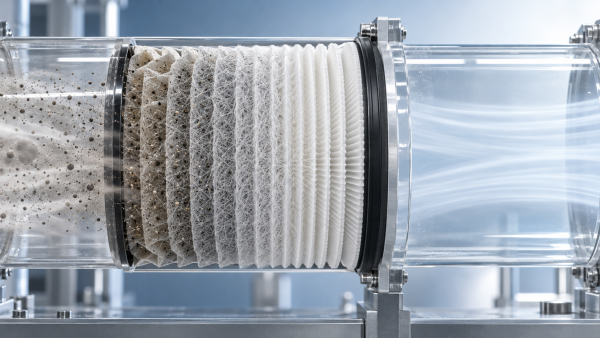
Pleating increases effective filtration area, but it also introduces geometry. Pleat height, spacing, tip shape, embossing, separator design, adhesive bead placement, and media stiffness all affect the final airflow path. If pleats crowd together under air load, the usable surface area falls. If the adhesive migrates too far into the media, it can create local restriction. If the cured pack has weak or incomplete bonds, vibration and pulsation may eventually cause pleat movement or separation.
Curing is equally important. A bond that looks acceptable immediately after production may behave differently after the adhesive has fully reacted, cooled, or been exposed to humidity and temperature cycling. This is particularly relevant when using PUR systems, hot-melt adhesives, solvent-based emulsion spray lamination, or ultrasonic bonding. Each method has its own process window, and each can affect the finished media pack differently.
That is why experienced manufacturers keep a clear separation between incoming-media qualification, in-process pleating checks, and finished-filter validation. The finished article is where the combined effect of material, process, adhesive, and design becomes visible.
Begin With Conditioning and a Controlled Sample Plan
Before running performance tests, allow the pleated and cured samples to stabilize under a defined laboratory environment. The exact conditioning period and conditions should follow the relevant product specification or test method. Testing a warm filter pack straight off the curing line can produce misleading results, especially when polymers, binders, or moisture-sensitive adhesives are involved.
The sample plan should also represent the real production situation. One hand-made development sample can be useful for design work, but it is not enough to judge a production process. Select samples from different positions in a run where practical, and record the material batch, pleater settings, adhesive type, curing conditions, pleat geometry, and frame or housing configuration. When a later problem appears, those records are often more useful than a single test result.
A common mistake is to compare finished filters made from different media lots without documenting the process changes. A minor variation in basis weight, resin content, fiber distribution, or surface treatment may interact with a new adhesive pattern in ways that are not obvious during visual inspection.
Inspect Pleat Geometry Before Testing Filtration Performance
Visual and dimensional inspection may sound basic, but it catches a large share of downstream failures. Examine the filter pack under adequate lighting and look for collapsed pleats, inconsistent spacing, tilted pleats, cracked fold lines, media tears, exposed adhesive, blocked channels, and loose separator material. Inspect both ends of the pack; defects near the end caps or frame interface are easy to overlook.
Measure the critical dimensions specified for the design: pleat height, pack depth, pleat count, spacing consistency, diagonal squareness, and final element dimensions. The purpose is not simply to confirm that the filter fits its housing. These dimensions influence air velocity through the media and the risk of pleat-to-pleat contact during service.
For rigid or highly engineered media, pay particular attention to fold-line damage. Some materials tolerate sharp pleating well; others need controlled fold geometry or a process that avoids stressing a delicate functional layer. A small crack may not be noticeable at first, but it can become a preferential leakage path when the element is subjected to airflow or vibration.
Measure Pressure Drop at the Intended Airflow
Pressure drop is normally one of the first functional measurements on a finished filter. Mount the element in a fixture that seals the perimeter properly, then measure the differential pressure across the filter at the required airflow or face velocity. The chosen flow condition should reflect the intended application rather than an arbitrary laboratory setting.
A higher-than-expected pressure drop may indicate tight pleat spacing, adhesive blockage, reduced effective area, media damage, an incorrectly assembled frame, or a test fixture leak that is disturbing the flow field. It is tempting to blame the media immediately, but the cause is often in the conversion process. Comparing the finished filter result with flat-media air-resistance data can help narrow the investigation, although the two values should not be treated as directly interchangeable.
Pressure drop also needs context. Extremely low resistance is not automatically good if it accompanies reduced efficiency, bypass leakage, or unstable pleats. The useful question is whether the finished filter delivers the expected balance of air resistance, retention performance, and service durability.
Verify Filtration Efficiency and Check for Local Leaks
Efficiency testing should use a method and particle challenge appropriate to the product category. General ventilation filters may be evaluated under methods such as ISO 16890, while high-efficiency filters can require methods within the ISO 29463 or EN 1822 family. Automotive, turbine, clean-process, and equipment-specific filters may also be assessed against customer specifications or sector-specific requirements. The correct method should be agreed before testing, because results from different standards are not automatically comparable.
For a finished pleated filter, overall efficiency alone does not tell the whole story. Scan testing or localized leak detection can be valuable when the application is sensitive to bypass or pinhole defects. The test should examine likely weak points: fold lines, media-to-frame seals, end-cap interfaces, joints, and any area where adhesive coverage is discontinuous.
If efficiency is unexpectedly lower after pleating, inspect the pack before adjusting media formulation. Possible causes include damaged media at the pleat tips, inadequate sealing, gaps between the pack and frame, or a geometry that promotes uneven velocity. Conversely, an apparent efficiency increase may come with an unacceptable pressure-drop penalty if the pleats have become too dense or partially blocked.
Test Bond Integrity After the Cure Has Fully Developed
Cured adhesive systems should be evaluated for adhesion, continuity, and flexibility under the conditions the filter is expected to encounter. A practical inspection includes checking whether adhesive beads are continuous, whether the media is properly anchored at the pleat tips or separators, and whether there is evidence of poor wetting, delamination, or brittle fracture.
Simple manual handling can reveal gross defects, but it should not replace a defined bond-strength or peel evaluation when the bond is critical to product safety or durability. The appropriate method depends on the construction. A laminated composite, for example, may need a different assessment from a pleat pack fixed with hot-melt beads. When using PUR adhesives, cure completion and moisture exposure deserve particular attention; when using ultrasonic lamination, bond pattern and local material damage both need review.
The important point is to test the bond as part of the structure. An adhesive coupon may show good strength on its own while the actual pleated component fails because the media surface, bond area, or stress direction is different.
Add Durability Tests That Match the Service Environment
Not every filter requires the same environmental validation. A cabin-air filter, a gas turbine inlet filter, and a high-purity process filter experience very different stresses. The post-curing test plan should reflect those differences rather than copying a generic checklist.
These tests do not need to be applied indiscriminately. They are most valuable when linked to a known service risk. For example, a filter expected to operate in high humidity should not be released solely because its initial dry-state efficiency is satisfactory. Likewise, a pleat pack intended for equipment with pressure pulses deserves a structural check beyond a static airflow measurement.
Do Not Ignore Dust Loading and Pleat Stability
Initial pressure drop is only a starting point. As particles accumulate, the filter’s pleat geometry determines whether dust is distributed across the available area or concentrated at the inlet face and narrow pleat channels. Overly close pleats can bridge early, meaning dust spans the gap between adjacent folds and restricts airflow faster than expected.
A dust-loading assessment can show whether the filter maintains a stable pressure-rise profile and whether the pack remains intact as loading increases. After testing, cut open representative samples when appropriate. This often reveals information that instrument readings cannot: uneven deposition, collapsed sections, adhesive intrusion, or localized tears around the fold line.
For filtration-material developers, this feedback is especially useful because it connects media design with conversion behavior. Fiber structure, surface treatment, stiffness, and composite construction all influence how a material performs after it has been pleated and loaded. Advanced filtration materials should be engineered with the finished manufacturing route in mind, not optimized only as flat sheets.
Build Testing Into Material and Process Development
At Hangzhou Chaocai Materials Co., Ltd., functional advanced-material development is closely tied to the practical demands of downstream processing. High-performance filtration media may pass through wet-laid production, lamination, adhesive bonding, or ultrasonic processes before it becomes a finished element. Each stage can alter stiffness, surface behavior, bondability, or airflow characteristics.
This is why collaboration between media supplier, pleating operation, adhesive supplier, and filter manufacturer is often more productive than testing each component in isolation. Fully synthetic wet-laid materials, PUR-laminated structures, hot-melt adhesive laminates, solvent-based emulsion spray laminates, and ultrasonically laminated constructions can each be suitable for specialized filtration fields, but they require different process controls and verification points.
When a filter fails after pleating and curing, the answer is not always to change the media. Review the full chain: material lot, storage history, pleat spacing, machine temperature, adhesive application, cure profile, assembly seal, test fixture, and target operating conditions. A disciplined review usually identifies whether the issue is a material limitation, a conversion mismatch, or a test-method problem.
A Practical Release Decision
A finished air filter should generally be released only when its dimensions and pleat form are stable, its pressure drop is within the agreed target, its efficiency and leak performance meet the relevant requirement, and its bonding system has survived the conditioning or durability checks appropriate to the application. The exact acceptance limits should come from the product specification, customer requirement, or applicable test standard—not from a generic online benchmark.
The most useful habit is to keep the test results connected to production records. If the same media behaves differently after a change in pleat count, adhesive pattern, curing time, or frame design, that information becomes a practical tool for controlling future runs. Post-pleating testing is not merely final inspection; it is how manufacturers confirm that a promising filtration material has become a reliable working filter.
Recommendation
 Oct 10, 2026
How Can Air Filter Media Increase Dust Holding Capacity Without Higher Pressure Drop?
Which liquid filter media is suitable for hydraulic oil fine-particle filtration? Discover how advanced air filter media increases dust holding capacity with low pressure drop.- Oct 10, 2026
Which Liquid Filter Media Is Suitable for Fine Hydraulic Oil Filtration?
Can synthetic filter media replace glass fiber in high-humidity gas turbine intakes? Explore media choices for fine hydraulic oil filtration, balancing efficiency, moisture resistance, pressure drop, and service life. - Oct 10, 2026
Can Synthetic Filter Media Replace Glass Fiber in Humid Turbine Intakes?
Is ePTFE filter media suitable for pulse-cleaned construction equipment air filters? Explore synthetic vs. glass fiber performance in humid turbine intakes.