How adhesive coat weight affects hot melt adhesive lamination
Adhesive coat weight affects bond strength, airflow resistance, and flexibility in hot melt adhesive lamination. Too little adhesive leaves insufficient bonding contact; excessive adhesive can obstruct pores, stiffen the laminate, or penetrate beyond the intended interface. The useful operating range is the amount that maintains adhesion through converting and service while preserving the material’s required function. There is no universal coat weight for filtration laminates: substrate structure, adhesive chemistry, application pattern, and thermal conditions determine that range.
Increasing coat weight is therefore justified only when additional adhesive addresses the actual cause of failure. A laminate with poor wetting, uneven application, or an unsuitable bonding temperature can remain weak even after adhesive consumption increases.
Coat weight and surface coverage describe different things
Coat weight is the adhesive mass applied per unit area, commonly expressed in grams per square meter. The measurement basis must be clear: adhesive mass per total web area differs from adhesive mass per coated area. For conventional hot melts, the relevant deposited mass is the adhesive remaining after cooling. Reactive hot melts also require a defined conditioning or cure state when comparing bond performance.
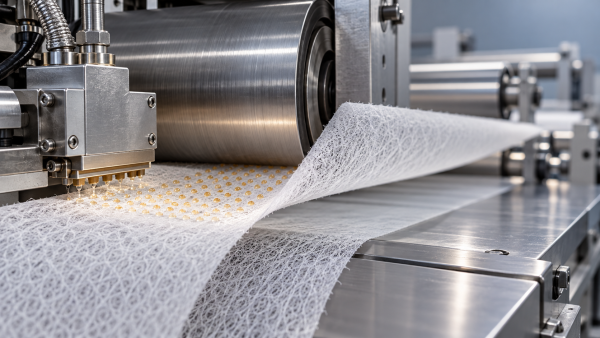
Average coat weight alone does not describe the bond geometry. A continuous film, closely spaced dots, and an open fiber spray can deposit the same mass while producing different pore blockage and load transfer. Pattern spacing determines the unsupported distance between bonded regions; adhesive thickness within those regions influences wetting, penetration, and local stiffness.
If adhesive covers only part of the web, its average mass within the coated regions is higher than the reported whole-web average. Dividing whole-web coat weight by the coated-area fraction gives an approximate local deposited mass. This relationship helps explain why a low overall coat weight can still create thick adhesive spots. It does not directly predict adhesive thickness on a porous substrate, where penetration and spreading change the geometry.
A production specification should therefore identify coat weight together with the application method and pattern. Changing from dots to a continuous coating while retaining the same grams per square meter requires renewed performance evaluation.
What changes as adhesive loading increases
At insufficient loading, adhesive fails to establish enough effective contact between layers. Porous or rough substrates are particularly sensitive because adhesive first contacts raised fibers and surface peaks. Some of the deposited material enters the substrate without forming bridges across the interface. The resulting laminate can show loose areas, edge separation, or unstable peel strength.
Adding adhesive can increase bonded contact and distribute separation forces across more attachment points. That improvement eventually reaches a practical limit. Once the available interface is adequately bonded, additional mass can accumulate within existing attachment zones or spread into open passages. Bond strength then becomes constrained by substrate strength, adhesive cohesion, or interfacial compatibility.
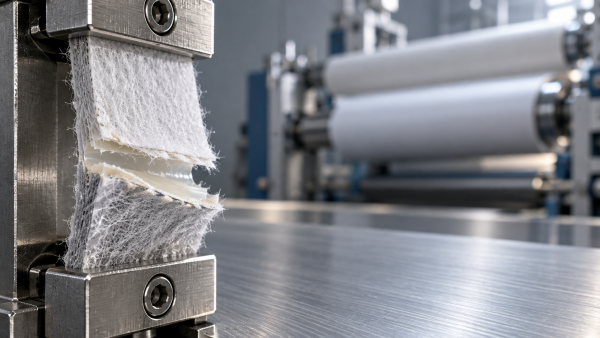
Failure appearance helps distinguish these conditions. Clean separation at one surface suggests an interfacial problem, although it does not identify whether the cause is insufficient adhesive, poor wetting, contamination, or inadequate contact. Adhesive remaining on both sides suggests cohesive failure within the adhesive. Fiber tearing indicates that the substrate limits the measured peel result under those test conditions.
A higher peel value accompanied by extensive fiber damage is not automatically a better setting. Damage to a thin filtration layer can compromise its integrity, and further adhesive addition may provide little useful improvement.
Airflow and flexibility respond to adhesive distribution
In filtration laminates, adhesive occupies space within an already restricted flow structure. A continuous adhesive film across the active filtration area presents a different obstruction from isolated bonds that leave connected air passages. Penetration into fine pores can increase resistance even when the visible surface pattern remains open.
Pressure drop comparisons require the same airflow, exposed area, specimen support, and conditioning. Air permeability comparisons likewise require a consistent pressure differential and test arrangement. A result measured under different conditions cannot establish the effect of a coat-weight adjustment.
The relationship between coat weight and pressure drop need not be proportional. Initial adhesive additions may remain concentrated at fiber contacts, while later additions spread across openings. Conversely, a pattern adjustment that distributes adhesive more effectively can improve bonding without an equivalent increase in obstruction. Microscopic inspection is useful when airflow performance changes more sharply than the measured adhesive mass suggests.
Adhesive loading also affects bending behavior. Dense bonding restricts movement between layers, and thicker deposits create locally rigid zones. During pleating, these zones can concentrate strain, distort folds, or encourage separation beside the bond. Evaluate a laminate after representative forming operations, because a flat sample can pass peel testing yet behave poorly at a tight fold.
For a construction machinery intake filtration material such as GF0907, relevant validation would include bonding and airflow measurements after representative converting, with service exposure conditions defined by the application. The application designation alone does not establish an adhesive loading or acceptance limit.
Separate coat-weight problems from process problems
Temperature changes adhesive viscosity and the time available for wetting. Adhesive that reaches the interface too cool can sit on the surface without developing sufficient contact. Excessive temperature can promote penetration or damage heat-sensitive layers. Set temperatures at the tank, hose, and applicator do not by themselves establish the adhesive temperature when the two webs meet.
The distance between application and the nip matters because cooling occurs during transport. At a fixed distance, increasing line speed shortens the time before contact, but it also changes adhesive delivery requirements and the time spent under nip contact. These effects can oppose each other, so a speed change should be evaluated through measured output and laminate behavior.
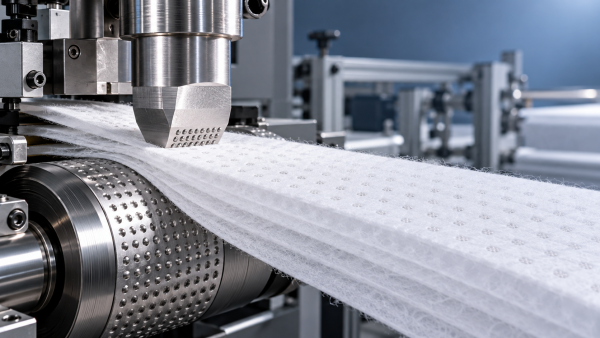
Nip pressure brings surfaces together and supports adhesive transfer. Excessive pressure can flatten a lofty web, force adhesive deeper into pores, or spread individual deposits into larger blocked areas. Compression of the substrate itself can also alter airflow resistance. When pressure drop increases, compare substrate thickness and adhesive distribution before attributing the entire change to coat weight.
Substrate changes deserve equal attention. Basis weight, roughness, surface treatment, moisture, and fiber composition influence wetting and adhesive uptake. A setting developed on a compact support layer may leave a more absorbent replacement poorly bonded at the interface.
Measure deposited mass before changing the recipe
Pump speed and applicator settings are process inputs; they are not direct measurements of coat weight. Delivery changes with equipment condition, restrictions, adhesive viscosity, and operating speed. A theoretical estimate provides a useful starting point when adhesive mass flow, coated width, and web speed are known:
Coat weight (g/m²) = adhesive flow (kg/h) × 1,000 ÷ [60 × coated width (m) × web speed (m/min)].
This calculation assumes that the measured flow reaches the defined coated area. Adhesive discharged during purging, deposited outside the usable width, or lost as overspray must be excluded when determining retained coat weight. Pattern gaps also require a consistent area convention.
Gravimetric measurement compares the adhesive mass with a known specimen area. Matched coated and uncoated specimens can support this approach, provided substrate variation and moisture changes are small enough relative to the adhesive addition. Simply subtracting the nominal basis weights of two substrates from the finished laminate basis weight can produce misleading results.
Where substrate variability masks the adhesive mass, a validated collection or mass-balance method may be needed. Collection on a release surface is useful only if it represents deposition onto the production substrate; spray capture and transfer can differ. The method should have sufficient resolution to distinguish the intended adjustment.
Measure across the web as well as along its length. A satisfactory roll average can hide weak edges, overloaded lanes, or intermittent delivery. Keep specimen locations identifiable so that coat weight, peel behavior, and airflow results can be compared at corresponding positions.
Establish an operating window through controlled trials
Begin with an approved material combination and adhesive processing guidance. Stabilize the line before collecting samples, then vary adhesive delivery in defined increments while holding substrate lots, application pattern, nip conditions, and speed as steady as practical. Record actual deposited mass at each condition.
The trial needs both bonding and functional measurements. Peel testing should define specimen width, separation angle, test speed, conditioning, and failure mode. A numerical peel result without these details is difficult to compare between trials. If the laminate is intended for pleating, include representative folds and examine them for separation or damage.
Reactive polyurethane hot melts require particular care when scheduling evaluation. Immediate handling strength and strength after moisture curing describe different stages of bond development. Compare specimens at equivalent conditioning states, and include the handling stage when the laminate must withstand converting before cure is complete.
Use the trial results to locate two practical boundaries. The lower boundary is where adhesion becomes inconsistent or fails an applicable requirement. The upper boundary is where additional loading causes unacceptable airflow resistance, stiffness, penetration, or converting behavior. If those boundaries overlap, changing coat weight alone cannot resolve the material and process combination.
The production target needs room for normal variation between these boundaries. Selecting the lowest passing trial point leaves little allowance for delivery fluctuations or substrate changes. Where the acceptable range is narrow, improving application uniformity or adjusting the bonding pattern can be more effective than increasing the average mass.
Define acceptance conditions that reproduce the application
A usable specification connects coat weight to measurable laminate performance. Record the mass basis, allowable distribution across the width, bonding pattern, peel method, airflow test conditions, conditioning period, and relevant converting exposure. There is no single coat-weight limit that establishes suitability for every hot melt filtration laminate.
During production, retain samples when adhesive delivery, speed, substrate lot, or thermal settings change. If a later failure appears, the recorded mass and failure surfaces help distinguish inadequate deposition from a change in wetting, curing, or substrate strength. Adjust the process according to that evidence, and release the revised setting only after both bond performance and the required filtration properties remain within their defined limits.
Recommendation
 Oct 26, 2026
Why insufficient curing causes delamination in PUR lamination
PUR Lamination can delaminate when cooling masks incomplete cure. Discover how moisture, temperature, and bond testing help prevent failures and improve laminate reliability.- Oct 26, 2026
How adhesive coat weight affects hot melt adhesive lamination
Hot Melt Adhesive Lamination: learn how to optimize coat weight for reliable bonds, airflow and flexibility. Explore practical testing tips to reduce waste and improve filtration laminate performance. - Oct 26, 2026
Can ultrasonic lamination preserve filter media air permeability?
Can Ultrasonic Lamination preserve filter media airflow? Discover how materials, bond patterns, and process settings help balance permeability, filtration performance, and bond strength.