How can water-resistant filter media be verified after humidity exposure?
Humidity exposure should be verified as a controlled before-and-after performance comparison, not as a visual inspection alone. A filter medium may look unchanged after conditioning while its bond strength, stiffness, pore structure, electrical properties, or resistance to airflow have shifted enough to affect filter construction and in-service protection.
For quality and safety teams, the practical question is whether the Water Resistant Filter Media still performs within its approved limits after exposure to the humidity level, duration, temperature, and recovery conditions that represent its intended use. The answer depends on the full media construction: fiber type, binder system, surface treatment, scrim or backing layer, adhesive compatibility, and whether the medium is used in a flat-sheet, pleated, or laminated filter element.
A credible verification program therefore needs four elements: a defined humidity-conditioning method, an unexposed control sample, performance tests tied to the intended application, and acceptance criteria established before the test begins.
Start with the failure mode, not with a generic humidity test
“Water resistant” can describe several different properties, and they should not be treated as interchangeable. A medium that resists liquid-water penetration for a short period may still soften, curl, delaminate, lose tensile strength, or develop a higher pressure drop after prolonged high-humidity exposure. Conversely, a medium designed for humid air may not be suitable for direct water contact, wash-down conditions, or condensate carryover.
Before selecting a test, define what humidity is expected to threaten in the finished filter. For example:
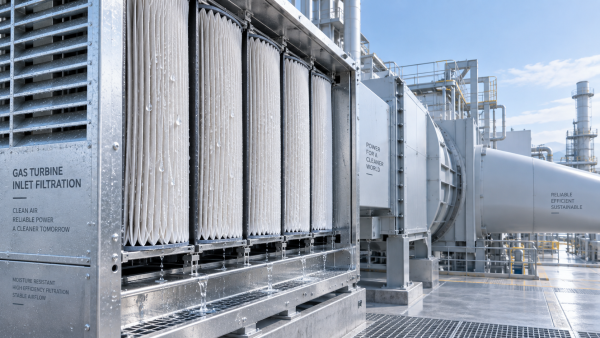
- In gas-turbine intake filtration, moisture exposure may be associated with fog, rain intrusion, salt-laden air, cycling temperatures, and wet-dry operation. The concern is often stable airflow, mechanical integrity, and avoidance of media damage that could permit downstream contamination.
- In automotive or mobile-equipment filtration, humidity can interact with vibration, pulsating flow, oil mist, and thermal cycling. Media stiffness and pleat retention can matter as much as initial efficiency.
- In semiconductor, biopharmaceutical, and controlled-environment systems, the more sensitive issue may be whether humidity alters efficiency, particle shedding, structural integrity, or the filter’s ability to remain sealed in its frame.
- In process ventilation, a humid airstream may contain chemicals, aerosols, or condensable contaminants. In that case, humidity alone is an incomplete challenge condition; the test plan may need to include the relevant chemical exposure or wetting mechanism.
This first step prevents a common quality error: approving a material based on a single “humidity resistance” statement when the actual application involves condensation, repeated wetting, or a combined temperature-and-moisture cycle. High relative humidity and direct liquid-water contact create different stresses. A test report should state clearly which one was evaluated.
Build the comparison around controlled conditioning
Humidity verification is most useful when exposed samples are compared with samples from the same production lot that have been held under the normal reference condition. Without a control group, it is difficult to tell whether a measured difference came from moisture exposure, specimen variability, handling, or the test method itself.
The conditioning protocol should define at least the following:
The recovery condition deserves particular attention. Some media regain apparent strength after drying but retain permanent dimensional change or loss of fiber-to-fiber bonding. Other materials show their weakest state only while humid. Both observations can matter. A medium that survives a post-drying tensile test may still fail during a humid operating period if it sags, releases fibers, or loses pleat geometry before it dries.
For this reason, testing only after a long recovery period can overstate moisture resistance. Where the service environment is continuously humid, measurements taken during or immediately after conditioning are often more relevant. Where the filter will encounter occasional humidity excursions and then return to normal service, both wet-state and recovered-state measurements may be justified.
Verify the properties that affect filtration performance
A humidity-exposed sample should first receive a careful physical inspection, but visual inspection is only a screening step. Record discoloration, wrinkling, edge curl, pinholes, tackiness, cracking, coating migration, delamination, and evidence of fiber release. Compare the exposed and control specimens under consistent lighting and handling conditions.
Dimensional stability is usually the next practical check. Measure length, width, thickness, and, for material intended for pleating, any permanent curl or distortion. A small dimensional movement can become significant after converting a roll good into pleated media. Changes in width can affect pleat pitch; thickness variation can alter pack density; edge curl can complicate automated processing and create sealing problems at the finished-filter stage.
Mechanical testing should reflect how the medium carries load. Tensile strength in machine and cross directions is commonly relevant for wet-laid and laminated materials. Tear resistance may be more informative where a local defect can propagate under airflow or handling. For multilayer media, peel or bond-strength testing can reveal moisture-related separation that tensile testing alone does not detect.
Mechanical results should be interpreted as retention values as well as absolute values. A material may remain above a minimum force requirement after exposure but still show an unusually large decline versus its baseline. That decline can signal a marginal binder system, incomplete curing, variable lamination, or moisture sensitivity that could become more severe under repeated cycles.
Airflow behavior must also be checked. Measure pressure drop or air resistance at the relevant face velocity, using the same specimen area and mounting approach for exposed and control samples. Humidity can change fiber swelling, sheet thickness, pore geometry, electrostatic contribution, or the interaction between layers. A rise in resistance can reduce system airflow and increase energy demand. A drop in resistance may indicate pore opening, structural damage, or loss of fine-fiber coverage.
Filtration efficiency should be assessed when the application is performance-critical or when the medium relies on a fine-fiber layer, electret charge, or carefully controlled pore structure. The particle size range, face velocity, aerosol type, and loading condition should match the approved product test plan as closely as possible. Reporting one efficiency value without its test conditions gives an incomplete picture, because apparent performance can change with particle size and airflow.
For electrostatically enhanced media, humidity exposure needs particularly careful interpretation. High humidity can reduce or alter electrostatic capture mechanisms in some constructions. A material can retain its visual appearance and pressure drop while experiencing a meaningful reduction in fine-particle efficiency. The verification plan should therefore include the particle range most relevant to the filter’s claimed duty, rather than relying solely on coarse-particle capture.
Test the finished construction when conversion creates the risk
Sheet-level testing is efficient for incoming inspection and material qualification, but it does not always represent the finished product. Pleating, adhesive application, hot-melt processing, ultrasonic bonding, frame sealing, and support-media integration can introduce failure modes absent from a flat sample.
When the humidity requirement is linked to a safety-sensitive filtration system, a representative finished filter or pleated coupon should be conditioned and evaluated alongside the media sheet. This is especially important when the material includes a laminate, a coating, a membrane layer, or a bonded support. Humidity may affect the adhesive interface, the fold line, or the support layer before it visibly affects the primary filtration layer.
Useful finished-construction checks can include pleat stability, separation at bonded interfaces, pack collapse, frame adhesion, bypass leakage, and changes in airflow resistance or efficiency. The scope should follow the product risk. It is unnecessary to run every possible test on every lot, but qualification testing should address the mechanism most likely to create field failure.
Acceptance criteria should describe allowable change
A pass/fail decision is only defensible when acceptance limits are defined before samples are tested. These limits should not be copied from an unrelated material merely because both are sold as water-resistant. The appropriate threshold depends on the required filtration level, operating environment, expected life, safety consequence of failure, and variability of the manufacturing process.
For a controlled production program, acceptance criteria commonly cover a combination of:
- No visible delamination, cracking, coating loss, or material breakdown after the specified conditioning and recovery sequence.
- Dimensional change within the conversion and installation tolerance for the finished filter design.
- Minimum retained mechanical strength, together with a defined maximum loss relative to the control sample where that comparison is meaningful.
- Pressure drop remaining within the approved product range at the specified airflow condition.
- Filtration efficiency remaining at or above the required level for the relevant particle challenge and test configuration.
- No unacceptable change in pleat shape, bonding, sealing, or structural stability for representative finished constructions.
It is useful to distinguish qualification limits from routine release limits. Qualification testing may include extended humidity exposure, cyclic conditioning, full filtration-performance testing, and finished-filter assessment. Routine incoming or production release can then focus on material identifiers and a smaller set of correlated properties, provided the relationship between those checks and humidity performance has been established and is periodically revalidated.
Documentation is part of verification
Humidity resistance claims become difficult to defend when records do not show how specimens were prepared and measured. A usable report should identify the material and lot, sample count, conditioning apparatus, exposure profile, control condition, test timing, test methods, raw or summarized results, and the approved acceptance criteria. Photographs may help document visible changes, but they should not replace numerical results where performance is at issue.
Traceability also matters when the media is changed. A new fiber source, binder formulation, surface treatment, curing profile, lamination adhesive, or support layer can alter humidity response even when the nominal basis weight and initial airflow values remain similar. Change-control review should determine whether the modification requires repeat humidity qualification rather than assuming equivalence from routine inspection data.
A final practical point: a successful single exposure test does not automatically establish durability under repeated moisture cycles. If the intended duty includes daily humidity variation, intermittent condensation, cleaning, or transport through changing climates, cycling should be considered during qualification. Repeated expansion, drying, and interlayer stress can expose weaknesses that a single steady-state condition leaves hidden.
Water-resistant filter media is verified convincingly when humidity conditioning is linked to the failure mechanisms that matter in service, followed by direct comparison of physical integrity, airflow behavior, and filtration performance against a defined control. That approach gives quality and safety teams evidence they can use for release decisions, supplier discussions, product changes, and investigations when a humid operating environment raises the stakes.
Recommendation
 Oct 10, 2026
How Can Air Filter Media Increase Dust Holding Capacity Without Higher Pressure Drop?
Which liquid filter media is suitable for hydraulic oil fine-particle filtration? Discover how advanced air filter media increases dust holding capacity with low pressure drop.- Oct 10, 2026
Which Liquid Filter Media Is Suitable for Fine Hydraulic Oil Filtration?
Can synthetic filter media replace glass fiber in high-humidity gas turbine intakes? Explore media choices for fine hydraulic oil filtration, balancing efficiency, moisture resistance, pressure drop, and service life. - Oct 10, 2026
Can Synthetic Filter Media Replace Glass Fiber in Humid Turbine Intakes?
Is ePTFE filter media suitable for pulse-cleaned construction equipment air filters? Explore synthetic vs. glass fiber performance in humid turbine intakes.