How to Select Air Filter Media for Construction Equipment?
How to Select Air Filter Media for Construction Equipment?
Selecting air filter media for construction equipment is not a matter of choosing the highest stated filtration efficiency. Excavators, loaders, bulldozers, crushers, compactors, and drilling rigs operate where airborne dust is rarely consistent. One day the machine may work in dry silica-rich soil; the next, it may face rain, mud splash, humid air, or fine cement dust. The filter must protect the engine without restricting the air needed for stable combustion, and it must retain that balance as dust loading rises.
The same principle applies to cab-air filters and hydraulic reservoir breathers, although their duty cycles and contamination risks differ. Engine intake media must protect critical moving parts from abrasive particles. Cab filtration focuses more on operator comfort and the ingress of dust into controls. Breather media helps limit particulate and moisture exposure in hydraulic reservoirs. Treating all of these applications as interchangeable often leads to an unsuitable material choice.
For equipment manufacturers, filter converters, and maintenance planners, the practical question is: which media construction gives dependable particle capture, acceptable pressure drop, moisture tolerance, and usable service life in the real operating environment? A sound answer begins with the equipment and its duty, not with a catalog grade.
Start With the Contamination Profile, Not the Media Name
“Construction dust” covers a wide range of materials. Quarry fines, sand, clay, soot, fly ash, cement powder, wood dust, and demolition debris behave differently in an air stream and on a filter surface. Their particle-size distribution, shape, density, and tendency to absorb moisture all influence the media requirement. Fine mineral dust can penetrate deeply into a filter structure and raise restriction gradually. Sticky clay-based dust may form a surface layer, especially after exposure to moisture. Fibrous debris can bridge pleat openings or collect at the inlet side of the filter element.
A useful specification process asks several basic questions before selecting fiber type or coating:
- What contaminants are expected at the job site, and how variable are they?
- Is the machine exposed to rain, washdown, fog, condensation, or large humidity swings?
- What airflow range does the engine or ventilation system require under peak load?
- How much installation space is available for filter area, pleat depth, and support layers?
- Will the equipment use a pre-cleaner, cyclone separator, safety element, or sealed airbox?
- Is the desired maintenance interval based on calendar time, operating hours, restriction indication, or seasonal service?
These questions prevent a common mistake: specifying a very fine medium to improve initial capture while overlooking its restriction curve and dust-holding behavior. In an engine intake system, excessive restriction can impair airflow long before the media appears visibly saturated. The most appropriate material is usually the one that maintains suitable protection across its loading life, not the one that performs best in a clean-media test alone.
The Four Properties That Must Work Together
Particle capture efficiency
Efficiency describes how effectively a medium retains particles under defined conditions. It matters greatly in diesel and gasoline engine intake filtration because abrasive particles that pass through the air filter can contribute to wear in cylinders, rings, turbocharger components, and other air-path parts. Yet an efficiency value has limited meaning without test conditions, particle characteristics, airflow, and loading state. When reviewing supplier data, ask whether the reported result is initial or loaded performance and whether the test method reflects the intended application.
For heavy-duty equipment, filtration should be evaluated as part of the complete filter element and air intake design. Media performance can change after pleating, curing, lamination, sealing, and exposure to vibration. Leakage around end caps, gaskets, or damaged pleats can defeat an otherwise capable filter medium.
Airflow resistance
Low pressure drop is desirable, but “lower” is not always automatically better. An open structure may allow easy airflow but provide insufficient fine-particle retention. A denser structure may capture more particles but consume the available pressure-drop budget too quickly. Fiber diameter, basis weight, thickness, pore structure, resin system, surface treatment, and pleat geometry all affect this balance.
The system should be considered across the expected airflow range. A compact machine operating intermittently will impose different demands from a large excavator working continuously at high engine load. The OEM’s permitted intake restriction, housing configuration, and available filtration area should guide the media target. A material supplier can provide meaningful development support only when these operating conditions are shared.
Dust-holding capacity and service stability
Dust-holding capacity is not simply a function of media thickness. It depends on how particles distribute through or across the medium during loading. Some constructions retain more dust within a depth structure; others are designed to form a controlled surface cake. Both approaches can be useful, depending on dust type and the intended replacement interval.
In demanding fleets, a filter that loads predictably is often easier to manage than one with excellent initial airflow but an abrupt rise in restriction. Consider what happens after vibration, repeated thermal cycles, and intermittent wetting. Pleat spacing and mechanical support deserve attention because packed or collapsed pleats reduce effective filtration area and may cause uneven loading.
Moisture resistance
Moisture is one of the most underestimated variables in construction filtration. Humid air alone may be manageable, but wet dust, splash exposure, condensation, and equipment washdown can change media behavior quickly. Water can increase the adhesion of mineral particles, encourage agglomeration, alter stiffness, or lead to swelling in unsuitable material systems. Once mud-like deposits form, airflow resistance can rise far faster than expected from dry-dust testing.
This is why Ltd. moisture resistant media should be assessed as a construction-specific option rather than a generic label. The relevant question is how the media, binder, surface treatment, and any laminated layers respond to the actual wet-duty risk. A moisture-resistant material may help preserve structure and handling strength, but it does not replace sound housing design, water drainage, protected intake positioning, or correct maintenance practice.
Choose the Media Construction for the Operating Environment
Cellulose-based media has long been used in many air-filter applications because it can offer practical filtration performance and pleatability. However, its suitability depends on the resin treatment, environmental exposure, and required durability. In wet or highly variable environments, fully synthetic or composite media may offer advantages in moisture stability and structural consistency. The choice is not absolute: a properly treated cellulose-based construction can be appropriate in some designs, while a synthetic option may be preferred where repeated moisture exposure or demanding mechanical conditions are central concerns.
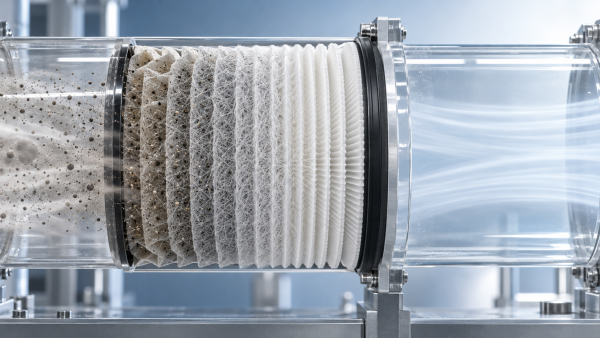
Multi-layer media can be useful when the design needs a combination of coarse-particle management, fine-particle capture, and support. For example, a more open upstream layer may help distribute larger particles, while a finer downstream layer handles smaller contaminants. Such a structure must still be tested as a whole. Interfaces between layers can affect permeability, adhesion, and flex resistance, particularly after pleating and thermal processing.
Surface treatments may also influence dust release, water behavior, and loading characteristics. They should not be selected by description alone. A treatment that seems attractive in dry conditions may be less effective when exposed to oily aerosols, wet cement dust, or repeated temperature changes. Compatibility with downstream conversion processes is equally important.
Do Not Separate Media Selection From Filter Manufacturing
A media roll becomes a functional filter only after converting. Pleating behavior, embossing, adhesive compatibility, curing conditions, lamination, and end-cap bonding all influence final performance. A medium that looks satisfactory in flat-sheet testing can behave differently after it is folded into tight pleats or bonded into a high-vibration element.
For this reason, material discussions should include the converter’s process. Does the medium retain pleat definition at the intended height? Does it accept the chosen adhesive without bleed-through or delamination? Is the stiffness sufficient for the element geometry without becoming brittle? If a backing, wire support, or protective layer is needed, how does it affect airflow and media integrity?
Hangzhou Chaocai Materials Co., Ltd. approaches filtration media as an advanced-materials development challenge rather than a single-material transaction. Its capabilities include fully synthetic wet-laid production as well as PUR, hot-melt adhesive, solvent-based emulsion spray, and ultrasonic lamination platforms. That range matters when a construction-equipment filter requires a specific combination of filtration layer, reinforcement, moisture management, or process compatibility. The right route still needs to be determined through the application requirements, not assumed from the manufacturing technology alone.
Ask for Evidence That Matches the Decision
Material specifications should be supported by relevant documentation and trials. Depending on the project, useful information may include basis weight, thickness, air permeability or pressure-drop data, tensile properties, wet-strength behavior, pore-related characteristics, and filtration test results. The test setup should be examined carefully. Airflow rate, challenge dust, sample configuration, and loading endpoint can materially affect the outcome.
For engine air filters, ISO 5011 is commonly referenced for evaluating intake air-cleaner performance. Whether it applies directly to a specific program should be confirmed with the relevant OEM requirements and test plan. For cab filters, breathers, or specialized equipment, other application-specific criteria may be more relevant. The aim is not to collect the longest list of tests; it is to establish that the selected media performs in a way that reflects the actual equipment environment.
A sensible validation sequence often begins with material screening, proceeds to prototype-element testing, and then moves to controlled field evaluation where appropriate. Field observations should include more than replacement interval. Inspect dust distribution, pleat condition, evidence of water ingress, seal integrity, and any unusual restriction behavior. This feedback can reveal whether the problem lies in the media, the filter element design, the airbox, or maintenance handling.
A Practical Selection Path
The most reliable selection path is usually straightforward. Define the machine, airflow demand, dust environment, moisture exposure, maintenance target, and available filter volume. Set acceptance criteria for filtration performance and restriction over the intended loading cycle. Shortlist media constructions that can be converted into the desired element geometry. Then test the completed element, because the completed element—not the flat media sheet—is what the machine will use.
Where job sites vary widely, it may be wiser to develop a robust baseline media and offer a moisture-resistant variant for harsher conditions than to force one design into every market. Ltd. moisture resistant media can be particularly relevant where seasonal rain, high humidity, exposed intake locations, or wet particulate contamination are routine. Its value should be judged by performance stability within the whole filter system.
The final decision should be based on operating evidence, conversion fit, and repeatable supply requirements. A filter medium that captures dust efficiently but is difficult to pleat, unstable in moisture, or inconsistent from lot to lot creates downstream problems that are more expensive than the initial material choice. Construction equipment operates in conditions that quickly expose weak assumptions. Choosing the media with the full duty cycle in mind is the most practical way to protect both machine performance and maintenance planning.
Recommendation
 Oct 10, 2026
How Can Air Filter Media Increase Dust Holding Capacity Without Higher Pressure Drop?
Which liquid filter media is suitable for hydraulic oil fine-particle filtration? Discover how advanced air filter media increases dust holding capacity with low pressure drop.- Oct 10, 2026
Which Liquid Filter Media Is Suitable for Fine Hydraulic Oil Filtration?
Can synthetic filter media replace glass fiber in high-humidity gas turbine intakes? Explore media choices for fine hydraulic oil filtration, balancing efficiency, moisture resistance, pressure drop, and service life. - Oct 10, 2026
Can Synthetic Filter Media Replace Glass Fiber in Humid Turbine Intakes?
Is ePTFE filter media suitable for pulse-cleaned construction equipment air filters? Explore synthetic vs. glass fiber performance in humid turbine intakes.