How to Select F9 Filter Media for Gas Turbine Intakes?
How to Select F9 Filter Media for Gas Turbine Intakes
A gas turbine intake system has a difficult job: it must admit a very large volume of air without allowing dust, salt, moisture, fibers, insects, or industrial aerosols to reach expensive rotating equipment. The filter media inside that system is not a minor consumable. Its behavior influences compressor cleanliness, pressure loss, fuel efficiency, maintenance planning, and the confidence an operator has in running through a dusty season or a sudden weather event.
Selecting F9 filter media for a turbine intake therefore requires more than choosing a label associated with fine-particle efficiency. The right material must capture the contaminants that matter at the site while maintaining predictable airflow over its service life. In many projects, high dust holding air filter media becomes a central requirement because a media layer that loads too quickly can create rising differential pressure, premature changeouts, and unnecessary exposure to intake-related performance losses.
The best choice begins with the operating environment, not with a catalog grade alone.
Start with the Meaning of “F9” in the Actual Specification
F9 is widely recognized from the former EN 779 classification system and is still commonly used in turbine intake specifications, discussions, and procurement documents. However, modern evaluations may also refer to ISO 16890 classifications, especially ePM1 performance. These systems are related in practical intent but are not identical. An F9 designation should never be treated as a complete description of filtration behavior.
Before comparing media, clarify what the turbine manufacturer, EPC contractor, filter-house designer, or end user expects the rating to mean. Ask whether the requirement is based on legacy EN 779 testing, current ISO 16890 testing, a minimum efficiency at a defined particle size, or a site-specific acceptance method. This avoids a common procurement mistake: comparing two materials with similar marketing grades but different test conditions, airflow rates, conditioning methods, or efficiency curves.
For gas turbine intakes, the key question is more practical: how consistently will the media control fine particles that can foul compressor blades and internal surfaces, while still allowing the intake system to operate within its permitted pressure-drop range?
Map the Site Contaminants Before Selecting the Media Structure
An intake beside a paved industrial area does not face the same risks as a coastal power plant, a desert compressor station, or a facility near cement handling, mining, agriculture, or construction activity. The particle mix may change by season, wind direction, production cycle, or even time of day.
Fine mineral dust is a familiar concern, but it is not the only one. Coastal and offshore locations may encounter salt-bearing aerosols and high humidity. Urban or industrial sites can contain soot, combustion particles, oily aerosols, and chemically active contaminants. Rural locations may see pollen, spores, organic debris, and short periods of extremely heavy dust loading. In cold climates, fog, freezing conditions, and snow can alter the way particles and moisture behave at the intake face.
A media supplier should be given more than the requested F9 grade. Useful project information includes:
- Location, elevation, prevailing wind conditions, and nearby emission sources
- Typical and peak ambient dust concentrations, if available
- Humidity, fog, rain, salt exposure, and temperature range
- Existing filter configuration, including prefilters and final filters
- Available filter area, target airflow, and allowable final pressure drop
- Whether the system operates continuously, cyclically, or in frequent start-stop duty
- Known history of compressor fouling, filter plugging, water carryover, or corrosion
This information helps determine whether the F9 layer should emphasize maximum fine-particle capture, extended dust storage, moisture resistance, or a carefully balanced combination of these properties.
Why High Dust Holding Matters as Much as Initial Efficiency
It is easy to focus on a new filter’s initial efficiency because it is simple to state and compare. Yet a turbine intake filter spends most of its useful life in a loaded condition. The way it stores particles is often more important to operating cost than the first clean-media result.
High dust holding air filter media is engineered to retain a substantial contaminant mass before reaching the specified terminal resistance. In practical terms, it gives the filter designer more room to build a product that maintains airflow longer, reduces the frequency of filter replacement, and avoids sharp pressure-drop increases under challenging dust conditions.
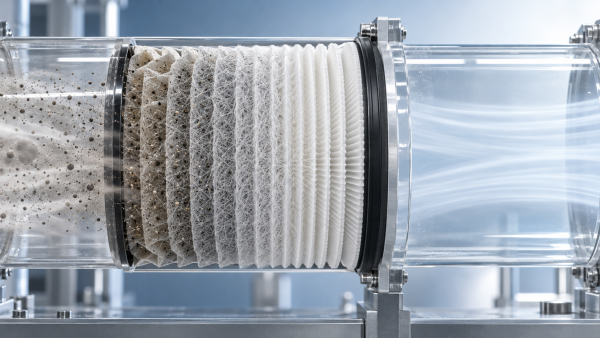
Dust holding capacity is influenced by fiber diameter, web density, thickness, pore structure, media area in the finished element, and the distribution of filtration layers. A very dense surface can capture fine particles effectively but may blind quickly when exposed to heavy dust. A more open structure can hold more particulate mass but may not achieve the required fine efficiency on its own. Well-designed media balances these competing needs through controlled fiber architecture, multilayer construction, or carefully selected functional treatments.
For this reason, buyers should not ask only, “What is the F9 efficiency?” They should also ask, “How does resistance rise during loading, and what type of dust was used to evaluate it?” A gradual, predictable pressure-drop curve is often more valuable in service than an attractive initial efficiency figure without meaningful loading data.
Do Not Confuse Media Performance with Finished Filter Performance
Filter media is the functional heart of the product, but the installed filter’s performance also depends on pleat geometry, media area, adhesive selection, frame design, sealing integrity, and the support system. A capable F9 media can still underperform if pleats are too closely packed, separators restrict airflow, or bonding materials create weak points under humidity and vibration.
When evaluating a media option, consider how it will be converted into the final panel, compact filter, V-bank, cartridge, or other intake filter format. The media must retain stiffness and dimensional stability through pleating and assembly. It should also work reliably with the selected lamination, adhesive, or ultrasonic bonding process without damaging the filtration layer or creating bypass paths.
Pressure Drop Is an Operating Variable, Not Just a Laboratory Number
Every filtration layer adds resistance to airflow. In a gas turbine application, excessive intake restriction can reduce available power and affect heat rate. Conversely, selecting an overly open media simply to minimize initial pressure drop may allow damaging fine contaminants to pass through the system. The objective is not the lowest possible resistance; it is the best total lifecycle balance.
Assess pressure drop at the actual face velocity and system airflow, rather than relying on a value from a different test setup. If the intake design has limited filter area, face velocity may be high and the resistance penalty of a dense F9 media can become significant. In that case, increasing media area through better pleat design or using a more open, depth-loading media structure may be more effective than compromising the required efficiency.
It is also important to set a realistic terminal pressure-drop strategy. Replacing filters too early wastes useful media life. Replacing them too late risks turbine performance loss, structural stress on filter elements, and potential failure under pulsing or wet conditions. Differential-pressure monitoring should be interpreted alongside weather, operating hours, inlet air quality, and inspection findings—not as an isolated number.
Choose Fiber and Binder Systems for the Real Environment
For demanding intake applications, fully synthetic filter media offers several advantages. Synthetic fibers can provide good resistance to moisture, stable mechanical properties, and flexibility in designing graded pore structures. They are particularly relevant where humidity, intermittent wetting, or long operating intervals make moisture-sensitive media undesirable.
However, “synthetic” alone is not enough. The formulation and manufacturing route matter. Fiber selection, web formation, thermal or chemical bonding, surface treatment, and lamination all influence how the material responds to dust, water, vibration, and handling. A material that looks acceptable in a dry sample review may behave differently after repeated humidity cycles or exposure to water droplets.
For coastal, offshore, or high-humidity installations, examine wet strength and resistance to deformation. Media should not sag, delaminate, or lose structural integrity when moisture is present. Hydrophobic characteristics may help reduce water uptake, but they need to be considered with the complete intake design, including weather hoods, droplet separators, drainage paths, and coalescing stages where applicable.
In areas with oily mist or industrial aerosols, discuss chemical compatibility and loading behavior. Some aerosol types can alter the way particles adhere to fibers, accelerate pressure-drop rise, or interact with binders and adhesives. A general F9 specification does not automatically address these risks.
Electrostatic Assistance: Useful, but Evaluate Stability
Some fine filtration media uses electrostatic charge to improve initial particle capture without making the structure excessively dense. This can be beneficial when low initial resistance is important. Yet for gas turbine intakes, the long-term stability of that performance deserves careful scrutiny.
High humidity, certain aerosols, repeated loading, and cleaning attempts can affect electrostatic contribution. If the intake environment is wet or chemically complex, it is prudent to understand how much of the media’s stated efficiency comes from mechanical interception and how much depends on charge. A mechanically robust filtration structure may offer more predictable performance over extended service, even if its initial resistance is somewhat higher.
The ideal decision is site-specific. There is no universal rule that charged media is unsuitable or that purely mechanical media is always superior. The meaningful comparison is how each option performs across the expected life of the finished filter under relevant environmental conditions.
Consider the Filter Train, Not Only the Final F9 Stage
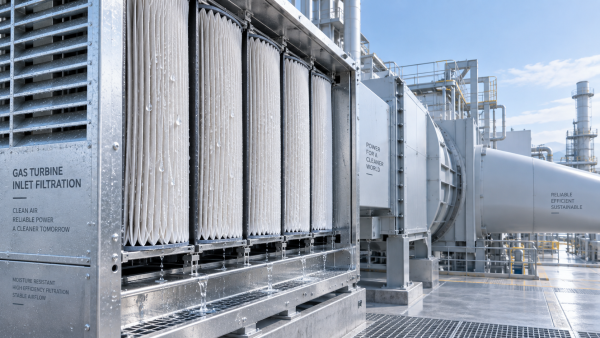
A final F9 filter is rarely expected to solve every intake challenge alone. In high-dust locations, a staged system can protect the fine filter from coarse debris and extend its useful life. Weather louvers, inertial separators, prefilters, and moisture-management components may all reduce the burden on the final stage.
Where a prefilter is present, the F9 media can be optimized for fine particle control and long-term stable resistance rather than acting as the first barrier against leaves, insects, sand, or large fibrous debris. Where no effective upstream stage exists, the final media needs greater tolerance for broad particle-size loading. This may change the preferred pore gradient, thickness, or support construction.
Do not assume that adding more stages automatically improves the system. Each stage adds resistance, maintenance activity, and possible leakage points. The design should be reviewed as an airflow system, with attention to seal quality and bypass control. A small leak around a well-specified F9 filter can undermine the value of the filtration media itself.
A Practical Evaluation Checklist for F9 Media Suppliers
When requesting samples or technical proposals, move the discussion beyond a single efficiency grade. The following questions can make comparisons more meaningful:
- What standard and test conditions support the stated F9 or equivalent fine-filtration performance?
- What is the initial pressure drop at the intended face velocity?
- How does pressure drop develop during dust loading?
- Is the material designed for depth loading, surface loading, or a graded combination?
- What evidence is available for dust holding capacity and media uniformity?
- How does the media perform after humidity exposure or wetting, where relevant?
- What are its tensile strength, pleatability, stiffness, and compatibility with the planned converting process?
- Can the media be laminated with support layers without compromising airflow or filtration performance?
- Does the construction remain stable during transportation, installation, and field vibration?
For filter manufacturers, convertibility deserves special attention. Stable material quality from roll to roll supports consistent pleat spacing, bonding, and finished-filter performance. A media partner with wet-laid, lamination, spray coating, and ultrasonic processing capabilities can often help tailor support, surface, and composite structures to the needs of a specific intake filter design.
Common Selection Errors That Shorten Filter Life
One frequent error is choosing the highest available efficiency without checking the pressure-drop budget. Another is specifying a fine filter based on average ambient conditions while ignoring short but severe dust events that dominate annual loading. Some projects also overlook moisture until filters show deformation, elevated resistance after fog, or corrosion-related concerns downstream.
There is also a tendency to compare products by media weight alone. Weight may indicate something about thickness or material content, but it does not reliably predict fine efficiency, dust holding capacity, or resistance behavior. Fiber distribution and pore architecture are far more important than a single mass-per-area figure.
Finally, avoid treating the F9 requirement as a substitute for site assessment. A desert installation, a coastal turbine, and a plant near industrial emissions may all use F9-class final filtration, but the best media construction for each can be quite different.
Select for Stable Protection Over the Full Service Interval
The strongest F9 filter media choice is one that supports clean turbine intake air without creating avoidable restriction or maintenance pressure. It should deliver dependable fine-particle capture, offer high dust holding where the environment demands it, tolerate the site’s moisture and temperature conditions, and remain compatible with the construction of the finished filter.
Hangzhou Chaocai Materials develops functional advanced filtration materials using fully synthetic wet-laid and multiple lamination technologies, including PUR, hot-melt, solvent-based emulsion spray, and ultrasonic processes. For gas turbine intake applications, this manufacturing flexibility can support the development of media structures that balance filtration efficiency, loading capacity, mechanical stability, and converting requirements.
Rather than selecting an F9 material from a grade name alone, define the contaminants, airflow, pressure-drop limits, climate exposure, and expected filter configuration. That approach turns high dust holding air filter media from a broad purchasing term into a practical tool for protecting turbine assets and planning a more reliable intake maintenance cycle.
Recommendation
 Oct 10, 2026
How Can Air Filter Media Increase Dust Holding Capacity Without Higher Pressure Drop?
Which liquid filter media is suitable for hydraulic oil fine-particle filtration? Discover how advanced air filter media increases dust holding capacity with low pressure drop.- Oct 10, 2026
Which Liquid Filter Media Is Suitable for Fine Hydraulic Oil Filtration?
Can synthetic filter media replace glass fiber in high-humidity gas turbine intakes? Explore media choices for fine hydraulic oil filtration, balancing efficiency, moisture resistance, pressure drop, and service life. - Oct 10, 2026
Can Synthetic Filter Media Replace Glass Fiber in Humid Turbine Intakes?
Is ePTFE filter media suitable for pulse-cleaned construction equipment air filters? Explore synthetic vs. glass fiber performance in humid turbine intakes.