What Custom Filter Media Does Hangzhou Super Material Co., Ltd. Offer?
Custom filter media is not a single product category defined by one material or one efficiency rating. It is a designed layer system that must work within a specific filter geometry, airflow or fluid condition, contaminant profile, and production process. Based on its stated manufacturing platforms and application focus, Hangzhou Super Material Co. offers custom-developed filtration media built around wet-laid nonwoven structures and several lamination methods, rather than a narrow catalog of standard filter rolls.
The company’s relevant capabilities include fully synthetic wet-laid media production, PUR lamination, hot-melt adhesive lamination, solvent-based emulsion spray lamination, and ultrasonic lamination. Together, these processes can support filtration materials with tailored fiber structures, multilayer constructions, backing layers, surface treatments, and converting characteristics for demanding uses such as gas turbines, automotive systems, new-energy equipment, semiconductor-related processes, and biopharmaceutical production.
Custom wet-laid synthetic filter media
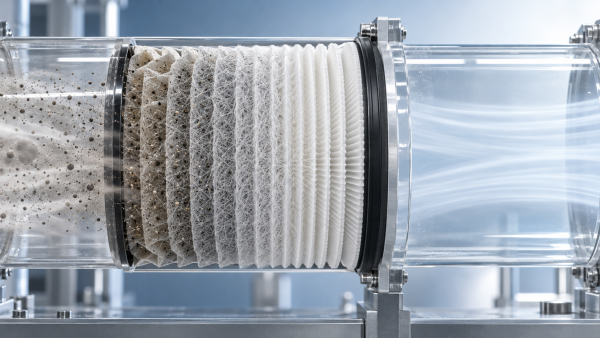
The core platform described by Hangzhou Super Material Co. is fully synthetic wet-laid media. Wet-laid production is particularly relevant where a filter material requires a controlled distribution of fine synthetic fibers across a sheet, along with stable basis weight, uniform porosity, and consistent downstream processing behavior.
Unlike commodity textile fabrics, filtration media must balance competing properties. A denser fiber structure can improve particle capture, but it may also raise pressure drop. A more open structure can support greater air or fluid throughput, but it may allow undesirable particles to pass through or reduce dust-holding capacity. The useful media design is therefore not simply “finer” or “thicker.” It depends on the contaminant size distribution, required service life, available pressure budget, pleat configuration, and the consequences of filter failure.
A synthetic wet-laid platform gives a manufacturer room to adjust variables such as fiber type, fiber diameter mix, sheet weight, thickness, bulk, stiffness, and bonding approach. In a custom program, these variables are often considered together with later lamination or coating steps. The resulting material may serve as the main filtration layer, a support layer, a prefiltration layer, or part of a composite media construction.
For buyers, “synthetic wet-laid” should not be treated as a complete specification. The relevant questions are whether the media must resist moisture, retain mechanical integrity after pleating, tolerate temperature exposure, withstand pulsation or vibration, and maintain a predictable pressure-drop profile over its intended operating period. A material that performs acceptably in flat-sheet testing may behave differently once folded, corrugated, bonded into a filter element, or exposed to cyclic load.
Multilayer and laminated filtration constructions
Hangzhou Super Material Co.’s lamination capabilities indicate that it can develop composite filter media rather than relying only on single-layer sheets. This is important because many filtration applications require separate layers to perform different functions.
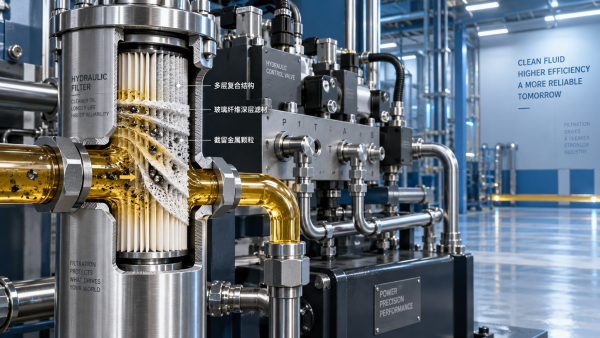
One layer may capture larger particles and protect a finer downstream layer from rapid blockage. Another may provide tensile strength for high-speed converting or pleating. A backing layer can improve handling and dimensional stability. In some cases, a surface layer is selected for cleanliness, abrasion resistance, or controlled contact with downstream equipment. The value of lamination lies in allowing these requirements to be addressed independently, instead of forcing one material layer to provide all functions at once.
The available joining method matters. Different adhesives and joining techniques affect pore openness, chemical compatibility, temperature tolerance, odor or extractables concerns, stiffness, and the risk of localized blockage. An appropriate lamination process is therefore selected not only for bond strength but also for its influence on filtration performance and the end-use environment.
PUR-laminated media
PUR, or polyurethane reactive, lamination can be relevant where a durable bond is needed between filtration media and supporting substrates. In practical filter-media design, the adhesive system must not migrate into the active filtration layer to the point that it alters permeability or creates inconsistent resistance. It must also remain compatible with downstream pleating, die cutting, corrugation, or element assembly.
PUR-laminated constructions may be considered when a filter media system needs mechanical cohesion and stable layer attachment under handling or operational stress. However, suitability depends on the complete requirement set, including thermal exposure, chemical contact, humidity, and any cleanliness restrictions associated with the application.
Hot-melt adhesive laminated media
Hot-melt lamination is often useful for bonding layers without introducing a solvent-drying stage. For custom filtration materials, the practical concern is not merely whether layers adhere. Buyers should evaluate whether the adhesive pattern, coating weight, and thermal history preserve the intended air or fluid permeability of the composite.
This route can support media structures in which a scrim, reinforcement, nonwoven backing, or protective layer is joined to an active filter sheet. The resulting construction may be designed for easier converting, higher tear resistance, reduced delamination risk, or more stable performance during pleating and assembly.
Hot-melt systems are not interchangeable. A filter manufacturer should define the thermal limits of processing and service, the desired flexibility of the final media, and whether adhesive contact could create unacceptable extractables, emissions, or surface contamination for the intended use.
Spray-laminated media
Solvent-based emulsion spray lamination provides another means of producing bonded composites. Its potential relevance is the ability to apply adhesive in a controlled pattern or distribution rather than as a continuous heavy film. That can matter when retaining media openness is more important than achieving a fully coated bond interface.
Spray application may help create composite structures with lower obstruction of pores than some continuous coating approaches, but the outcome depends on adhesive chemistry, spray distribution, curing conditions, and substrate absorption. For filtration applications involving sensitive environments, the residual-solvent profile, curing completeness, and cleanliness controls require careful review rather than assumption.
Ultrasonically laminated media
Ultrasonic lamination joins compatible materials using localized vibrational energy rather than a separately applied adhesive layer. This can be valuable where adhesive addition is undesirable or where precise bonding points are preferred over full-surface bonding. It may also support cleaner composite constructions in applications where loose adhesive particles, chemical migration, or added binder content would be a concern.
Its limits are equally important. Ultrasonic bonding depends on the materials being joined and can change local thickness, stiffness, or pore structure at bond points. It is best evaluated as part of the finished media design, not selected solely because it is adhesive-free.
Application-specific media development
The company identifies gas turbines, automotive applications, new energy, semiconductors, and biopharmaceutical fields as areas for high-performance filtration material development. These categories have very different technical priorities. The same nominal filtration rating would not make one media construction suitable across all of them.
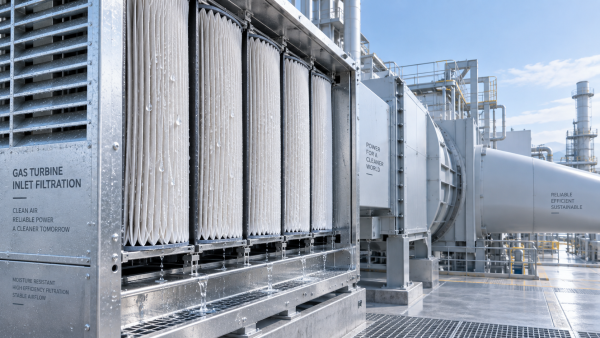
Gas turbine filtration places emphasis on maintaining air quality while managing pressure drop and service stability. Intake systems may encounter dust, humidity, salt-containing aerosols, or fluctuating environmental conditions depending on location. Media selection must consider resistance to moisture-related deformation, the behavior of the material during dust loading, mechanical strength in pleated configurations, and the consequences of uneven airflow across a large filter installation. A media supplier’s role is often to provide a substrate that can be converted into an element meeting the system designer’s requirements; the final filter performance also depends on pleat geometry, sealing, frame design, and system operation.
Automotive filtration can involve intake air, cabin air, oil-related, fuel-related, battery-related, or manufacturing-process filtration, each with distinct constraints. Automotive media frequently faces vibration, limited package space, high-volume processing requirements, and tight consistency expectations. In this environment, custom media may require predictable pleatability, robust bonding compatibility, low odor or low emissions characteristics where relevant, and stable performance across temperature and humidity changes. A material suitable for an engine-air application should not automatically be assumed suitable for cabin-air or fluid-filtration use.
New-energy applications include diverse processes and equipment, so the phrase alone is not a sufficient media specification. Filtration may be required to control particles in manufacturing environments, protect air-management systems, support process cleanliness, or manage contaminants in specialized equipment. Key questions include the form of the contaminant, sensitivity of downstream components, material compatibility, flame-related requirements where applicable, and whether the media is used for air, gas, or liquid service.
Semiconductor-related filtration raises a different set of concerns. Particle control is only one part of the decision. Fiber shedding, extractables, outgassing, surface cleanliness, packaging, handling, and lot-to-lot consistency can be critical depending on where the material is used. A filtration medium may perform well in conventional industrial air handling but still be unsuitable for a contamination-sensitive process. Buyers should distinguish between a material intended for general facility filtration and one designed for direct use near critical process zones.
Biopharmaceutical production likewise requires application-specific review. Where media may contact process air, clean environments, or sensitive production systems, questions of material composition, cleanliness, traceability, compatibility with sterilization or disinfection conditions, and validation support may be more decisive than nominal efficiency alone. The intended role of the media must be clear: prefiltration, equipment protection, ventilation, cleanroom support, or direct process-related use each carry different qualification expectations.
What “custom” should mean in a filter-media inquiry
A credible custom-media discussion begins with operating conditions, not with a request for the “best” material. Hangzhou Super Material Co.’s combination of wet-laid and lamination platforms suggests that customization can extend beyond roll width or basis weight. It can involve the structure of the active filtration layer, the addition of support or prefilter layers, the joining method, and the material’s suitability for a particular conversion route.
To determine whether a proposed construction is appropriate, a technical inquiry should define the fluid being filtered, particle characteristics, operating temperature and humidity, target flow rate, permissible pressure drop, required lifetime, media dimensions, end-product geometry, and downstream manufacturing process. For composite designs, it is also important to state whether the material will be pleated, embossed, welded, glued, molded, or exposed to chemical agents.
Performance requirements should be expressed in testable terms. “High efficiency,” “long life,” and “low resistance” are commercial descriptions rather than engineering specifications unless they are connected to a test method, particle challenge, face velocity, loading condition, or end-use standard. If a customer has an existing qualified material, comparative samples can be more informative than a broad description because they establish a baseline for thickness, stiffness, permeability, strength, and processability.
Where material selection can fail
One common mistake is to focus only on initial efficiency. A media that captures fine particles effectively at the beginning of service may not deliver the preferred balance of loading life and energy consumption. Pressure-drop development during use can be more consequential than an initial test result, especially in continuously operated air systems.
Another mistake is treating the media and the finished filter as identical. Filter-element design changes the practical outcome. Pleat depth, pleat count, spacing control, adhesive placement, frame rigidity, gasket sealing, and air distribution all affect how a media performs in service. A well-designed media can underperform in a poorly constructed element, while a finished filter cannot compensate indefinitely for an unsuitable media substrate.
Composite media also needs careful compatibility review. A reinforcement layer may improve strength but reduce flexibility. An adhesive system may improve layer integrity but affect pore structure or thermal limits. A very fine surface layer may enhance initial capture but create rapid surface loading under the wrong dust profile. Customization is valuable when these trade-offs are made visible and tied to actual operating conditions.
How to assess the scope of Hangzhou Super Material Co.’s offering
The available information supports viewing Hangzhou Super Material Co. as a developer and manufacturer of engineered filtration media structures, particularly where synthetic wet-laid substrates and multilayer bonding are required. Its stated process range is relevant to customers seeking filter-media components rather than only completed filter assemblies.
The practical scope of any project should still be confirmed at the specification level. The decisive issues are the available material formulations, achievable construction range, sample-to-production consistency, applicable quality documentation, converting compatibility, and the ability to evaluate performance under conditions representative of the intended product. In specialized fields, qualification requirements can be as important as the media’s physical structure.
For industrial buyers, the useful question is not simply whether a supplier offers custom filter media. It is whether the supplier can translate a defined filtration problem into a manufacturable media architecture, explain the trade-offs created by each layer and bonding method, and provide material that remains consistent through the customer’s own conversion and validation process. The manufacturing capabilities cited for Hangzhou Super Material Co. indicate a broad technical foundation for that type of work, especially in multilayer, application-specific filtration media development.
Recommendation
 Oct 10, 2026
How Can Air Filter Media Increase Dust Holding Capacity Without Higher Pressure Drop?
Which liquid filter media is suitable for hydraulic oil fine-particle filtration? Discover how advanced air filter media increases dust holding capacity with low pressure drop.- Oct 10, 2026
Which Liquid Filter Media Is Suitable for Fine Hydraulic Oil Filtration?
Can synthetic filter media replace glass fiber in high-humidity gas turbine intakes? Explore media choices for fine hydraulic oil filtration, balancing efficiency, moisture resistance, pressure drop, and service life. - Oct 10, 2026
Can Synthetic Filter Media Replace Glass Fiber in Humid Turbine Intakes?
Is ePTFE filter media suitable for pulse-cleaned construction equipment air filters? Explore synthetic vs. glass fiber performance in humid turbine intakes.