What Determines the Price of Moisture-Resistant Filter Media?
Two moisture-resistant filter media can look nearly identical on a sample table yet carry very different prices. The difference usually comes from fiber selection, pore structure, water-repellent treatment, layer bonding, manufacturing consistency, and the evidence required to verify performance. A lower quotation may cover a simpler material—or a different performance target—not necessarily the same product made more cheaply.
This matters when filters operate around fog, high humidity, or intermittent water carryover. Media that performs adequately when dry may develop excessive pressure drop, lose strength, or suffer layer separation when wet. To compare prices meaningfully, first define the moisture exposure and filtration duty, then check whether each quotation includes comparable material specifications and supporting test data.
Start with the moisture condition, not the water-repellent label
“Moisture-resistant” is not a complete purchasing specification. It may describe a surface that sheds droplets, a structure that retains strength after wetting, or a composite that limits liquid penetration under defined conditions. These properties are related, but they are not interchangeable, and each can require different materials or processing steps.
A gas turbine intake exposed to fog presents a different challenge from an industrial ventilation filter operating in humid air without direct liquid exposure. Humidity involves water vapor; fog introduces suspended droplets. Occasional splashing creates another loading condition. Specifying the most demanding construction for every application can increase cost unnecessarily, while treating these conditions as equivalent can leave the filter under-specified.
Before requesting prices, describe the expected temperature, humidity range, likelihood of condensation, droplet exposure, and wet/dry cycling. Also identify whether upstream weather protection or droplet separation is present. These details help determine whether the quotation should prioritize water repellency, wet mechanical strength, drainage behavior, or a combination.
Fiber selection and structure set the underlying cost
Fiber chemistry, diameter, length distribution, and supply consistency influence both raw material cost and manufacturing difficulty. Fine fibers can improve particle capture, but their benefit depends on the complete structure. Excessively dense packing may increase airflow resistance; an insufficiently supported fine-fiber layer may be vulnerable during pleating or service.
Synthetic fibers can support moisture-tolerant constructions, but “fully synthetic” alone does not establish filtration performance or wet durability. Fiber bonding, surface treatment, and pore distribution still matter. Where cellulose-containing or glass-fiber structures are considered, their wet behavior likewise depends on binders, reinforcement, and the finished construction rather than the fiber name alone.
Basis weight is a cost driver, not a stand-alone quality rating. More material per square meter generally increases material consumption, yet a heavier sheet does not automatically offer better efficiency, lower resistance, or longer service life. Thickness and stiffness must also suit the intended pleat geometry. A material that requires wider pleat spacing may change the usable filtration area inside the same element.
Uniformity adds another cost layer. Maintaining consistent formation, thickness, and permeability across a production roll requires process control and inspection. A cheaper average specification can become expensive if local variations cause weak pleat sections, inconsistent airflow, or excessive converting scrap.
Water resistance must survive the manufacturing route
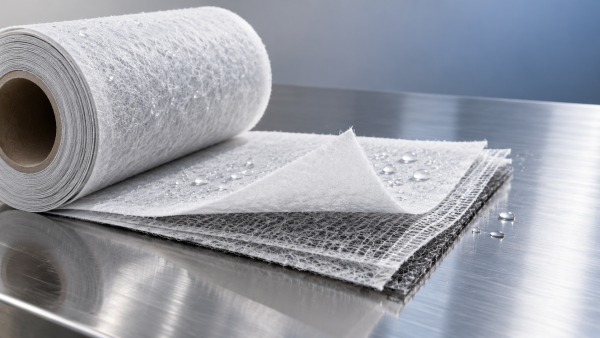
A droplet beading on a flat sample demonstrates surface behavior under that observation. It does not establish resistance to sustained liquid pressure, durability after handling, or filtration performance during moisture exposure. Treatment selection and application uniformity help explain why visually similar samples may have different prices.
Water-repellent treatments introduce chemical, application, drying, and quality-control costs. Their coverage must be controlled without unnecessarily obstructing airflow. Binders can improve structural integrity and wet strength, but binder chemistry and loading may also affect stiffness, permeability, and suitability for the operating environment.
Ask whether reported moisture resistance was measured on the untreated base sheet, the finished composite, or a converted sample. Pleating, thermal exposure, and contact with assembly materials can affect the finished product. Where repeated moisture exposure is expected, evidence after relevant conditioning is more useful than a single demonstration on a fresh sheet.
Why multilayer media can cost more
A composite can divide functions among layers: one provides support, another contributes particle capture, and another helps manage exposure or protect a delicate surface. Each additional layer adds material and handling cost. Bonding must then preserve useful airflow while providing adequate adhesion.
PUR, hot-melt adhesive, spray, and ultrasonic lamination use different bonding mechanisms and have different compatibility requirements. No method is inherently the best or cheapest for every construction. Adhesive coverage, curing conditions, thermal sensitivity, line speed, and acceptable bond patterns all affect processing cost.
The useful purchasing question is what the bonded structure achieves. Request evidence of adhesion and mechanical integrity under relevant moisture conditions. A premium for lamination has little value if the interface separates during conversion or service; conversely, an appropriately bonded support layer may reduce damage and improve manufacturing yield.
Filtration targets determine whether a premium is justified
Efficiency, initial resistance, and dust-loading behavior must be evaluated together. A medium that meets an efficiency target only with an unacceptable pressure drop may not suit the equipment. A low-resistance medium that fails the required capture performance is not an economical substitute.
Some constructions use electrostatic effects to contribute to particle capture. Where this applies, distinguish initial performance from performance after relevant conditioning. Initial efficiency alone may not reveal how the medium will behave after exposure to the intended environment. Ask which measurements reflect mechanical filtration and which may depend on charge.
Moisture exposure can also alter loading behavior. Deposits may interact with water and change airflow resistance or drainage. Dry dust capacity therefore does not establish wet-service capability. If this interaction is important to the application, the validation plan should address it rather than relying on unrelated dry test results.
Read ISO 29461 evidence at the correct level
Requests for ISO 29461 filter media test data need a scope clarification. The ISO 29461 series addresses air intake filter systems for rotary machinery, with different parts covering different evaluations. A report for a complete filter element should not be treated as a universal certification of the flat-sheet medium, and a media coupon result does not establish finished-element performance.
Ask which part and edition were used, what was tested, and under which operating conditions. The report should identify the sample construction, airflow or face velocity, conditioning, measured properties, and any deviations from the referenced method. Confirm whether moisture-related claims are supported by a relevant procedure or only by separate internal observations.
For a finished filter, pleat geometry, seals, frame construction, and assembly quality influence results alongside the media. An element report is therefore most relevant when its construction represents the proposed product. Reusing results from a different configuration requires a technical justification, not simply a matching media description.
Separate qualification cost from routine release testing. Developing a construction and validating an element can involve different expenses from checking each production lot for basis weight, permeability, or strength. Ask whether the quotation includes existing reports, new testing, periodic verification, or only a basic material inspection record. These differences can explain a substantial quotation gap without any change in raw material quality.
Order format and converting yield change the real purchase price
A quotation per kilogram cannot be compared directly with one per square meter without accounting for basis weight. For a composite, confirm that the stated weight includes every layer and the bonding material. Otherwise, an apparently cheaper unit price may represent a different amount of usable filtration material.
Roll width, slit tolerance, roll length, core requirements, and packaging also affect price. A width that fits the converting line can reduce edge trim, while short custom runs may require additional setup and changeover work. Minimum order quantities and campaign scheduling can therefore influence the quote independently of performance.
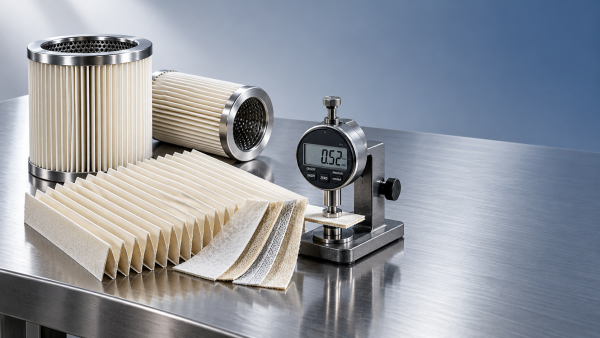
Converting behavior deserves attention before a full purchase. A sheet that cracks at folds, sheds fibers, or develops unstable pleats can create scrap and slow production. Trial material should be assessed using the intended pleating and assembly conditions, not only through flat-sheet measurements.
Use a common cost boundary for comparison: delivered media cost divided by usable converted area provides a more useful starting point than nominal roll price alone. Then assess any differences in assembly cost, required filtration area, operating resistance, and replacement assumptions. Do not credit a premium material with longer service life unless relevant evidence supports that assumption.
A practical sequence for comparing supplier quotations
- Fix the duty. State the airflow, available filter geometry, particle-capture requirement, resistance limits, temperature range, and moisture exposure. Distinguish mandatory requirements from preferred improvements.
- Issue one comparison specification. Include basis weight, thickness, permeability test conditions, strength requirements, water-resistance methods, roll dimensions, and acceptable tolerances. Identify which properties are controlled lot by lot.
- Align the evidence. Separate flat-sheet measurements from finished-element reports. Check sample identity, test conditions, conditioning history, and whether results describe typical values or guaranteed limits.
- Separate commercial components. Request clarity on material price, setup, slitting, qualification testing, packaging, freight, and minimum order requirements. Avoid comparing an all-inclusive offer with a bare material quotation.
- Validate the unresolved risk. Use representative converting trials or element testing where existing data does not answer the application question. Agree on acceptance criteria before committing to production quantities.
When a premium remains unexplained, ask the supplier to connect it to a specific requirement: tighter permeability variation, retained wet strength, a more durable bond, or documented performance under relevant exposure. When the cheaper material meets the same agreed requirements with equivalent evidence and acceptable converting yield, the higher price may not buy useful value.
The purchasing specification should also define change control. A substitution in fibers, treatment chemistry, support layers, or bonding conditions can affect performance even when nominal basis weight remains unchanged. Requiring notification of relevant changes helps preserve the technical basis on which the original price comparison was made.
Recommendation
 Oct 20, 2026
What Determines the Price of Moisture-Resistant Filter Media?
ISO 29461 filter media test data can clarify supplier quotes. Discover key cost drivers, check test scope, and choose moisture-resistant media with confidence.- Oct 20, 2026
What Test Data Should Hydraulic Oil Filter Media Suppliers Provide?
Compare moisture resistant filter media price with confidence. Discover the test data hydraulic oil filter media suppliers should provide to verify performance and choose better value. - Oct 20, 2026
What Should Suppliers Validate for Custom Pleatable Filter Media?
Qualify custom hydraulic oil filter media with confidence. Discover key checks for filtration, pleat stability, fluid compatibility, and production consistency before scaling up.