Can Moisture-Resistant Filter Media Prevent Wet Clogging?
Moisture-resistant filter media can reduce the risk of wet clogging, but it cannot prevent every blockage on its own. It works by retaining its strength, pore structure, and airflow path when exposed to high humidity, condensation, or intermittent liquid aerosols. That can keep a filter from collapsing, swelling, tearing, or developing a rapid pressure-drop increase. However, if the system allows bulk water, oil mist, sticky particles, or poorly drained condensate to reach the filter continuously, even a moisture-resistant medium will eventually foul.
The practical question is not simply whether a medium has a moisture-resistant label. It is whether the complete filter design and operating conditions can manage the type, amount, and duration of moisture present. This distinction matters in gas turbine intake systems, automotive air filtration, battery and new-energy production, semiconductor facilities, biopharmaceutical environments, and other equipment where unstable airflow or contaminant bypass can create expensive downstream problems.
What wet clogging actually looks like
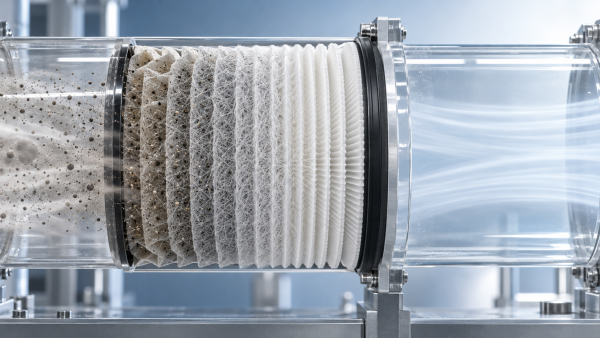
Wet clogging occurs when water, condensate, liquid aerosol, or moisture-bound dust obstructs the open structure of a filter. Dry dust often forms a relatively porous cake on the media surface. Once moisture is introduced, that dust can turn into a dense, sticky layer. Fine particles may bridge pores, fibers can become loaded more quickly, and airflow resistance rises faster than expected.
The visible symptom is often a higher pressure drop, but the underlying failure mode can vary. In some filters, moisture weakens the web or the bonding system, allowing pleats to deform and close together. In others, the media remains physically intact but captured particles become cement-like after repeated wet-and-dry cycles. A third situation is water carryover: liquid reaches the filter faster than it can drain, so the filter is being asked to act as a water separator and a fine-particle filter at the same time.
This is why the answer to “Does moisture resistant filter media prevent wet clogging?” is conditional. It helps prevent failures caused by moisture sensitivity in the medium. It does not remove the need to control liquid loading before it reaches the fine filtration stage.
How moisture-resistant media helps
Moisture-resistant filtration media is designed so that exposure to humidity or water does not immediately compromise the material’s filtration structure. Depending on the construction, this may involve synthetic fibers, water-tolerant binders, protective surface treatments, hydrophobic or oleophobic characteristics, or a laminated structure that supports the media under demanding conditions.
A robust moisture-resistant medium can provide several practical benefits:
- It is less likely to lose tensile strength or rupture after becoming damp.
- It can better maintain pore geometry, helping airflow remain more stable during humid operation.
- It can reduce swelling, fiber migration, and pleat distortion associated with moisture-sensitive constructions.
- It may release or drain water more effectively when the media surface and filter geometry are designed for it.
- It can provide a more reliable base for filters exposed to cyclic humidity, short condensation events, or liquid aerosol carryover.
These benefits are meaningful when the moisture exposure is moderate or intermittent. For example, an outdoor air intake may experience rain, fog, dew, and condensation during shutdown. A moisture-resistant medium can remain serviceable through these events far better than a medium that softens or loses integrity when wet.
That does not mean every hydrophobic-looking surface will perform well. Surface repellency can help water bead and move away, but it does not automatically solve particulate fouling. If airborne dust contains salts, soot, process residues, or oils, the liquid can still bind those contaminants into a restrictive layer.
Where moisture-resistant media is most useful
The strongest use case is an application with moisture exposure that is real but controllable. The filter should be exposed to humidity, condensate, splash, fog, or occasional aerosol, rather than being continuously flooded.
In sensitive applications, the medium alone is only one part of the decision. The filter frame, adhesive, seal, pleat spacing, support layer, and housing design all need to tolerate the same environmental exposure. A water-resistant sheet inside a poorly sealed or badly drained filter assembly will not deliver the expected result.
When it will not solve the problem
Moisture-resistant media is often selected after a filter plugs unexpectedly in wet weather. That is reasonable, but it can become a costly misdiagnosis when the true cause is system-level water management.
If there is free water entering the housing, a drainage issue, or a failed upstream separator, the filter is receiving a load it was not intended to hold. Fine media has a large surface area and captures particles efficiently, but it is not necessarily designed to collect continuous liquid. Once water fills surface openings or combines with dust, pressure drop can rise rapidly regardless of the media’s wet strength.
Oil aerosols are another important limitation. Water repellency does not guarantee resistance to oil, plasticizers, sticky process vapors, or adhesive dust. These contaminants can coat fibers and hold other particles in place. In such cases, the solution may require an upstream coalescing stage, mist elimination, source capture, a washable prefilter, or a different media chemistry.
Salt-containing moisture also deserves attention in coastal, marine, and certain industrial environments. Water may evaporate after entering the filter, but dissolved material remains behind. Repeated cycles can leave deposits that increase resistance or contribute to corrosion elsewhere in the system. A filter strategy should therefore consider both the liquid and what the liquid carries.
Do not confuse wet strength with water separation
This is one of the most common selection errors. Wet strength describes the media’s ability to stay structurally sound when wet. Water separation describes the ability of a filter stage to remove liquid droplets from an airstream. Water drainage describes whether collected liquid can leave the filter without blocking airflow.
A product may have good wet strength and still be a poor water separator. It may repel water but have insufficient drainage once dust accumulates. It may separate droplets effectively but require a specific face velocity and orientation to drain correctly. These functions should be evaluated separately.
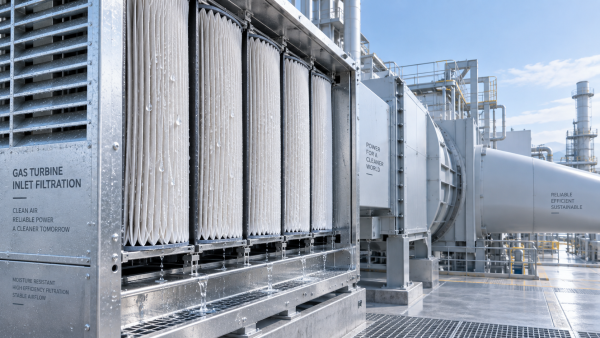
For systems exposed to rain or heavy mist, a staged arrangement is often more reliable than asking one final filter to do everything. A weather hood, louver, inertial separator, droplet eliminator, or coarse prefilter may reduce bulk water and large debris. The moisture-resistant fine filter then handles the remaining particulate load under conditions it can sustain.
What to check before changing the filter media
Before specifying a new material, identify what is actually wetting the filter and when it happens. This prevents a media change from masking a housing or process defect.
- Inspect the removed filter. Clear water, oily residue, mud-like deposits, hard mineral film, and collapsed pleats point to different causes.
- Determine the moisture source. Check weather ingress, condensation from temperature swings, humid process air, washdown exposure, leaks, or aerosol-generating equipment.
- Look at the timing. A problem after rain suggests ingress or drainage; a problem after startup or shutdown often suggests condensation; a gradual sticky buildup may indicate oil or process vapor.
- Check the housing. Confirm that seals, doors, drains, slopes, and water-shedding features are functioning. Water pooled in the housing will undermine almost any media selection.
- Review face velocity and filter area. Excessively high air velocity can drive droplets deeper into the media, reduce drainage, and accelerate loading.
- Define the filtration duty. Clarify the particle type, required efficiency, acceptable pressure-drop behavior, temperature, chemical exposure, and whether the filter must tolerate cleaning or replacement cycles.
This sequence also helps distinguish a temporary weather-related event from a recurring operating condition. A filter that only becomes damp occasionally may benefit greatly from a moisture-resistant construction. A filter exposed to daily liquid aerosol needs a broader separation and drainage strategy.
Material construction affects the result
Fully synthetic wet-laid media can be useful where moisture tolerance, consistent structure, and process-specific fiber design are needed. Lamination can also add functional layers, support, or protective surfaces, provided the adhesive system remains compatible with the expected heat, humidity, chemicals, and mechanical stress.
The manufacturing route matters because filtration media is not just a sheet of fibers. Fiber selection, web formation, bonding, surface treatment, and lamination influence how the medium handles wet exposure, how it holds dust, and how reliably it can be converted into a finished filter. For specialized filtration fields, it is often more useful to discuss the operating failure mode with the media supplier than to request a generic “waterproof filter material.”
Hangzhou Chaocai Materials develops functional advanced materials and supports filtration applications through fully synthetic wet-laid production as well as PUR, hot-melt, solvent-based emulsion spray, and ultrasonic lamination capabilities. For applications involving gas turbines, automotive systems, new energy manufacturing, semiconductors, or biopharmaceutical processes, that range of manufacturing options can be relevant when moisture resistance must be balanced with filtration performance, structural support, and conversion requirements.
FAQ
Can a moisture-resistant filter be used outdoors without a weather hood?
It may tolerate occasional damp exposure, but it should not be treated as a substitute for rain protection. A weather hood or suitable intake design reduces bulk-water loading and makes the filter’s service life more predictable.
Why does pressure drop rise after the filter dries?
Drying does not reverse all wet loading. Water can bind fine dust into a denser deposit, and dissolved residues may remain on the fibers after evaporation. The filter can therefore stay restrictive even when it no longer feels wet.
Will a hydrophobic treatment stop oil mist from clogging a filter?
Not necessarily. Hydrophobic performance relates to water, while oil mist requires compatibility with oil and sticky aerosol. Where oil is present, assess oleophobic behavior and consider upstream mist control.
Should the final filter handle both water and fine dust?
Only when liquid exposure is low and the filter is designed for that combined duty. For sustained droplet loading, separating bulk liquid upstream usually protects the fine filter and reduces unstable pressure-drop behavior.
A moisture-resistant medium is a practical safeguard against humidity-related damage and intermittent wet loading. It delivers the best result when the filter assembly can drain, upstream components control bulk liquid, and the selected media matches the contaminant rather than moisture alone.
Recommendation
 Oct 10, 2026
How Can Air Filter Media Increase Dust Holding Capacity Without Higher Pressure Drop?
Which liquid filter media is suitable for hydraulic oil fine-particle filtration? Discover how advanced air filter media increases dust holding capacity with low pressure drop.- Oct 10, 2026
Which Liquid Filter Media Is Suitable for Fine Hydraulic Oil Filtration?
Can synthetic filter media replace glass fiber in high-humidity gas turbine intakes? Explore media choices for fine hydraulic oil filtration, balancing efficiency, moisture resistance, pressure drop, and service life. - Oct 10, 2026
Can Synthetic Filter Media Replace Glass Fiber in Humid Turbine Intakes?
Is ePTFE filter media suitable for pulse-cleaned construction equipment air filters? Explore synthetic vs. glass fiber performance in humid turbine intakes.