Why Does Gas Turbine Intake Filter Pressure Rise After Rain?
A rise in gas turbine intake filter differential pressure after rain is usually a real filtration event, not simply a sensor anomaly. Rainwater, high humidity, and the contaminants already held in the filter can combine to restrict airflow much more quickly than dry dust alone. The increase may be temporary when the media dries, or it may persist because the wetting event has created a compacted, mud-like dust layer that no longer releases easily.
For an operator, the practical question is not only why the pressure rises, but whether the filter system will recover, whether water is bypassing the intended drainage path, and whether the installed media is suited to the site's rain, humidity, salt, dust, and operating-cycle conditions. A small, short-lived increase after a heavy shower may be expected. A sharp increase, repeated wet-weather alarms, or differential pressure that remains elevated after conditions improve deserves investigation.
Why rain changes filter resistance
An intake filter is designed to pass a large volume of air while capturing particles before they reach the compressor. Under dry conditions, deposited dust occupies part of the media surface and pore structure, gradually increasing resistance. Rain changes how that deposited material behaves.
Fine dust can absorb moisture and swell. Hygroscopic contaminants, including certain salts and industrial aerosols, may become sticky at high relative humidity even before visible water reaches the filter. Once wet, loose dust can migrate deeper into the media, bridge pores, or form a denser surface cake. The airflow path becomes narrower and more tortuous, so the differential pressure across the filter rises.
The effect can be especially pronounced when a rain event follows a dry and dusty period. A filter that appeared to have substantial remaining life based on dry differential pressure may already be holding a significant dust load. Moisture then binds that dust into a restrictive layer. In such cases, the pressure increase is not caused by rainwater alone; it is the combined effect of accumulated contaminants and wetting.
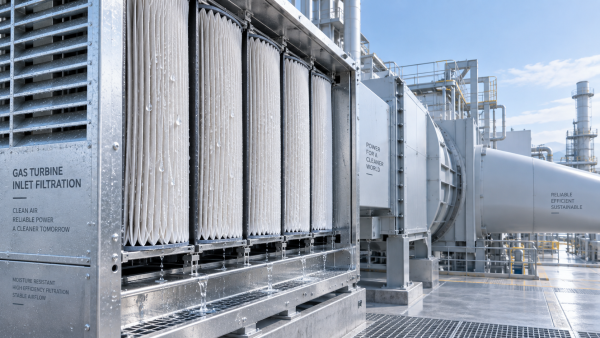
Water droplets can also create localized blockage. If the intake hood, louvers, weather hoods, mist eliminators, drain channels, or filter seals do not control water correctly, droplets may strike the filter face directly. A uniform rise across a filter bank may point to high ambient humidity or widespread wetting. A localized rise, uneven loading pattern, or visibly wet section may indicate water carryover, poor drainage, damaged weather protection, or air leakage around internal components.
High humidity can matter even without direct rain penetration
It is easy to assume that post-rain pressure problems require visible water on the filters. In reality, humid air alone can affect many intake systems. The response depends on the filter media, binder system, surface treatment, dust chemistry, and operating temperature.
Some particles retained on the media have a strong affinity for moisture. When humidity rises, they may soften, agglomerate, or adhere more strongly to fibers. Fine particles that were previously distributed through a relatively open dust cake can consolidate into a lower-permeability layer. In coastal, marine-influenced, agricultural, mining, cement, chemical, and industrial locations, the composition of the deposited material often matters as much as the visible amount of dust.
High humidity can also reduce the effectiveness of pulse cleaning where a self-cleaning or pulse-operated prefiltration stage is used. Dust that would detach readily when dry may remain bonded to the filter surface when damp. Repeated pulse cycles may then offer little recovery while placing additional mechanical stress on the elements.
This is why a filter system can show a recurring pressure pattern after rain even when inspection finds no obvious bulk-water entry. The system may be responding to humidity-sensitive deposits rather than a major failure of the weather hood.
When the rise is expected, and when it signals a problem
A modest pressure increase during or immediately after rain can occur in a properly designed intake. The important observation is the recovery pattern. If the differential pressure returns close to its previous trend after the filter media and deposited dust dry, the event may be primarily moisture-related and reversible. The rate of recovery will depend on weather, turbine operation, airflow, and the amount of retained contamination.
More concern is warranted when one or more of the following conditions appears:
- The pressure rise is rapid and substantially larger than the site’s normal wet-weather variation.
- Differential pressure remains high after a reasonable drying period and stable operating conditions.
- Only one stage, one compartment, or one area of the intake shows abnormal loading.
- Filters are visibly wet, distorted, sagging, delaminated, or stained by water paths.
- Drain pans overflow, drains are blocked, or water is retained near filter frames.
- Frequent pulse cleaning does not reduce resistance in a system intended to clean filters in service.
- The turbine shows an airflow-related performance concern or reaches its intake pressure limit sooner than expected.
A persistent increase often indicates that the deposited dust has changed state. Once particles have formed a hardened or compacted cake, drying does not necessarily restore the original porosity. Replacing the filters may then be necessary even though the pressure increase began with a rain event.
Do not assume the differential-pressure transmitter is wrong
Instrumentation should still be checked, especially when the reading changes abruptly. Wet sensing lines, condensate accumulation, blocked pressure taps, or a transmitter range problem can produce misleading values. Yet treating every post-rain increase as an instrument issue can delay identification of a genuine intake problem.
A useful approach is to compare the differential-pressure trend with several physical observations: weather timing, turbine load, inlet guide vane position where relevant, compartment readings, filter-face condition, drain condition, and any change in cleaning-system behavior. A pressure increase that begins with rain, affects several sections consistently, and remains aligned with visible wet loading is unlikely to be explained only by the transmitter.
For systems with multiple filter stages, stage-by-stage pressure readings are particularly valuable. They help distinguish a wet prefilter or mist-control stage from a final filter that has become loaded with moisture-bound fine dust. A single total differential-pressure measurement can show that resistance is rising, but it cannot reliably identify where the restriction is occurring.
The intake housing can be as important as the filter media
Replacing filters with a more water-resistant product may help, but it will not correct an intake housing that directs water toward the filter bank. The inspection should therefore extend beyond the elements themselves.
Check the external weather hood and louvers for damage, gaps, incorrect orientation, or debris accumulation. Confirm that droplet separators and coalescing components are installed correctly and have not been displaced. Inspect drain paths from the upper intake sections through to discharge, because standing water can be re-entrained into the airflow. Look for missing seals, poorly seated filter frames, and open bypass routes that may allow water or unfiltered air to reach downstream components.
Air velocity distribution also matters. High local velocity can carry droplets past weather-protection components that appear adequate at average flow. It can also load certain portions of the filter bank much faster than others. If rain-related pressure rises repeatedly occur in the same compartment, the airflow pattern and water-management geometry deserve closer attention than the nominal filter efficiency alone.
Filter construction influences wet-weather behavior
Not all high-efficiency intake filters respond to moisture in the same way. Media selection affects water repellency, resistance to fiber swelling, dust-release behavior, structural stability, and the ability to maintain airflow after exposure to high humidity. The material must also work with the full filter construction, including pleat geometry, spacers, adhesives, frame, gasket, and any protective layers.
For outdoor gas turbine intake service, selection discussions should include more than initial differential pressure and particle-capture performance. Procurement and engineering teams should ask how the media behaves after wetting, whether its water-repellent treatment is durable, how it handles fine hygroscopic dust, and whether its construction maintains pleat spacing under moisture and airflow load.
Where the site experiences frequent rain or fog, a staged arrangement may be more appropriate than relying on one filter layer to perform every function. A well-designed system can use weather protection and droplet management upstream, retain larger contaminants in an accessible prefilter stage, and reserve the final filtration stage for fine-particle control. The correct configuration depends on the inlet architecture and contaminant profile; adding stages without evaluating airflow and drainage can create its own pressure-loss penalty.
How to investigate a post-rain pressure event
The first task is to establish whether the event is reversible, localized, or progressive. Recording the differential-pressure trend before, during, and after rainfall is more useful than a single inspection reading. Pair that trend with ambient humidity, rainfall intensity where available, turbine operating state, and the timing of cleaning cycles.
Next, inspect safely accessible sections for wet media, streaking, standing water, dirt accumulation at drains, and uneven discoloration. Compare compartments rather than viewing the intake as one large filter bank. Uneven evidence usually narrows the investigation toward housing geometry, a damaged component, or a drainage issue. Uniform evidence is more consistent with a system-wide humidity and contaminant interaction.
It is also important to examine the removed filter elements when replacement occurs. A dry, evenly distributed dust cake suggests normal loading. A dense crust, sticky deposits, tide marks, collapsed pleats, or localized muddy deposits suggests wetting and may reveal whether water entered from the weather side, collected internally, or interacted with the retained dust. The observation should feed back into the next filter specification and maintenance plan rather than being treated as a routine disposal detail.
Maintenance decisions should follow the pressure trend, not the calendar alone
Rain can compress the useful service interval of an intake filter, but a calendar-based replacement decision can be misleading. Replacing too early increases operating cost and waste. Waiting until a persistently wet-loaded filter reaches an operational limit can reduce available airflow and create avoidable turbine performance risk.
A better basis for action is the relationship among differential pressure, recovery after wet weather, visual condition, and the equipment manufacturer’s operating limits. When a filter bank repeatedly fails to recover after rain, the response should include root-cause review rather than simply shortening the replacement interval. Otherwise, the site may continue purchasing filters to compensate for drainage, weather-protection, or contamination-control problems upstream.
The same principle applies to pulse-cleaned systems. More frequent pulsing is not automatically a solution. If deposits are damp and adhesive, cleaning energy may not remove them effectively. The system may need attention to water carryover, cleaning sequence, media surface properties, or the upstream stage that is allowing fine, moisture-sensitive material to reach the final filters.
What operators should ask before changing filter media
A post-rain pressure issue should lead to a site-specific technical discussion. The useful questions are practical: How often do high-humidity and rainfall events occur? Is the site exposed to salt, fine mineral dust, industrial aerosols, or organic material? Does the pressure rise occur across the whole bank or only in certain sections? Is water found upstream, on the filter face, or downstream of the filters? Does the existing media recover after drying?
The answers determine whether the priority is a more durable hydrophobic media, better droplet separation, stronger wet structural stability, improved dust-release behavior, revised prefiltration, or housing and drainage correction. In many cases, the correct answer is a combination of these measures.
Gas turbine intake filter differential pressure rises after rain because moisture changes the air path through both the filter media and the contaminants retained on it. The event becomes costly when wetting is repeated, dust cakes permanently, water bypasses the intake’s protective features, or the installed filter construction is mismatched to the environment. Tracking recovery after rainfall and inspecting the path that water takes through the intake provide a stronger basis for action than treating every pressure increase as a normal weather effect.
Recommendation
 Oct 10, 2026
How Can Air Filter Media Increase Dust Holding Capacity Without Higher Pressure Drop?
Which liquid filter media is suitable for hydraulic oil fine-particle filtration? Discover how advanced air filter media increases dust holding capacity with low pressure drop.- Oct 10, 2026
Which Liquid Filter Media Is Suitable for Fine Hydraulic Oil Filtration?
Can synthetic filter media replace glass fiber in high-humidity gas turbine intakes? Explore media choices for fine hydraulic oil filtration, balancing efficiency, moisture resistance, pressure drop, and service life. - Oct 10, 2026
Can Synthetic Filter Media Replace Glass Fiber in Humid Turbine Intakes?
Is ePTFE filter media suitable for pulse-cleaned construction equipment air filters? Explore synthetic vs. glass fiber performance in humid turbine intakes.