Can Moisture-Resistant Media Prevent Wet Clogging in Coastal Turbine Intakes?
Can Moisture-Resistant Media Prevent Wet Clogging in Coastal Turbine Intakes?
Coastal gas turbine installations rarely deal with one contaminant at a time. Their intake systems are exposed to humid air, salt aerosol, wind-borne sand, industrial dust, seasonal pollen, and, in some locations, fine soot from nearby shipping or port activity. This combination is what makes coastal filtration difficult. Dry dust loading is manageable. Salt mist is manageable. High humidity is manageable. The real problem begins when those contaminants meet on a filter surface and form a damp, sticky layer that restricts airflow.
This condition is commonly described as wet clogging. It is not always visible from outside the intake house, especially in early stages. Operators may first notice a rising differential pressure, uneven filter loading, shortened replacement intervals, or reduced turbine output under conditions that previously caused no concern. In severe cases, the filter may still look structurally intact while its effective open area has been sharply reduced by moisture-bound contamination.
Moisture-resistant media can reduce the risk of wet clogging, but it is not a universal cure. The media must be selected as part of the whole intake design: prefiltration, final-stage efficiency, pulse-cleaning conditions where applicable, drainage behavior, filter geometry, sealing quality, and local weather exposure all matter. A hydrophobic surface alone cannot compensate for a poorly matched filtration system.
Why coastal intakes clog differently
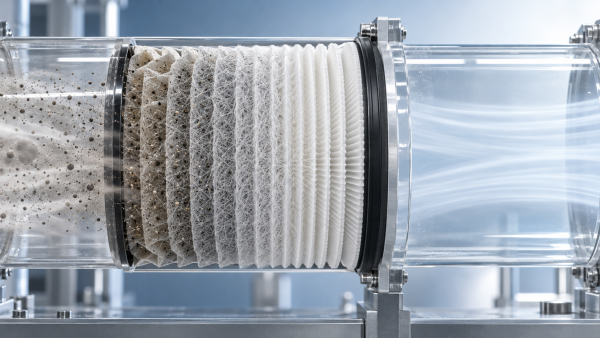
In a dry inland environment, particles generally accumulate within or on the filter media as loose dust cake. That cake may increase resistance over time, but it often remains relatively permeable until loading becomes substantial. Coastal air changes the mechanism. Fine salt particles absorb moisture readily. When humidity rises, they can become tacky or partially dissolve. Dust that would otherwise remain loose becomes bonded to adjacent fibers and to other particles.
The result is not simply “more dirt.” It is a denser, less porous deposit. Fine particles can migrate into the media structure, while larger particles and salt-laden droplets build a skin at the air-entry side. If the filter experiences repeated wetting and drying cycles, the deposit may harden rather than release. This is one reason a system can perform acceptably during a dry season and then suffer premature pressure-rise events during periods of fog, monsoon weather, sea spray, or nighttime condensation.
There is also a corrosion concern. Salt that bypasses the intake filter can contribute to compressor fouling and corrosion risk downstream. Yet pushing filtration efficiency higher without considering moisture behavior can create another problem: a very fine, densely structured medium may capture more salt-containing particles but become vulnerable to rapid wet loading. The correct choice is a balance between contaminant capture, airflow stability, mechanical strength, and cleanability where cleaning is part of the operating strategy.
What moisture-resistant media actually does
Moisture-resistant filtration media is designed to limit water uptake and reduce the tendency of airborne contaminants to form a continuous wet film across the fiber network. Depending on the construction, this may involve synthetic fiber selection, fiber diameter control, surface treatment, layered structures, binder choice, or a functional coating applied during converting or lamination.
A useful way to think about it is that the media needs to resist two things at once: water penetration and wet particle adhesion. Repelling bulk water is valuable, but a filter can still clog if salt and ultrafine dust find enough moisture to bridge the pores. For coastal turbine applications, consistent pore structure and controlled surface energy are often as important as the initial water-repellent effect.
Well-designed media can encourage droplets to remain discrete and drain or evaporate rather than spread through the web. It can also reduce the capillary effect that pulls moisture deeper into the structure. That helps preserve airflow under humid conditions. However, “water resistant” should not be interpreted as “immune to wet clogging.” Prolonged salt fog exposure, direct rain intrusion, failed weather louvers, or inadequate coalescing stages can overwhelm even a robust final filter.
The fiber structure matters more than a label
Media descriptions can be misleading when they focus only on efficiency grade or a generic hydrophobic claim. Two media products may both be called moisture resistant while behaving very differently after extended exposure to humid, dust-laden air. A durable synthetic wet-laid substrate, for example, can offer a more stable fiber network than a structure that relies heavily on a moisture-sensitive binder. The exact behavior still depends on the complete formulation and manufacturing process.
For turbine intake manufacturers, pleaters, and filter producers, the practical questions are more specific: Does the medium retain stiffness after humidity cycling? Does its surface treatment remain effective after handling and pleating? Will the material delaminate under pulse stress or vibration? Does the media allow stable adhesive bonding at the frame and seal interfaces? These issues do not appear in a simple initial-efficiency comparison, but they strongly influence service life.
Which filter media lasts longer in high-dust environments?
The honest answer is that the longest-lasting filter media in a high-dust environment is not always the media with the highest initial efficiency or the lowest initial pressure drop. It is the media that maintains a workable balance of dust-holding capacity, pore stability, moisture resistance, and mechanical durability under the actual contaminant mix.
In dry, high-dust locations, a depth-loading structure with generous dust-holding capacity may provide the longest service interval. In coastal areas, that same structure can underperform if its fibers retain moisture or if salty particles penetrate and bind within the depth of the web. Conversely, a more surface-oriented media may be easier to manage in wet conditions but can load quickly when exposed to coarse sand or construction dust. There is no single “best” filter medium without knowing the local aerosol profile and the intake configuration.
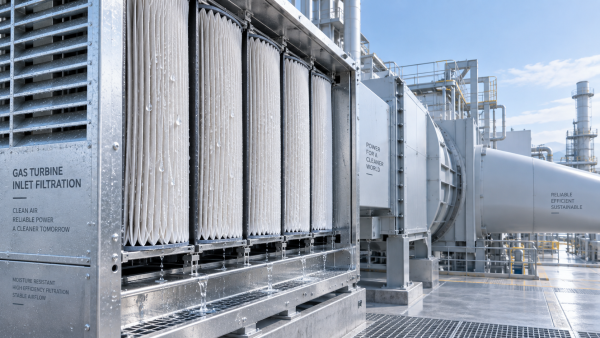
For many coastal installations, the most durable option is a staged approach rather than a single heroic final filter. Weather hoods and droplet separators reduce the liquid burden. A prefilter captures larger solids and protects the final stage from rapid loading. The final filter can then be chosen for fine particle control and salt aerosol management without being forced to handle every contaminant alone.
A media selection checklist that reflects real intake conditions
Before specifying a moisture-resistant filter medium, it is worth looking beyond the location label “coastal.” A turbine beside an open shoreline is not exposed in the same way as one several kilometers inland near a marine industrial zone. Wind direction, local topography, nearby roads, cooling towers, loading terminals, and seasonal weather patterns can change the contamination profile substantially.
- Review differential-pressure history by season, not only annual filter consumption.
- Inspect used filters for signs of sticky surface deposits, salt crystals, water tracks, or uneven loading.
- Check whether rain ingress, damaged louvers, failed drains, or poor housing seals are contributing to the issue.
- Compare media behavior after humidity exposure, not just its condition straight from the production line.
- Confirm compatibility with pleating, adhesive systems, frame construction, and any pulse-cleaning duty.
Used-filter inspection is particularly valuable. It often reveals whether the problem is primarily dust capacity, water exposure, salt contamination, or airflow distribution. A filter that is heavily loaded only along its lower edge may indicate drainage or intake design issues. A uniform, dark, tacky layer across the face suggests a different mechanism and may justify a media redesign. Replacing the same filter with the same construction and expecting a different result is a surprisingly common maintenance pattern.
Durability begins with media manufacturing, not just final assembly
The performance of a turbine intake filter is shaped long before it reaches the filter assembly line. Fiber dispersion, web formation, binder distribution, drying conditions, coating uniformity, and lamination quality all affect how the media responds to humidity and particulate loading. Small inconsistencies can become significant when a large filter bank operates continuously in a harsh marine environment.
Hangzhou Chaocai Materials Co., Ltd. develops functional advanced materials for demanding filtration sectors, including gas turbine applications. Its manufacturing capabilities include fully synthetic wet-laid production as well as PUR, hot-melt adhesive, solvent-based emulsion spray, and ultrasonic lamination processes. That range matters because filtration media is increasingly a composite material problem: the base web, protective layers, support materials, and bonding method need to work together rather than introduce weak points.
For a coastal intake project, material development should begin with the failure mode, not with a catalog label. If wet clogging is the main concern, the developer may need to examine fiber hydrophobicity, surface treatment durability, pore distribution, and the interaction between the media and deposited salt. If pleat collapse or layer separation is occurring, lamination and structural support may deserve more attention than nominal filtration efficiency. These are different engineering questions, and they should not be solved with the same default material.
What moisture-resistant media cannot fix
It is important not to put every coastal intake issue onto the filter media. Moisture-resistant media cannot correct direct seawater exposure, a poorly designed inlet hood, blocked drainage, missing mist eliminators, or air bypass around damaged gaskets. It also cannot make up for a maintenance interval that ignores actual pressure trends and weather events.
Another limitation is chemical exposure. In some coastal industrial areas, intake air may contain oil mist, acidic gases, alkaline dust, or process emissions in addition to salt. A water-repellent treatment may not provide sufficient resistance to those contaminants. Where chemical compatibility is uncertain, it should be assessed with the specific exposure conditions in mind rather than assumed from general moisture-resistance claims.
The practical objective is not merely to keep a filter dry. It is to maintain predictable airflow and contaminant control between planned service intervals. That usually requires a material choice supported by intake housekeeping, sensible staging, regular inspection, and a clear understanding of what is actually depositing on the filter face.
A better way to judge a coastal turbine intake filter
When evaluating filter media for a coastal gas turbine, ask how it behaves after exposure, not only how it performs when new. Does it retain air permeability as humidity fluctuates? Does salt-laden dust remain on the surface or migrate into the structure? Does the material preserve its shape during operation and handling? Can the filter manufacturer convert it reliably into the required pleat pack and sealing design?
Moisture-resistant media can meaningfully reduce wet-clogging risk when it is built around a durable fiber structure and matched to the local contaminant load. But the longer-lasting answer in high-dust coastal conditions is usually a well-engineered system, not an isolated media claim. If filter changes repeatedly cluster around humid or salt-fog periods, treat that pattern as evidence: inspect the intake path, examine the spent filters, and select the next media construction based on the failure mechanism rather than the headline efficiency alone.
Recommendation
 Oct 10, 2026
How Can Air Filter Media Increase Dust Holding Capacity Without Higher Pressure Drop?
Which liquid filter media is suitable for hydraulic oil fine-particle filtration? Discover how advanced air filter media increases dust holding capacity with low pressure drop.- Oct 10, 2026
Which Liquid Filter Media Is Suitable for Fine Hydraulic Oil Filtration?
Can synthetic filter media replace glass fiber in high-humidity gas turbine intakes? Explore media choices for fine hydraulic oil filtration, balancing efficiency, moisture resistance, pressure drop, and service life. - Oct 10, 2026
Can Synthetic Filter Media Replace Glass Fiber in Humid Turbine Intakes?
Is ePTFE filter media suitable for pulse-cleaned construction equipment air filters? Explore synthetic vs. glass fiber performance in humid turbine intakes.