Is ePTFE Filter Media Suitable for Pulse-Cleaned Equipment Air Filters?
Is ePTFE Filter Media Suitable for Pulse-Cleaned Equipment Air Filters?
For operators of coastal gas turbines and pulse-cleaned air filtration systems, moisture is rarely a minor detail. Humid air, sea-salt aerosols, fog, rain carryover, and rapid temperature changes can all affect how a filter loads, releases dust, and maintains airflow. The practical question is not simply whether a filter can capture particles. It is whether the media can keep doing so after repeated exposure to moisture and repeated pulse-cleaning cycles.
That is why ePTFE filter media is often considered for demanding equipment air filters. Its surface-filtration behavior can support efficient dust release, while its hydrophobic character can reduce direct wetting of the filtration surface. Still, ePTFE is not a universal answer to every intake problem. A well-performing pulse-cleaned filter depends on the membrane, the substrate, the pleat design, the sealing system, the pulse pressure, and the actual contamination profile at the installation site.
In other words, ePTFE can be highly suitable for pulse-cleaned equipment air filters, particularly where fine dust and intermittent moisture occur together. But suitability should be judged as a system decision rather than a material label.
Why pulse-cleaned filters place unusual demands on media
Pulse-cleaned filters are expected to recover airflow without being removed from service every time dust accumulates. During cleaning, a short burst of compressed air flexes the filter element and dislodges part of the dust cake. The process sounds straightforward, but it creates competing requirements for the media.
The filtration layer needs to capture fine particles efficiently. At the same time, it should not allow contaminants to become deeply embedded within the substrate, because embedded dust is harder to remove. The backing material must tolerate repeated mechanical movement. Adhesion between layers must remain stable, especially if the filter sees humidity, temperature cycling, vibration, or oil mist. A media construction that performs well in a static laboratory test may not necessarily retain the same pressure-drop behavior after extended pulse-cleaning exposure.
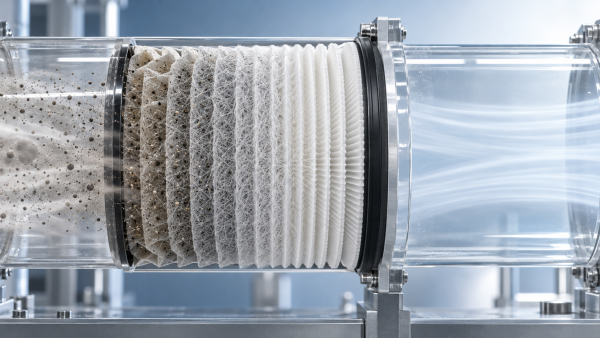
This is where surface filtration becomes relevant. Conventional depth-loading media often captures particles throughout its fiber structure. That can be acceptable in applications where filters are changed frequently, but it can make cleaning less predictable when dust is fine, sticky, or damp. An ePTFE membrane provides a fine porous layer on the surface. Instead of allowing a large fraction of dust to penetrate deeply, it encourages more of the particulate load to remain near the outer filtration face.
For pulse-cleaned equipment, that surface-oriented dust cake is generally easier to release than a load buried inside a fibrous web. The benefit is not that the filter never loads; every filter loads. The benefit is that the loading process can be more controllable when the media, pulse settings, and operating environment are properly matched.
What ePTFE changes in real operating conditions
Expanded polytetrafluoroethylene, commonly called ePTFE, is valued in filtration because it can form a highly porous membrane with fine pore structure and strong chemical inertness. In practical equipment air filtration, the membrane is usually supported by a substrate rather than used alone. That support layer contributes strength, pleatability, processability, and overall durability.
The most useful characteristic in a pulse-cleaned setting is not simply “high efficiency.” It is the way the membrane manages the first stages of dust loading. A clean membrane surface may initially show a certain airflow resistance, then develop a relatively stable dust cake that becomes part of the filtration mechanism. If the dust can be released effectively during the cleaning pulse, the filter may avoid the rapid and irreversible pressure-drop increase often associated with deep penetration or compacted contamination.
This can be especially relevant for machinery operating near ports, cement handling areas, mining sites, processing plants, or exposed industrial facilities. In these places, airborne contamination is seldom uniform. Dry mineral dust may be present in the morning, followed by damp particles after fog or rain. Salt can make deposits more cohesive. Insects, plant matter, oily aerosols, or fine soot may create an additional layer of complexity. The media needs to handle the dominant risk, not merely perform well against an idealized dust type.
ePTFE does not make a filter immune to poor operating conditions. Excessive pulse pressure, unsuitable cleaning frequency, damaged pleats, water ingress, or inadequate drainage can still shorten service life. It does, however, give designers a useful tool for reducing particulate penetration into the base media and improving the likelihood of effective dust release.
Does moisture-resistant filter media prevent wet clogging in coastal gas turbine intakes?
Moisture-resistant filter media can reduce the risk of wet clogging in coastal gas turbine intakes, but “prevent” is too absolute unless the full intake design is considered. Wet clogging is usually not caused by humidity alone. It often results from moisture combining with salt, dust, soot, or other airborne matter to form a sticky deposit. Once that deposit bridges pores or collects in pleat valleys, airflow resistance can rise quickly.
A hydrophobic ePTFE surface can help because water is less likely to spread through and wet the filtration layer in the same way it may wet some untreated fibrous media. This may limit the tendency for particles to bind within the substrate. For pulse-cleaned systems, a drier and more surface-localized dust layer is generally more favorable for cleaning than a damp, compacted deposit embedded within the media structure.
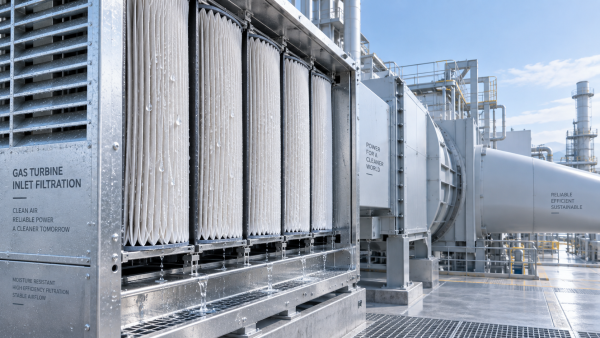
But coastal intake conditions can exceed what filter media alone can solve. Wind-driven rain, persistent fog, salt spray entering through louvers, drainage problems, or water bypass around poorly sealed elements may overwhelm even a moisture-resistant filter. In a gas turbine intake, moisture management typically begins upstream: weather hoods, louvers, coalescing stages, droplet separators, drainage paths, and correct housing design all matter. The final filter media should be selected as part of that moisture-control strategy.
There is also a distinction between water repellency and salt tolerance. Water may bead on a hydrophobic surface, yet dissolved salts can remain behind after droplets evaporate. If salt deposits accumulate, they can attract moisture again and change the behavior of the dust layer. This is one reason coastal applications need a maintenance plan based on actual differential-pressure trends and visual inspection, rather than a calendar-only replacement schedule.
The substrate and lamination method matter as much as the membrane
It is easy to focus on the ePTFE membrane and overlook the rest of the construction. In reality, the substrate often determines whether the finished filter media can be pleated cleanly, bonded reliably, and processed into an element that tolerates repeated cleaning pulses. A membrane with good filtration properties can still underperform if the support is too stiff, too weak, poorly bonded, or incompatible with the operating environment.
The lamination process deserves similar attention. Different constructions may use thermal bonding, adhesive-based bonding, ultrasonic techniques, or other methods depending on the materials and intended application. Each route involves trade-offs. A bond must be strong enough to prevent delamination during converting and service, but it should not unnecessarily obstruct airflow or create brittle areas that crack during pleating.
For specialized filtration projects, material suppliers with several processing platforms can be useful because they are better positioned to evaluate construction choices rather than force every application into one process. Hangzhou Chaocai Materials Co., Ltd. develops functional advanced materials using fully synthetic wet-laid, PUR lamination, hot-melt adhesive lamination, solvent-based emulsion spray lamination, and ultrasonic lamination capabilities. That range is relevant when a filtration developer needs to balance membrane protection, mechanical support, handling characteristics, and end-use durability.
The right construction for a pulse-cleaned industrial collector may not be the right one for a gas turbine intake, automotive air system, semiconductor environment, or biopharmaceutical application. The contamination source, cleaning regime, acceptable pressure drop, service temperature, and required downstream protection should drive the design discussion.
Where ePTFE media is a strong fit—and where caution is needed
ePTFE-laminated media is often a strong candidate when the system must handle fine particulate matter, regular pulse cleaning, and conditions where dust release is a major operating concern. It is particularly worth evaluating when filters show a pattern of pressure drop that does not recover adequately after cleaning, when dust penetrates too deeply into conventional media, or when damp conditions make deposits difficult to remove.
It may also make sense when equipment downtime is costly and filter behavior needs to remain stable across changing weather. Gas turbine air intake systems are an obvious example, but the same logic can apply to industrial compressors, dust extraction systems, process-air units, and certain high-value manufacturing environments.
Caution is needed where the dominant contaminant is oil, condensable vapor, or liquid aerosol rather than dry or semi-dry particulate. A membrane is not automatically a substitute for mist separation or coalescing stages. Likewise, if an intake regularly experiences bulk water carryover, the first question should be why water is reaching the final filter. Replacing media without correcting the upstream water-management issue usually produces a short-lived improvement at best.
Another common mistake is specifying a membrane solely because it is hydrophobic. Hydrophobicity is useful, but pore structure, air permeability, basis weight, substrate composition, bond integrity, pleat geometry, and media-to-element compatibility all affect final performance. These details should be verified through product specifications and, where possible, representative application testing.
Questions worth asking before selecting the media
A productive filter-media discussion usually starts with the equipment rather than the material name. Before choosing ePTFE media for pulse-cleaned air filters, operators and filter manufacturers should clarify several points:
- What contaminants are actually reaching the filter: mineral dust, salt, soot, fibers, moisture, oil mist, or a mixture?
- Is the filter cleaning problem caused by poor dust release, wetting, over-aggressive pulsing, insufficient pulse energy, or damaged elements?
- Does the system experience high humidity only, or does it see fog, rain ingress, salt spray, and condensation?
- What pressure-drop pattern is observed before and after cleaning cycles?
- Can the housing, seals, drainage arrangement, and upstream separation stages control bulk water before it reaches the final filter?
- Will the selected media convert reliably into the intended pleated element without cracking, delamination, or excessive restriction?
These questions can reveal whether the issue is truly a media-selection problem. In many installations, the answer is partly yes—but only partly. A good filter material cannot compensate indefinitely for air bypass, poor drainage, incorrect element installation, or a pulse-cleaning strategy that is out of step with the dust load.
A practical conclusion for coastal and pulse-cleaned applications
ePTFE filter media is well suited to many pulse-cleaned equipment air-filter applications because it supports surface filtration, can improve dust-release behavior, and offers useful resistance to moisture wetting. In coastal gas turbine intakes, it can be part of an effective defense against wet clogging, particularly when fine dust and salt-laden humidity occur together.
The important qualification is that moisture-resistant media reduces a risk; it does not eliminate the need for sound intake engineering. The best results come from matching the membrane and substrate construction to the dust profile, using an appropriate lamination approach, confirming element compatibility, and addressing upstream water control. For applications where pressure-drop stability and cleaning recovery affect equipment availability, that extra level of evaluation is usually worth the effort.
Recommendation
 Oct 10, 2026
How Can Air Filter Media Increase Dust Holding Capacity Without Higher Pressure Drop?
Which liquid filter media is suitable for hydraulic oil fine-particle filtration? Discover how advanced air filter media increases dust holding capacity with low pressure drop.- Oct 10, 2026
Which Liquid Filter Media Is Suitable for Fine Hydraulic Oil Filtration?
Can synthetic filter media replace glass fiber in high-humidity gas turbine intakes? Explore media choices for fine hydraulic oil filtration, balancing efficiency, moisture resistance, pressure drop, and service life. - Oct 10, 2026
Can Synthetic Filter Media Replace Glass Fiber in Humid Turbine Intakes?
Is ePTFE filter media suitable for pulse-cleaned construction equipment air filters? Explore synthetic vs. glass fiber performance in humid turbine intakes.