



Can Synthetic Air Filter Media Extend Replacement Intervals?
Yes, but only when the media is matched to the duty
Synthetic air filter media can extend replacement intervals, sometimes substantially, but the material alone does not guarantee a longer service life. A filter lasts longer when its structure maintains airflow and particle-holding capacity as dust accumulates. Synthetic media can perform well on both counts because it can be engineered with controlled fiber diameter, density gradient, thickness, and bonding method.
For an equipment owner, the practical question is not whether synthetic media is inherently longer-lasting than every alternative. It is whether a specific synthetic media design reaches the required efficiency without creating an excessive pressure-drop penalty, losing shape under load, or becoming prematurely blocked by the contaminants present in the system.
That distinction matters in gas turbine intake systems, automotive air filtration, clean manufacturing environments, battery production, semiconductor facilities, and process equipment. Each application sees a different mix of dust, moisture, oil aerosols, fibers, salt, soot, or fine particulate. A media that extends replacement intervals in a dry industrial intake may be a poor choice for a humid process stream containing sticky aerosol contamination.
Why synthetic media can stay in service longer
A filter is generally replaced for one of three reasons: airflow restriction reaches an operating limit, filtration performance can no longer be trusted, or the physical filter element has degraded. Well-designed synthetic media can improve all three areas, although the degree of improvement depends on construction.
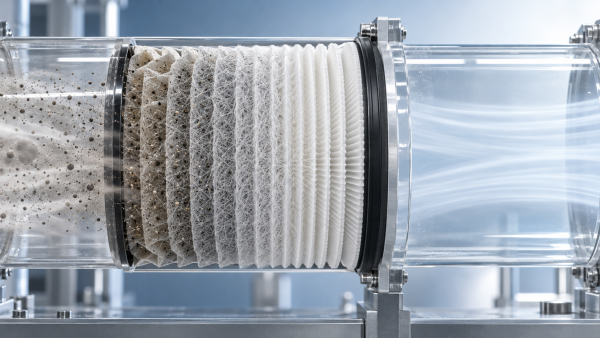
Synthetic fibers such as polyester, polypropylene, and other engineered polymers can be produced with relatively consistent geometry. This gives media designers more control over pore structure than is possible with less uniform fiber systems. Rather than forcing all particles to collect at the surface, a depth-loading structure can capture particles through the thickness of the media. More of the available media volume then contributes to dust storage.
This is especially useful where filters see long periods of stable particulate loading. A media with a gradual density change from upstream to downstream can retain larger particles near the inlet side while allowing smaller particles to be captured deeper in the structure. The result may be a slower rise in differential pressure than a dense surface-loading layer with similar initial efficiency.
Synthetic media can also offer good resistance to moisture-related distortion. In applications where air humidity changes significantly, or where intermittent water exposure is possible, dimensional stability affects far more than appearance. Pleat spacing, media tension, adhesive integrity, and sealing geometry all influence whether a filter continues to use its full effective area. Media that swells, relaxes, or collapses can lose usable surface area and develop a rapid pressure-drop increase long before its nominal dust capacity is reached.
Mechanical durability is another reason synthetic constructions are considered for extended-service designs. Robust fiber bonding and appropriate support layers can help the media tolerate pulsation, vibration, handling, and frequent operating cycles. In vehicle intake systems and turbine air inlet assemblies, for example, media failure may begin with pleat deformation or local damage rather than a gradual loss of filtration efficiency.
Longer interval does not mean “replace only when it looks dirty”
Visual inspection is a weak basis for determining filter life. A filter can look heavily loaded while retaining acceptable airflow, and it can also appear relatively clean while a thin layer of fine or oily contamination has sharply increased resistance. This is particularly relevant for fine filtration stages, where the contaminants that most affect pressure drop may not be obvious on the upstream face.
Replacement intervals should be tied to the operating condition that matters for the equipment. In many systems, the most useful measure is differential pressure across the filter at a defined airflow. The replacement threshold must reflect the system rather than a generic calendar interval. A threshold that is too high can increase fan energy, reduce available process airflow, or affect engine and turbine performance. A threshold that is too low discards usable filter life and can erase the expected savings from a more durable media.
For critical applications, replacement planning should also consider the consequence of a filter failure. A long-life media may be technically capable of remaining installed, but a facility may still choose a conservative changeout schedule where contamination control, uptime, or product quality has a high value. Semiconductor, biopharmaceutical, and other tightly controlled manufacturing environments often require that filter decisions account for validation, system design, and contamination risk, not only pressure drop.
Conditions that determine whether the interval will actually improve
The same filter media can produce very different maintenance results in different locations. Before expecting an extended replacement interval, evaluate the contaminant profile and the filter housing as carefully as the media specification.
Particle size and dust character
Coarse, dry, non-sticky dust is usually easier to manage with depth-loading synthetic media. Fine particles can also be handled effectively, but the media must have enough thickness and a suitable pore gradient to avoid rapid surface blockage. Dust containing oil mist, moisture, plasticizers, or tacky process residues presents a different problem. Once particles adhere to one another and bridge across pores, airflow resistance can rise quickly even if the total collected mass is modest.
Fibrous contamination deserves separate attention. Lint, paper fibers, insulation fragments, and textile debris can form a surface mat. In such cases, a highly efficient synthetic layer may load early unless the upstream filtration arrangement is designed to remove the larger fibrous material first.
Airflow velocity and filter area
Media life is strongly influenced by face velocity. At higher velocity, fewer square meters of media are available to process a given air volume, and the loading rate per unit area rises. Increasing media area through proper pleat design can lower face velocity and improve dust capacity, but only when pleats remain open throughout service.
A pleated filter with unstable spacing can initially look generous in area while behaving like a much smaller filter after loading. Media stiffness, pleat separators, backing materials, and adhesive placement all affect this outcome. For long replacement intervals, effective area under operating conditions matters more than the theoretical area calculated before the element is installed.
Moisture, temperature, and chemical exposure
Synthetic polymers offer useful flexibility in demanding environments, but polymer selection still matters. High temperature, chemical vapor, solvent exposure, ultraviolet exposure, or repeated wet-dry cycling can alter media stiffness, bonding, and sealing performance. Filter construction must be assessed as a complete assembly: media, adhesive, frame, gaskets, support mesh, and any lamination layers may have different limitations.
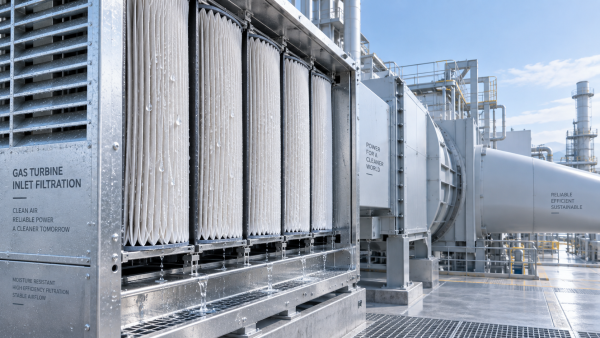
For gas turbine intakes near coastal or industrial locations, salt, moisture, and corrosive contaminants may make staged filtration and water-management design as important as the final-stage media. A longer-life filter is of little value if upstream moisture carryover causes loading, corrosion, or bypass problems elsewhere in the intake system.
System leakage and installation quality
Premature replacement is sometimes blamed on media when the underlying issue is bypass air. Poor gasket compression, damaged frames, misaligned elements, or gaps in a filter bank allow contaminants to enter where they should not. The downstream equipment then sees contamination even though the media itself may have adequate rated performance.
Installation defects can also change the apparent life of the filter. A warped element or compressed pleat pack may develop localized loading, causing an early pressure-drop increase. When evaluating a media upgrade, inspect the housing, clamping system, access-door seals, and maintenance procedures. Otherwise, a new media specification may be asked to solve a mechanical problem it cannot address.
Initial pressure drop is not a complete buying criterion
Low initial resistance is attractive because it reduces fan energy and leaves more operating margin before replacement. However, the filter with the lowest initial pressure drop is not automatically the best choice for a long interval. A very open structure may have limited capture efficiency or may allow fine particles to penetrate into downstream stages. Conversely, a denser media may begin with higher resistance but accumulate dust more gradually across its depth.
Procurement teams should compare the complete loading curve where such information is available, not only the initial pressure-drop figure. The most informative comparison is made at the required airflow and efficiency level, using a dust challenge that reflects the intended service environment as closely as possible. The desired behavior is a stable increase in resistance over useful dust loading, without unexpected performance loss or structural change.
Where synthetic media is most likely to provide a maintenance benefit
Synthetic media is often a strong candidate when the application needs durability, moisture tolerance, stable geometry, or a tailored filtration structure. Automotive intake filters may benefit from media that withstands pulsating airflow and road-dust exposure while preserving low restriction. Industrial machinery can benefit where maintenance access is difficult and a longer interval reduces downtime. High-performance intake systems may use synthetic layers within a staged design to manage large contaminant loads without placing excessive burden on a final filter stage.
Advanced manufacturing applications require a more selective assessment. In cleanrooms and process environments, extended life may be useful, but the filter choice must remain aligned with particle-control requirements, equipment compatibility, and facility operating procedures. The highest dust capacity is not necessarily the deciding factor when the cost of downstream contamination is high.
For applications involving variable environmental loads, a multi-layer construction can be more valuable than simply increasing media thickness. A coarse upstream layer may protect finer downstream fibers from rapid blockage, while a reinforcing or laminated layer can preserve handling strength and pleat stability. Manufacturing methods such as wet-laid formation, adhesive lamination, and ultrasonic bonding can influence how these layers behave together, particularly under vibration or cyclic airflow.
Common assumptions that lead to disappointing results
- Assuming all synthetic media performs the same. Polymer type alone says little about fiber distribution, electrostatic treatment, bonding, thickness, pore structure, or finished-element strength.
- Replacing a filter with a “higher capacity” media at the same size without reviewing airflow. The new media may change system resistance, fan operating point, or required maintenance threshold.
- Extending the interval by calendar alone. Seasonal dust, construction activity, process changes, and weather can alter loading rates substantially.
- Ignoring prefiltration. A well-selected prefilter can protect a higher-efficiency final stage and deliver a larger maintenance benefit than changing final-stage media alone.
- Evaluating only the media sample. The finished filter's pleat pack, seals, frame, and support design determine whether media performance survives field conditions.
A practical way to decide
Start with the existing filter record, even if it is incomplete. Note the installed filter configuration, replacement trigger, pressure readings before changeout, observed contaminant type, operating hours, and any changes in airflow or equipment behavior. This identifies whether the present interval is limited by ordinary dust loading, structural issues, moisture exposure, or an incorrectly selected replacement threshold.
Then define the outcome being sought. It may be fewer shutdowns, lower fan energy, better protection of downstream equipment, less frequent filter handling, or a more predictable maintenance schedule. These goals can point to different media designs. A filter optimized for maximum dust holding may not be the optimal choice when low initial pressure drop or very high fine-particle capture is the first requirement.
A trial should compare equivalent operating periods and should measure differential pressure at comparable airflow. Inspect removed elements for uneven loading, moisture marks, pleat movement, seal damage, and evidence of bypass. Those observations reveal whether the potential interval is constrained by the filtration media or by the surrounding system.
Synthetic air filter media can extend replacement intervals when its loading behavior, mechanical durability, and environmental resistance fit the application. The strongest results come from treating the filter as part of an air-management system, then selecting media based on how that system actually loads and operates rather than on a general claim of longer life.
Recommendation
 Oct 10, 2026
How Can Air Filter Media Increase Dust Holding Capacity Without Higher Pressure Drop?
Which liquid filter media is suitable for hydraulic oil fine-particle filtration? Discover how advanced air filter media increases dust holding capacity with low pressure drop.- Oct 10, 2026
Which Liquid Filter Media Is Suitable for Fine Hydraulic Oil Filtration?
Can synthetic filter media replace glass fiber in high-humidity gas turbine intakes? Explore media choices for fine hydraulic oil filtration, balancing efficiency, moisture resistance, pressure drop, and service life. - Oct 10, 2026
Can Synthetic Filter Media Replace Glass Fiber in Humid Turbine Intakes?
Is ePTFE filter media suitable for pulse-cleaned construction equipment air filters? Explore synthetic vs. glass fiber performance in humid turbine intakes.