



Gas Turbine Intake Filter Media Selection for Coastal Sites and High Dust Loads
For coastal installations with heavy airborne dust, the right Gas Turbine Intake Filter Media is rarely the material with the highest stated particle efficiency alone. The more reliable choice is the one that keeps salt-bearing moisture, fine particulate, and water exposure from combining into rapid pressure-drop growth, leakage, corrosion risk, or unstable service intervals.
These sites create a difficult mixed-contaminant problem. A dry, dusty inland environment mainly challenges dust-holding capacity. A marine environment adds salt aerosol and persistent humidity. When both are present, captured dust can become damp, form a compact surface layer, and restrict airflow much earlier than a dry-laboratory result would suggest. Media selection therefore has to start with the operating environment and filter-system design, then move to efficiency grade and construction details.
Start with the contamination pattern, not the filter grade
Before comparing media samples, define what is actually entering the intake. “Coastal” can mean an open shoreline with direct sea spray exposure, a humid port area, or an inland plant affected by seasonal marine air. “High dust” can refer to coarse mineral dust, cement-like particulate, industrial soot, agricultural debris, or a mixture that changes by season. These conditions behave differently on a filter surface.
Salt aerosol is especially important because it is often fine, hygroscopic, and difficult to manage once it reaches downstream components. It can absorb moisture and remain active even when the air appears dry. Coarse dust, by contrast, tends to load the upstream face quickly and can increase resistance sharply if the prefiltration stage is undersized. Fine dust is more likely to penetrate deeply into the media structure and consume useful dust-holding volume.
A technical evaluation should therefore collect site-specific inputs before setting a media specification:
- Distance and exposure direction relative to the sea, including whether wind can carry direct salt-laden air toward the inlet.
- Humidity cycles, rain ingress risk, fog, mist, and periods of condensation inside the intake system.
- Particle source and size character: natural dust, process dust, traffic-related soot, or corrosive industrial aerosol.
- Expected dust events, seasonal changes, maintenance access, and whether shutdowns for filter replacement are operationally costly.
- The existing intake arrangement, including weather hoods, louvers, moisture separators, prefilters, final filters, and drainage paths.
Without this information, selecting a higher-efficiency final filter may simply move the problem upstream: pressure drop rises sooner, the filter surface cakes, and maintenance becomes less predictable.
Salt protection depends on the whole filtration train
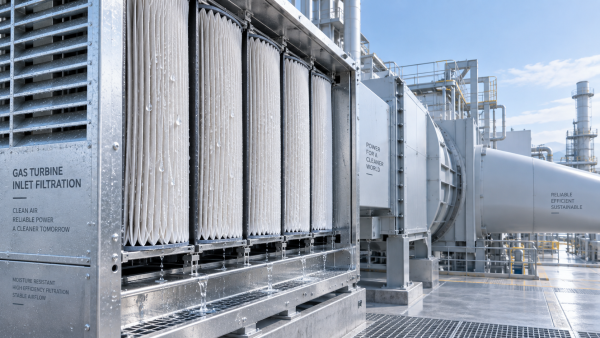
For a turbine operating near the coast, the final filter media is important, but it should not be asked to solve every exposure condition by itself. Large droplets, rain, and entrained mist need to be controlled by the inlet design, weather protection, and, where appropriate, a moisture-separation stage. Final filtration media performs best when it receives air that is already protected from bulk water.
This distinction matters because a filter can show strong dry particle capture yet lose practical stability when repeatedly wetted. Moisture can increase resistance, encourage dust consolidation, alter pleat spacing, and place stress on media-to-frame and media-to-media bonds. In severe exposure, water bypass around damaged seals or poorly designed drainage can be more harmful than the nominal media efficiency.
For the final stage, evaluators should look for a media construction that is suitable for humid operation and compatible with the intended filter geometry. Fully synthetic, wet-laid nonwoven structures are often considered where moisture tolerance, controlled pore structure, and mechanical durability are required. The actual suitability still depends on basis weight, fiber design, surface treatment, support layers, pleat configuration, and the operating pressure range. “Synthetic” alone is not a complete selection criterion.
Do not confuse water resistance with salt aerosol control
A hydrophobic or water-repellent treatment can help reduce wetting, but it does not automatically establish effective control of fine salt aerosol. Salt capture depends on the filtration efficiency of the completed filter, the particle-size behavior of the media, air velocity, leaks, and the condition of seals. Conversely, a highly efficient filter without adequate wet durability may create a short service cycle under fog, mist, or condensation.
The practical requirement is a balance: enough fine-particle capture to reduce contaminant passage, enough resistance to wet loading to keep airflow stable, and enough structural integrity to maintain performance through handling and operation.
Pressure drop must be evaluated as a loading curve
Initial pressure drop is useful, but it is not the operating cost. A media option with very low initial resistance may have limited depth loading or may form a dense cake rapidly under fine dust. Another option may begin with moderately higher resistance but maintain a more gradual increase because its fiber structure uses more of the media depth.
For high dust loads, ask suppliers to discuss how the media is expected to behave as it loads, not just its clean-state airflow resistance. The answer should address dust-holding behavior under the particles relevant to the site and the intended face velocity. The same media can perform very differently when installed in a compact, high-velocity panel than in a larger-area, deeply pleated element.
A common error is to use an efficiency increase as the default answer to corrosion concern. Higher efficiency can be justified, particularly where fine salt aerosol is a credible threat. But if it is added without reviewing filter area, prefiltration, moisture control, and replacement strategy, the result can be excessive resistance and frequent changes. The better decision is often to improve the staged system rather than force the final-stage media to carry a heavy coarse dust burden.
Choose the media architecture with the finished filter in mind
Filter media is not used as a flat laboratory sheet. It is pleated, bonded, sealed, supported, transported, installed, and exposed to changing airflow. Those conversion steps can determine whether the designed performance survives in the field.
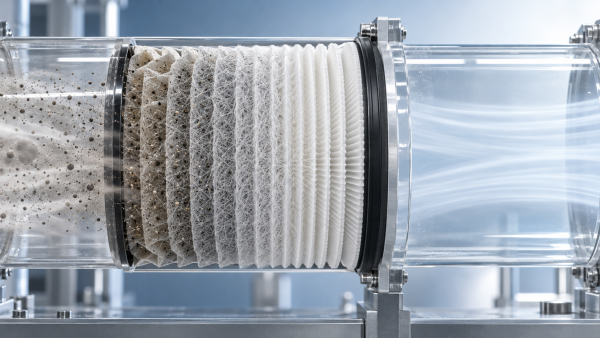
For high dust loads, deep pleating and adequate spacing help preserve active surface area. If pleats crowd together after loading or wet exposure, air passages narrow and resistance rises quickly. Support layers must provide stability without blocking too much air or creating local stress points. The adhesive and lamination method also matter because delamination, brittle bonds, or poor compatibility with moisture can shorten the useful life of an otherwise suitable filtration layer.
Material developers with wet-laid synthetic production and multiple lamination platforms can be useful partners during this stage because the filtration layer, backing, support, and bonding approach may need to be matched rather than specified independently. Hangzhou Chaocai Materials Co., Ltd. develops advanced filtration materials using fully synthetic wet-laid lines alongside PUR, hot-melt, solvent-based emulsion spray, and ultrasonic lamination capabilities. For an intake-filter evaluation, that type of manufacturing scope is relevant when the requirement involves a durable composite media structure rather than a single unsupported sheet.
The evaluation should remain application-led. A laminated construction may improve handling or stability in one filter design, while adding unnecessary resistance or stiffness in another. Request a construction discussion based on the final element, expected pleat geometry, operating humidity, and mechanical loading.
Separate dry-dust problems from wet-dust problems
Dry dust usually rewards media with useful depth-loading capacity and an upstream stage that removes larger debris before it reaches the final filter. Wet dust is different. Once moisture is present, particles can agglomerate and adhere to the surface, turning a normally gradual loading process into rapid face loading. Salt makes this more problematic because deposited material can retain moisture.
Where fog, frequent rain, washdown exposure, or condensation is likely, inspect the intake housing as carefully as the media specification. Poor drainage, bypass around filter doors, damaged gaskets, and unprotected filter changes can defeat a carefully selected media. The system should direct bulk water away from the filters and prevent collected water from being re-entrained into the airflow.
For sites with alternating dry dust storms and humid marine periods, a staged arrangement generally offers more control than a single high-duty filter. A replaceable coarse stage can handle visible debris and large dust, while a final stage is selected for finer contaminants and stable operation. The exact staging approach must fit available space and acceptable resistance, but the principle is consistent: protect the final media from the loading it is least efficient at handling.
A practical selection sequence
- Map the exposure. Identify salt, moisture, particle source, and event-driven loading rather than using a generic “coastal” label.
- Review the inlet hardware. Confirm weather protection, drainage, sealing, and whether droplets can reach the filtration stages.
- Set the performance priority. Decide whether the dominant risk is compressor contamination, rapid dust loading, water exposure, restricted airflow, or a combination.
- Define the staged filter role. Assign coarse debris removal, moisture management, and fine-particle control to appropriate parts of the system.
- Compare media in the intended element design. Consider pleat depth, support, bonding, face velocity, and loaded resistance, not only flat-sheet properties.
- Plan the service decision. Use pressure-drop monitoring and site-condition observations to establish change criteria that reflect actual loading behavior.
The last step is often undervalued. A fixed calendar replacement interval can discard useful filters too early in mild conditions and leave them in service too long after unusual dust or salt events. Differential pressure trends, visual inspection of upstream stages, and records of weather-driven loading give a more defensible maintenance basis.
Questions that should be resolved before approval
Before approving a Gas Turbine Intake Filter Media specification, the evaluator should be able to answer a few direct questions: Can the inlet prevent bulk water from reaching the final filter? Is the chosen efficiency appropriate for fine salt and dust without creating an unacceptable resistance penalty? Will the media remain structurally stable when humid or wet? Does the element geometry provide enough area for the expected dust load? Are the support and bonding materials compatible with the operating environment?
If those answers are unclear, the specification is not yet complete. Coastal high-dust service is not solved by selecting the most restrictive filter available. It is solved by matching media structure, filtration stages, inlet protection, and maintenance practice to the actual contaminants the turbine will see.
Recommendation
 Oct 10, 2026
How Can Air Filter Media Increase Dust Holding Capacity Without Higher Pressure Drop?
Which liquid filter media is suitable for hydraulic oil fine-particle filtration? Discover how advanced air filter media increases dust holding capacity with low pressure drop.- Oct 10, 2026
Which Liquid Filter Media Is Suitable for Fine Hydraulic Oil Filtration?
Can synthetic filter media replace glass fiber in high-humidity gas turbine intakes? Explore media choices for fine hydraulic oil filtration, balancing efficiency, moisture resistance, pressure drop, and service life. - Oct 10, 2026
Can Synthetic Filter Media Replace Glass Fiber in Humid Turbine Intakes?
Is ePTFE filter media suitable for pulse-cleaned construction equipment air filters? Explore synthetic vs. glass fiber performance in humid turbine intakes.