Can High Performance Filter Media Lower Energy Use Without Sacrificing Particle Capture?
The energy-saving claim is credible, but only under the right operating conditions
High Performance Filter Media can reduce energy use without giving up particle capture, but the result is not automatic. The balance depends on how the media behaves at the required airflow, throughout its dust-loading life, and inside the actual filter design. A low initial pressure drop looks attractive on a datasheet; a low total energy cost requires that the media also maintains acceptable resistance, efficiency, and structural stability after installation.
For manufacturing facilities, cleanrooms, turbine air-intake systems, automotive production lines, semiconductor processes, and other controlled environments, fan energy can be a meaningful operating cost. Filters sit directly in the air path, so every unnecessary unit of resistance demands more work from fans or blowers. At the same time, reducing resistance by simply making a filter more open can create a different problem: lower capture efficiency, faster downstream contamination, or a shorter usable filter life.
The practical purchasing question is therefore not whether a filter medium has a low pressure drop. It is whether it delivers the required particle capture at the system's real face velocity and does so with a stable pressure-drop curve over the planned replacement interval.
Why lower resistance can reduce energy demand
Air-moving equipment consumes energy to overcome system resistance. Filters are only one part of that system, alongside ductwork, coils, dampers, housings, and process equipment, but they are a controllable part. When a filter medium creates less pressure drop at a given flow rate, the fan generally requires less power to maintain that flow. In variable-air-volume systems, the relationship may be affected by control settings, but resistance still influences how hard the system must work.
The most important distinction is between initial resistance and operating resistance. A medium may begin with a very low pressure drop yet load rapidly, producing a steep rise in resistance. Another medium may start slightly higher but accept dust more evenly and remain within the operating range longer. In many industrial applications, the second option can be the lower-energy choice over the full service cycle.
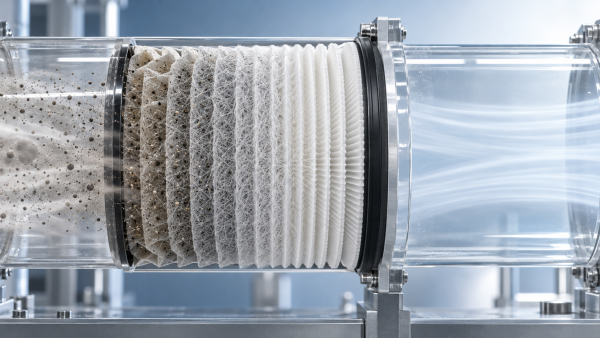
High performance media often pursues this balance through fiber selection, fiber diameter distribution, web formation, pore structure, surface treatments, electrostatic effects where appropriate, and multilayer construction. These design choices can improve the available filtration area or create a more controlled path for airborne particles. The objective is to capture particles efficiently while avoiding an unnecessarily restrictive air path.
That objective should be evaluated at the filter level, not only at the media-roll level. Pleat geometry, media area, pack depth, adhesive placement, support layers, frame sealing, and housing bypass can all change the final result. A capable substrate can lose much of its advantage when the filter pack is poorly designed or when the installation allows air to bypass the media.
Particle capture and airflow are not a simple trade-off
It is tempting to assume that higher efficiency always means higher energy use. The relationship is real, but it is not linear and it is not fixed. Media engineering can shift the balance by creating more effective capture mechanisms without proportionally increasing airflow resistance.
Particle capture may occur through interception, impaction, diffusion, and, in certain constructions, electrostatic attraction. Larger particles are more likely to be captured when their movement carries them into fibers. Very fine particles can be captured through diffusion as their irregular motion increases the chance of contact with fibers. The difficult size range often lies between those extremes, where a filter must be sufficiently efficient without becoming overly dense.
A purchaser should be cautious when a supplier presents efficiency as a standalone number. The useful question is: efficiency against which particle size distribution, at what face velocity, and after what conditioning or loading state? A rating that performs well in one air-cleaning duty may not predict behavior in a high-flow industrial intake, a humid process environment, or a system exposed to oily aerosol.
Equally, low pressure drop should be tied to a defined airflow condition. Pressure drop rises as velocity rises, and a medium that works efficiently in a generously sized filter may become restrictive in a compact unit with insufficient area. System designers can sometimes preserve both efficiency and energy performance by increasing media area, adjusting pleat spacing, or selecting a deeper filter configuration. Those changes may add initial cost or require more housing depth, but they can improve lifecycle economics.
Lifecycle pressure drop matters more than the opening reading
For a procurement team comparing options, the initial pressure-drop figure is a starting point rather than a decision. The more informative comparison follows the filter through its usable life. Ask how the media captures and retains dust, whether loading remains distributed across the filter pack, and how rapidly resistance rises under representative contaminants.
Surface-loading media may collect much of the contaminant near the upstream face. This can be beneficial where dust release during changeout must be controlled, or where the contaminant should not penetrate deeply into the structure. However, rapid cake formation can also increase resistance quickly. Depth-loading structures may accommodate particles within the media volume and potentially offer greater dust-holding capacity, but their suitability depends on particle type, airflow, moisture, and the need for clean downstream air.
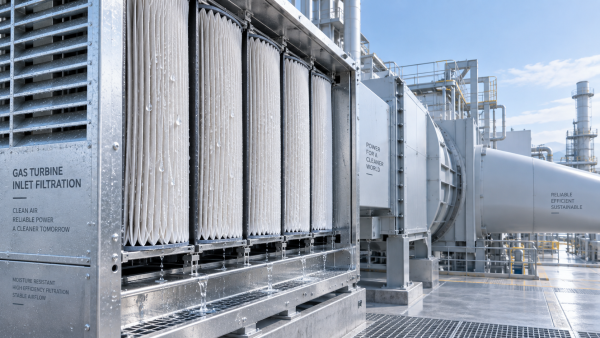
There is no universal preference between surface and depth loading. Fine, dry, relatively uniform dust behaves differently from fibrous debris, sticky particles, oil mist, moisture-laden air, or intermittent high-dust events. A gas turbine intake, for example, may require a different loading profile and water resistance than a filter used to protect sensitive production equipment. Semiconductor and biopharmaceutical air-handling duties may place greater emphasis on stable fine-particle control, cleanliness of construction, and controlled replacement practices.
Replacement thresholds also influence the financial outcome. If filters are changed too early, available service life is discarded. If they are left in service too long, fan energy rises and airflow may fall below process requirements. The best replacement point is linked to the system's permitted pressure drop, energy cost, airflow demand, contamination risk, labor access, and disposal burden. It should not be determined solely by calendar intervals.
What purchasers should compare before approving a media change
When evaluating High Performance Filter Media, buyers should ask suppliers and filter converters for information that connects material performance to the final application. This is especially important when an existing filter is being replaced with a lower-resistance alternative. A change that appears equivalent in nominal efficiency may behave differently once exposed to actual airflow, contaminants, temperature, and humidity.
- Efficiency at relevant conditions: Request particle-capture performance at the intended face velocity and, where relevant, after conditioning or loading. A broad efficiency claim without the test context offers limited purchasing value.
- Initial and final pressure-drop behavior: Compare more than the starting resistance. Understand the expected loading curve and the specified or recommended final pressure drop for the application.
- Dust-holding behavior: Ask how the media is expected to load with the dominant contaminant. Fine mineral dust, combustion by-products, fibers, salt, oil aerosols, and moisture can produce very different results.
- Mechanical integrity: Confirm tensile properties, stiffness, pleatability, resistance to tearing, and compatibility with support layers and adhesives. Filter failure caused by media deformation or pleat collapse can eliminate any energy benefit.
- Environmental compatibility: Consider temperature, humidity, chemical exposure, hydrolysis risk, water resistance, and possible microbial-control requirements where the application demands them.
- Manufacturing consistency: For volume programs, assess lot-to-lot control, basis-weight consistency, thickness variation, roll handling, and the supplier's ability to support validated converting conditions.
For filter manufacturers, converting compatibility deserves close attention. A media selection may look strong in laboratory measurements but introduce difficulties during pleating, lamination, curing, ultrasonic bonding, or final assembly. Excessive variation in stiffness, coating behavior, or surface energy can affect production yield. The cost of scrap, rework, line adjustment, or inconsistent finished-filter performance can exceed the value of a modest reduction in media price.
Where energy savings can disappear
Several common assumptions can lead to disappointing results. One is treating nominal airflow as fixed when the system actually operates across a wide range. At low flow, most media may appear acceptable; at peak flow, pressure drop and capture behavior can change enough to alter the selection. Another is sizing the filter only for clean conditions. A filter that meets airflow requirements when new may push the fan toward its limit after loading.
Bypass is another overlooked loss point. If the gasket, frame, housing, or filter pack seal is inadequate, some air avoids the intended filtration path. The system may show a favorable pressure drop while downstream particle control worsens. Lower resistance in that situation is not a measure of better media performance. It is a sign that the air is not being filtered as intended.
Electrostatic enhancement also requires careful interpretation. It can improve initial fine-particle capture with relatively low resistance, but performance may be influenced by humidity, aerosols, particle characteristics, and the operating environment. Buyers should understand whether the required efficiency depends substantially on an electrostatic charge and whether the relevant test method reflects the service conditions.
Finally, energy savings should not be isolated from equipment protection. In automotive paint environments, precision production areas, turbine installations, and high-value process air systems, insufficient particle capture can increase cleaning, defect, maintenance, or downtime risk. The least restrictive filter is not necessarily the least expensive option when downstream consequences are included.
A more useful way to calculate value
The procurement case should combine filter cost with operating cost and risk cost. A practical comparison includes the purchase price of the finished filter, expected fan-energy effect, anticipated service interval, number of changeouts, labor and access requirements, disposal, production interruption, and the financial exposure associated with inadequate air cleanliness or equipment fouling.
This does not require a perfect forecast. It requires a consistent comparison across options. Use the same airflow profile, expected operating hours, replacement threshold, and contamination assumptions for each candidate. Where site conditions are uncertain, it is often more defensible to assess a small number of operating scenarios rather than relying on a single optimistic estimate.
Start with the system, then specify the media
A sound specification begins with the air system's job: protect equipment, maintain process cleanliness, control emissions, preserve product quality, or meet a defined environmental requirement. From there, define the required airflow, allowable resistance range, particle-control target, anticipated contaminant, operating temperature and humidity, space envelope, and service strategy.
Only then is it possible to judge whether a lower-resistance medium is genuinely an upgrade. Advanced wet-laid synthetic structures, laminated composites, and application-specific filtration materials can provide useful design options where conventional media cannot balance efficiency, durability, and converting needs. Their value lies in matching material architecture to the filter duty, rather than treating “high performance” as a universal grade.
The answer to the original question is therefore qualified but clear: high-performance filter media can lower energy use without sacrificing particle capture when it is selected around full-life pressure drop, verified capture performance, contaminant behavior, and finished-filter design. A procurement decision based only on initial efficiency or initial resistance leaves too much of the operating result to chance.
Recommendation
 Oct 10, 2026
How Can Air Filter Media Increase Dust Holding Capacity Without Higher Pressure Drop?
Which liquid filter media is suitable for hydraulic oil fine-particle filtration? Discover how advanced air filter media increases dust holding capacity with low pressure drop.- Oct 10, 2026
Which Liquid Filter Media Is Suitable for Fine Hydraulic Oil Filtration?
Can synthetic filter media replace glass fiber in high-humidity gas turbine intakes? Explore media choices for fine hydraulic oil filtration, balancing efficiency, moisture resistance, pressure drop, and service life. - Oct 10, 2026
Can Synthetic Filter Media Replace Glass Fiber in Humid Turbine Intakes?
Is ePTFE filter media suitable for pulse-cleaned construction equipment air filters? Explore synthetic vs. glass fiber performance in humid turbine intakes.