



Synthetic Filter Media vs. Cellulose: Which Fits High-Humidity Air Filtration?
For high-humidity air filtration, fully synthetic media is usually the safer starting point when the filter must retain its geometry, maintain predictable pressure drop, and tolerate repeated exposure to moisture. Cellulose can still be appropriate in controlled, intermittent, or cost-sensitive applications, but it requires tighter control of water exposure, condensate carryover, and service conditions.
The decision should not be reduced to a simple “synthetic is better” conclusion. A cellulose-based medium may deliver strong initial particulate efficiency and can be economical in dry service. Yet humidity changes the selection criteria. Once moisture is present for extended periods, the filter medium is no longer judged only by particle capture. Wet strength, dimensional stability, bonding durability, microbial susceptibility, pleat integrity, and recovery after drying all become part of the filtration performance.
For technical evaluators, the practical question is this: will the air stream remain below the moisture threshold at which cellulose begins to lose stable mechanical behavior, or must the filter continue operating through condensation, high relative humidity, washdown-adjacent conditions, weather exposure, or cyclic wet-dry service? That answer usually determines which material family deserves priority.
Why humidity changes the filtration decision
Humidity does not affect every filter medium in the same way. Cellulose fibers are hydrophilic. They absorb moisture from the surrounding air and, under more severe conditions, can take up liquid water. This absorption can alter fiber bonding, increase media mass, reduce stiffness, and create localized swelling. In pleated elements, these changes can affect pleat spacing and support behavior before a visible failure occurs.
Synthetic fibers used in air filtration, such as polyester or polypropylene-based constructions, are generally less moisture-absorbing. Their behavior depends on polymer selection, fiber diameter, binder system, web formation, and downstream lamination, but they usually show better resistance to moisture-driven swelling. This gives synthetic media an advantage where filter geometry must remain stable through changing inlet conditions.
That distinction matters because filtration systems are designed around airflow and resistance. A medium that softens or distorts when wet may not fail immediately, yet it can change how air distributes across the filter. Some pleats may close, some areas may receive excessive flow, and local pressure drop may rise. The result can be earlier changeout, uneven dust loading, reduced usable surface area, or downstream exposure if the media or its seal system is compromised.
Cellulose: effective in dry service, vulnerable in wet operating conditions
Cellulose remains widely used for good reasons. It can provide efficient particle capture, a familiar processing route, and an attractive cost position. In applications where inlet air is dry, condensation is prevented, and filter replacement intervals are short or well controlled, cellulose-based media may be entirely suitable.
High humidity narrows that operating window. Relative humidity alone is not always the decisive factor; the more serious condition is liquid water formation. Condensation can occur when warm humid air contacts colder filter housings, duct surfaces, or media. Water carryover from cooling coils, humidification equipment, compressor systems, or poorly drained intake sections can produce a much more severe exposure than humid air alone.
When cellulose gets wet, several risks can develop together:
- Fiber swelling can alter pore structure and airflow resistance.
- Reduced wet strength can make the sheet more vulnerable to tearing, rupture, or pleat deformation under differential pressure.
- Water can weaken some resin or adhesive systems used in composite constructions.
- Trapped moisture and accumulated organic dust can create conditions that are less favorable for hygiene-sensitive systems.
- Repeated humidification and drying can progressively degrade the medium even when no single wetting event appears catastrophic.
These risks vary substantially between media grades. A treated cellulose medium with a suitable wet-strength chemistry and adequate downstream support may perform well in moderately humid service. A basic paper-like medium without robust wet-strength design is a different proposition. Evaluators should therefore avoid treating “cellulose” as one uniform material class.
Another common mistake is to judge cellulose only by its initial laboratory performance. Initial efficiency and initial pressure drop do not show how the medium behaves after moisture exposure, dust loading, drying, or a rise in differential pressure. In demanding air systems, retained performance after environmental cycling is more relevant than a single dry-condition test point.
Where synthetic media has a practical advantage
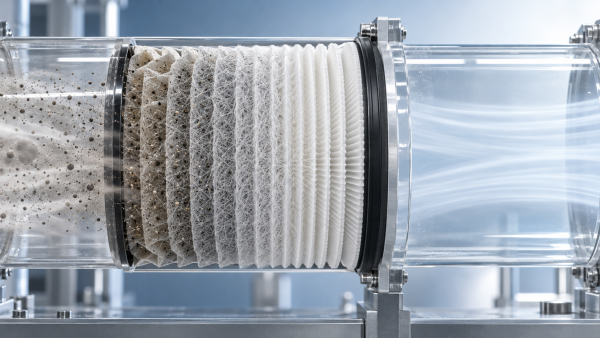
Synthetic Filter Media is often selected for environments where moisture exposure is foreseeable rather than exceptional. The advantage is primarily mechanical and environmental stability. A well-designed synthetic web is less likely to absorb water, swell substantially, or lose its basic fiber structure due to humidity. This supports more consistent pleat geometry and airflow distribution.
For high-humidity filtration, however, “synthetic” still does not automatically mean fit for purpose. Media construction matters. A thin synthetic layer may need reinforcement to withstand pulse cleaning, airflow cycling, or high differential pressure. A multilayer medium may combine a fine filtration layer with a coarser support layer, and each layer must remain bonded when humidity and temperature change. If lamination is used, the adhesive system can be as important as the filtration layer itself.
In many applications, synthetic media is particularly compelling when one or more of the following conditions applies:
- The intake system operates outdoors and is exposed to rain, fog, coastal moisture, or large day-night temperature swings.
- Condensate may form upstream or within the filter housing.
- The filtration stage is installed near cooling coils, humidifiers, wet scrubbers, or process exhaust conditioning equipment.
- Long service life is required and the media cannot be replaced immediately after a moisture event.
- Filter deformation would threaten a sensitive downstream process, such as precision equipment, clean manufacturing areas, battery-related production, or protected rotating machinery.
- The element must tolerate repeated humid-dry cycles rather than one short humid period.
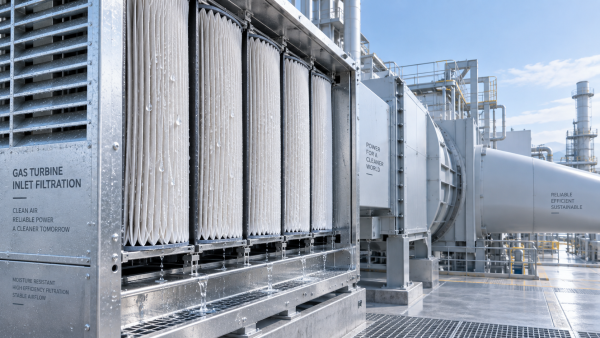
For gas turbine and heavy-duty intake systems, moisture resistance can be closely tied to operational reliability. A filter medium that remains dimensionally stable helps the system preserve intended airflow under weather-driven changes. For automotive, electronics, biopharmaceutical, and other controlled-process applications, the concern may be less about outdoor weather and more about condensate, washdown-adjacent exposure, or maintaining predictable filter behavior near conditioned air systems.
Efficiency ratings do not settle the comparison
Two media samples can show similar initial efficiency under dry test conditions and still produce very different results in humid operation. Technical evaluation should separate particle-capture performance from durability under use conditions.
A high-efficiency cellulose medium may appear attractive on paper, especially when its initial pressure drop is competitive. Yet if it retains moisture, the apparent advantage can be offset by changes in resistance, loading behavior, or mechanical stability. Conversely, a synthetic medium with stable wet performance may have a different initial efficiency-pressure-drop balance but offer a more predictable operating profile over its service interval.
The useful comparison is therefore not “which medium has the highest efficiency?” It is “which medium delivers the required efficiency while staying structurally stable in the expected humidity, dust, airflow, and maintenance environment?” That is a system question, not just a media question.
Evaluators should also distinguish between humidity resistance and water repellency. A water-repellent surface treatment may reduce wetting, but it does not automatically guarantee wet strength, durable pleat spacing, or bond integrity. Likewise, a hydrophobic fiber base may still be paired with an unsuitable adhesive, backing, frame seal, or support layer. The filter element must be assessed as an assembled construction.
Assess the failure mode before selecting the media
High humidity is often used as a broad description for several very different operating problems. The most effective specification begins by identifying the actual moisture mechanism.
If the system sees high relative humidity but no condensation, the evaluation should focus on long-term dimensional stability, resistance drift, and cyclic exposure. If visible water droplets or condensate reach the filter, wet burst strength, drainage behavior, pleat support, and water-related loading become more important. If the filter is exposed to oily mist, salt aerosols, chemical vapors, or process moisture, compatibility with those contaminants must be reviewed separately; moisture resistance alone is insufficient.
Consider the following questions during technical evaluation:
- Can the inlet temperature fall below the dew point at or near the filter stage?
- Is there an upstream coalescer, louver, moisture separator, or drainage section, and how effective is it under peak flow?
- Will the filter be exposed to fog, rain entrainment, coil carryover, humidification spray, or cleaning-related moisture?
- What is the maximum expected differential pressure, including a loaded or partially wetted condition?
- Does the filter need to retain shape after a wet-dry cycle, or is immediate replacement permitted following wetting?
- Are there hygiene, corrosion, odor, or downstream contamination concerns if moisture remains in the element?
- Which components besides the media can limit performance: adhesive, backing, frame, gasket, potting compound, or pleat separator?
These questions often reveal that the right answer is not simply to upgrade the media. In some systems, the more important correction is preventing free water from reaching the final filter. Better drainage, a properly designed pre-separation stage, corrected coil operation, or improved housing sealing can protect any downstream medium and extend service life.
How to compare candidate media samples
When suppliers present synthetic and cellulose options, request comparison data that reflects the expected environment rather than relying only on catalog values. The evaluation should include dry-condition efficiency and pressure drop, but it should also examine what remains after humidity exposure or wet-dry cycling. The exact test method should match the application and internal qualification requirements.
Useful evidence can include visual inspection for warping or delamination, dimensional change after conditioning, change in pressure drop, tensile or burst performance after moisture exposure, and pleat stability in the intended element geometry. For laminated materials, inspect the interface between layers after conditioning. Delamination may not appear in a flat-sheet sample but can emerge once the material is pleated, bonded, and subjected to airflow.
Sample preparation matters. A media supplier may provide a flat laboratory specimen, while the actual filter uses pleating, curing, adhesive beads, wire support, or a multilayer laminate. If humidity resistance is central to the application, qualification should move beyond flat-media data and include a representative element or at least a representative pleat pack.
It is also sensible to ask how material variability is controlled. Fiber distribution, basis weight, pore structure, binder application, and lamination consistency affect both filtration performance and mechanical response. For engineered synthetic materials, wet-laid formation and appropriate lamination methods can support controlled multilayer construction, but the desired design depends on the filtration duty rather than on manufacturing complexity alone.
When cellulose may still be the right choice
Cellulose should not be excluded merely because the site is described as humid. If the filter is housed indoors, condensation is controlled, airborne water is absent, exposure is brief, and replacement is routine, cellulose may meet the technical requirement at a reasonable cost. It can also remain suitable in multi-stage systems where upstream components reliably remove water and coarse contaminants before the final filter.
The decision becomes less favorable when humidity is paired with uncertain operations. Seasonal weather changes, intermittent shutdowns, variable airflow, inadequate drainage, poorly controlled cooling sections, or inaccessible filter locations all increase the value of a more moisture-tolerant medium. In these cases, the cost of an early filter failure can exceed the price difference between material options.
A practical specification should state the moisture condition explicitly. Terms such as “high humidity resistant” are too vague on their own. The requirement should identify whether the filter must withstand elevated relative humidity, intermittent condensation, direct water contact, repeated wet-dry cycling, or a defined combination of moisture and differential pressure. That gives suppliers a basis for proposing a construction that can be evaluated rather than a generic material claim.
Selection should follow operating risk, not material labels
For consistently humid or condensation-prone air streams, synthetic media is generally the more defensible choice because it offers a stronger foundation for moisture stability. The specification should still verify the full construction: filtration layer, support structure, lamination or binder system, pleat design, and sealing components.
Cellulose remains viable where air management is reliable and the medium will stay dry in service. Its use becomes a risk decision when water exposure is possible, especially where filter collapse, resistance increase, contamination, or unplanned maintenance would have significant operational consequences.
The most useful next step is to define the real moisture exposure at the filter face and assess candidate elements after environmental conditioning, not only under dry initial conditions. That approach turns the synthetic-versus-cellulose question into a decision based on expected service behavior, which is where high-humidity filtration performance is ultimately decided.
Recommendation
 Oct 10, 2026
How Can Air Filter Media Increase Dust Holding Capacity Without Higher Pressure Drop?
Which liquid filter media is suitable for hydraulic oil fine-particle filtration? Discover how advanced air filter media increases dust holding capacity with low pressure drop.- Oct 10, 2026
Which Liquid Filter Media Is Suitable for Fine Hydraulic Oil Filtration?
Can synthetic filter media replace glass fiber in high-humidity gas turbine intakes? Explore media choices for fine hydraulic oil filtration, balancing efficiency, moisture resistance, pressure drop, and service life. - Oct 10, 2026
Can Synthetic Filter Media Replace Glass Fiber in Humid Turbine Intakes?
Is ePTFE filter media suitable for pulse-cleaned construction equipment air filters? Explore synthetic vs. glass fiber performance in humid turbine intakes.