




How Can Air Filter Media Hold More Dust Without Increasing Pressure Drop?
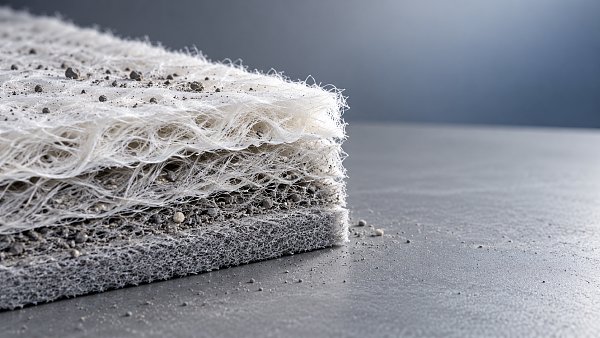
Air filter media can hold more dust without a substantial increase in pressure drop when its fibers, pore structure, and layers allow particles to accumulate through the depth of the material rather than forming a dense surface cake too early. The aim is not to eliminate resistance: every filter creates some pressure drop, and loading normally increases it. The practical goal is to slow that increase while maintaining the required filtration efficiency.
For a filter manufacturer or equipment operator, the problem often appears as a familiar trade-off. A replacement medium starts with acceptable airflow, but resistance rises quickly after dust exposure; another lasts longer but does not capture the particles the application requires. The useful comparison is therefore not simply “more dust” or “lower pressure drop,” but how much specified test dust the finished filter holds before reaching an agreed final resistance.
Where does the extra dust-holding capacity come from?
A depth-loading structure distributes deposited particles across more of the available fiber network. Coarser upstream regions can capture larger particles while leaving downstream regions available for smaller particles. When that arrangement works as intended, the upstream face is less likely to become the only active collection surface.
Pore size distribution matters as much as average pore size. A medium dominated by very small passages may offer good capture, but those passages can constrict rapidly as dust accumulates. A very open structure can lower initial resistance, yet may allow unacceptable particle penetration or concentrate loading on a downstream fine layer. An effective design balances accessible void space with fibers capable of capturing the target particles.
Fiber diameter, shape, packing density, and the uniformity of the web all influence that balance. Finer fibers can provide more collection surface for a given amount of material, but a densely packed fine-fiber layer can also raise resistance. Coarser fibers can help create open passages and structural support, although a coarse layer alone may not deliver the required efficiency. Blending or arranging fibers is therefore a design decision, not a guarantee that every combination will outperform a simpler medium.
Does a thicker medium always hold more dust?
No. Greater thickness can provide additional collection volume, but it also lengthens the path air must travel. Adding material without controlling porosity or fiber distribution may increase the initial pressure drop enough to offset the benefit of extra capacity. Thickness can also change pleat geometry and reduce the amount of media that fits in a finished filter.
When comparing two designs, ask whether the added thickness is usable collection depth or merely extra densely packed material. A meaningful trial measures initial resistance, efficiency, and the loading curve at the same airflow. It should also check whether the material remains dimensionally stable during pleating and service; a thick web that compresses locally may lose the open structure it was intended to provide.
Can a layered filter achieve both low resistance and high capacity?
Layering can help, particularly when the dust stream contains a broad range of particle sizes. An open upstream layer may intercept larger particles and protect a finer downstream layer. The fine layer can then perform its capture function without receiving the entire coarse dust burden at its surface.
Layer sequence matters. Reversing a gradient structure may cause particles to collect on the densest face first, producing a faster rise in resistance. Mark the intended upstream side and confirm that assembly and installation instructions preserve that orientation. Not every laminated medium is directional, so the supplier should identify which face, if any, must meet the incoming air.
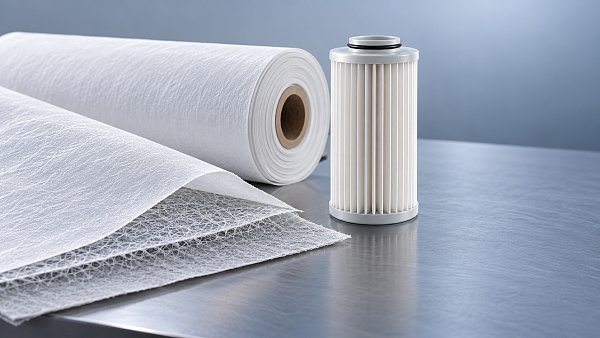
The joining process also deserves attention. Adhesive, heat, pressure, or bonding points can alter the open area at a layer interface. Excessive bonding can obstruct passages or compress a web; insufficient bonding can allow separation during pleating or operation. A laminate should be assessed as a complete structure, because the properties of its individual layers do not necessarily predict the behavior of the bonded medium.
What should be checked when pressure drop rises too quickly?
Start by separating a media problem from a filter-design or operating problem. Record the initial pressure drop of a clean filter and compare it with the value expected at the actual airflow. Then examine how quickly resistance rises during loading. A high starting value points to a different investigation from a normal starting value followed by rapid blockage.
- Verify airflow and measurement conditions. Compare readings at the same flow rate, with pressure taps positioned consistently. A change in fan operation, duct conditions, or measurement location can make two filters appear different even when their media are similar.
- Inspect the finished element. Uneven pleats, blocked pleat channels, adhesive intrusion, or damage can restrict flow. Check seals and bypass paths as well: leakage may make resistance appear lower while unfiltered air escapes the media.
- Review the dust challenge. Fine particles, fibrous material, moisture, and sticky contaminants can load the same medium differently. A dry laboratory dust result should not be treated as a direct prediction for an oily or humid application.
- Examine the loading pattern. Heavy deposits at the upstream surface may indicate early surface loading, but they can also reflect the dust characteristics or upstream conditions. Compare the deposit pattern with the medium’s intended orientation and construction before changing materials.
- Compare equivalent test results. Use the same test dust, flow, filter area, efficiency measurement, and final pressure-drop limit. Otherwise, a higher reported capacity may simply reflect a more permissive test condition.
Moisture deserves particular attention because it can change both the deposit and the medium. Damp dust may agglomerate, form a restrictive cake, or bridge pleats. Some media may also change shape or strength when wet. A dust-holding result obtained under dry conditions does not establish how the filter will perform after condensation or repeated humidity exposure.
How should dust-holding capacity be compared?
Dust-holding capacity is meaningful only with its endpoint. Ask for the mass of specified test dust captured when the filter reaches a defined final pressure drop, together with the initial pressure drop and the airflow used. The final limit should reflect the equipment’s allowable operating resistance rather than an arbitrary value selected to make capacity look larger.
Results reported per unit area of flat media are useful for screening materials, but the installed filter may behave differently. Pleat depth, spacing, pack density, frame restrictions, and airflow distribution affect the resistance of the complete element. Compare finished filters at the same face dimensions and flow whenever the purchasing decision concerns a complete filter rather than a roll of media.
Efficiency must remain part of the comparison throughout the loading test. Two candidates can reach the same final pressure drop with different captured dust masses because one lets more particles pass. Request efficiency data for the particle sizes relevant to the application, including any available information about changes during loading. A gain in apparent capacity is not useful if it comes from failing the required capture performance.
Would adding a prefilter solve the problem?
A prefilter can reduce the coarse dust reaching a finer downstream filter, but it adds its own resistance and maintenance requirement. It is most useful when the incoming contaminant includes a substantial removable coarse fraction and there is enough space to install and service the extra stage.
Assess the combined pressure drop of both stages, not just the extension of the final filter’s service interval. The prefilter also needs a replacement or cleaning criterion; once overloaded, it can restrict the entire system. For predominantly fine particles, a coarse prefilter may provide limited protection, so a media redesign or a larger effective filtration area may be more relevant.
Can pleating improve capacity without changing the media?
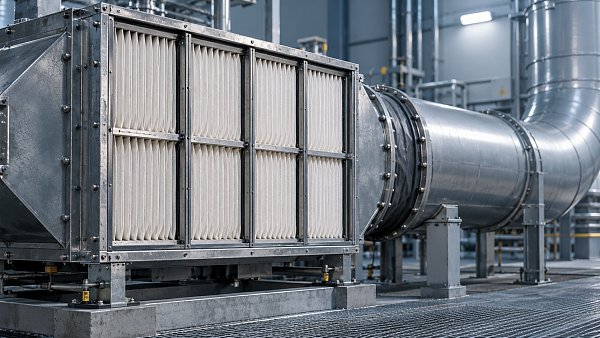
Pleating increases the media area that can be fitted into a given filter face, which can reduce the airflow velocity through each portion of the medium. Lower media velocity may reduce clean resistance and distribute loading over more area. However, packing in more pleats is not automatically better.
When pleats sit too close together, their channels can narrow or close as dust accumulates. The effective area becomes smaller than the geometric area, and resistance can rise sharply. Media stiffness, pleat depth, spacing, and support all influence whether the additional area remains accessible. Compare pleat designs in the finished element under the intended flow and loading conditions, rather than judging them solely by pleat count.
What production details can affect consistency?
Even a sound media design can vary if fiber distribution, basis weight, thickness, or bonding is inconsistent across the web. Local dense areas may increase resistance, while thin or poorly bonded areas can affect strength or filtration performance. For laminated structures, bond coverage and layer alignment are also relevant because they influence both handling and airflow.
Before approving a material for production, agree on which properties will be checked, the sampling approach, and the acceptable variation for the application. Include conversion trials where appropriate: cutting, pleating, and bonding can reveal issues that are not apparent from a flat-sheet measurement. Retain comparable records for the qualified material so later deliveries can be assessed against the same conditions.
Further questions about selection and supply
Does lower initial pressure drop mean a longer filter life?
Not necessarily. An open medium may start with low resistance but load rapidly if particles collect at a restrictive layer or bridge its pores. Filter life also depends on the permitted final resistance, dust composition, airflow, and required efficiency. Compare complete loading curves rather than choosing by the clean pressure-drop value alone.
Can electrostatic media provide capacity with less resistance?
Electrostatically charged fibers can enhance particle capture without relying solely on a tightly packed mechanical structure. That can be useful when low initial resistance is important. Charge-dependent performance may change with exposure to certain aerosols or operating conditions, however, so evaluate the relevant efficiency before and after conditioning or loading appropriate to the application. Do not assume that an initial efficiency rating describes the whole service period.
What information should be provided when requesting a lead time?
Searches such as “Ltd. filter media lead time” often reflect a need to coordinate material selection with production. A useful inquiry identifies the media construction or approved specification, width, roll dimensions, quantity, required delivery location, and whether the material is an existing grade or requires development. Ask separately about sample availability, qualification time, production lead time, and shipping; these are different stages and should not be treated as one fixed interval.
Can a substitute be approved using only a datasheet?
A datasheet can narrow the options, but matching nominal thickness, basis weight, or clean resistance does not establish equivalent loading behavior. Confirm efficiency, dust-loading performance, mechanical handling, and compatibility with the finished filter design. A substitution is especially consequential when the application has a strict pressure limit or particle-capture requirement, so the acceptance test and release criteria should be agreed before production quantities are ordered.
Recommendation
 Oct 30, 2026
How Can Air Filter Media Hold More Dust Without Increasing Pressure Drop?
Explore Ltd. filter media lead time and discover how depth loading, layered media, and pleat design can increase dust capacity while controlling pressure drop.- Oct 30, 2026
How to Evaluate an ePTFE Laminated Filter Media Supplier
Explore Ltd. moisture resistant media and learn how to evaluate ePTFE laminated filter suppliers for performance, consistency and long-term value. - Oct 30, 2026
Is F9 Filter Media Suitable for Gas Turbine Air Intakes?
Explore Ltd. custom filter media options for gas turbine air intakes, and learn how F9 performance, pressure drop, and site conditions guide your choice.