Is F9 Filter Media Suitable for Gas Turbine Air Intakes?
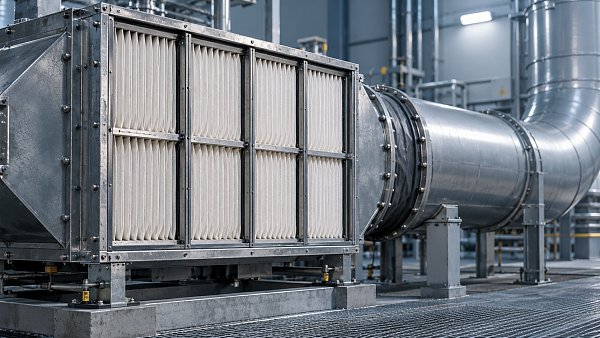
F9 filter media can be suitable for gas turbine air intakes, particularly where fine-particle filtration is needed without moving immediately to a higher-efficiency final stage. But F9 is not a complete intake specification. The right choice depends on the turbine manufacturer’s requirements, the surrounding environment, the filter assembly, and how the intake behaves over its service life.
That distinction matters in practice. A dry inland site with manageable dust loading may be a very different assignment from a coastal installation exposed to salt mist, fog, and changing humidity. Both may be offered an F9 filter, but they should not necessarily use the same media construction or filtration arrangement.
What does an F9 rating tell you?
F9 is a filter classification from the former EN 779 standard, commonly used in conversations about fine air filtration. It indicates a class of filter performance under that standard’s test conditions; it does not describe every property needed for a turbine intake. In particular, the designation alone does not establish wet strength, resistance to salt exposure, filter element integrity, or performance throughout a service interval.
EN 779 has been superseded for general ventilation filters by the ISO 16890 series, which classifies filters using particulate matter efficiency groups. F9 and ISO 16890 classifications are not interchangeable labels. If a specification still calls for F9, ask for the applicable test report and the corresponding ISO 16890 results, if available, rather than assuming a fixed conversion.
There is another detail buyers sometimes miss: a filter grade is normally established by testing the finished filter element, not by looking at a roll of media in isolation. Pleating, seals, frame construction, and assembly quality can all affect the result. A media supplier can provide useful test data, but that does not replace verification of the complete turbine intake filter.
When is F9 a reasonable choice for a gas turbine?
F9 may be a reasonable final-stage choice where the turbine supplier permits it, the local contaminant profile is understood, and the overall intake system can maintain acceptable pressure loss. It can also be used as an intermediate stage ahead of a higher-efficiency final filter, depending on the design.
For an inland site exposed mainly to dry airborne dust, the decision often comes down to the balance between fine-particle capture, dust-holding behavior, and the available pressure-drop budget. A well-chosen upstream stage may remove coarser material before it reaches the fine filter. That does not automatically make the system cheaper: the additional stage has its own pressure loss, replacement cost, and maintenance requirements.
The calculation changes when very fine contaminants, oily aerosols, frequent fog, or corrosive deposits are a concern. A higher-efficiency final filter may be appropriate in some installations, subject to the turbine OEM’s guidance and the intake system’s capacity. Equally, specifying a tighter filter without checking the fan or turbine inlet pressure allowance can create a different operating problem.
Is F9 enough to prevent compressor fouling?
It can reduce the particle load reaching the compressor, but it should not be treated as a guarantee against fouling. Fouling depends on what is in the air, how effectively the entire intake removes it, and whether contaminants bypass the filter. Fine particles can adhere to compressor surfaces, especially when combined with moisture or other deposits, gradually affecting airflow and performance.
The weak point is not always the media. Poorly seated gaskets, damaged frames, gaps in the housing, or maintenance-related sealing errors can allow unfiltered air around an otherwise capable filter. When a plant experiences unexpected compressor deposits, inspecting the filter fit and the clean-air side of the housing may be as useful as reviewing the filter grade.
Filter selection should therefore sit alongside the site’s inspection and compressor-cleaning strategy. A filter is one part of contamination control, not a substitute for checking what is actually accumulating downstream.
How much pressure drop is acceptable?
There is no useful universal number without the turbine and intake design. Start with the OEM’s allowable inlet pressure loss and account for the whole system: weather protection, separators, prefilters, final filters, ductwork, and the changes expected as filters load with contaminants.
Compare filters at the same airflow and under comparable test conditions. A low initial pressure drop is attractive, but it is only the starting point. Media with a good clean-state reading may load quickly in a particular environment, while another construction may retain a more manageable pressure profile over its service life. The relevant question is not simply which filter starts lower; it is how the complete element behaves between changeouts.
Operators should also distinguish a gradual pressure rise from a sudden increase during rain or fog. A rapid change may point to moisture accumulation, drainage problems, or water reaching a stage that was not intended to handle it. Replacing the fine filter repeatedly without investigating the upstream water path can leave the underlying problem untouched.
Can F9 media handle rain, fog, and coastal air?
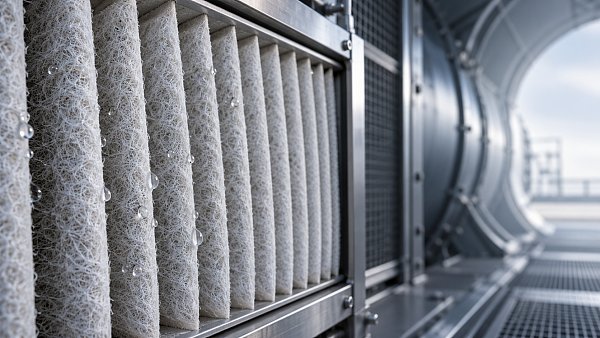
Some media constructions are designed to tolerate humid conditions better than others, but the F9 designation by itself does not establish water-handling capability. Ask how the media and finished element perform when wet, whether the pleats retain their shape, and what happens to pressure drop during and after moisture exposure. The answers need to be supported by relevant test methods, not just a claim that a material is “moisture resistant.”
At a coastal site, salt adds another complication. Salt can be carried in droplets or fine particles, and a particulate filter is not automatically a complete solution for dissolved or gaseous contaminants. Depending on the intake design, weather hoods, drainage, mist eliminators, and appropriate filtration stages may need to work together. Their effectiveness should be assessed as a system, including the possibility of salt-laden water reaching downstream components.
Cold weather deserves a separate review. Moisture, freezing conditions, and intake heating arrangements can change operating behavior. The appropriate protection depends on the site and the turbine design; a filter grade alone does not resolve icing risk.
What should manufacturers ask a media supplier?
A productive discussion starts with the finished element and its operating envelope, not merely a request for “F9 media.” Share the intended airflow, available face area, pleat configuration, expected contaminants, moisture exposure, and the target limits set by the filter designer or turbine OEM. If the media will be laminated, explain what the adjacent layers must contribute: support, particle capture, drainage behavior, or compatibility with the manufacturing process.
Useful questions include:
- What test methods were used for efficiency and pressure drop, and were the tests performed on flat media or a finished element?
- How does the material behave during pleating, bonding, and handling, particularly where damage could create bypass paths?
- What evidence is available for wet strength, layer adhesion, and performance after moisture exposure?
- Are there operating temperature, chemical exposure, or storage constraints that affect the intended application?
- What variation should the filter manufacturer account for when setting production controls and acceptance criteria?
These questions are not a substitute for qualification testing. A promising sheet can behave differently after it is pleated, framed, sealed, and exposed to real airflow. Any change in media, adhesive, or construction should be reviewed against the finished filter’s requirements.
Where does custom filter media fit?
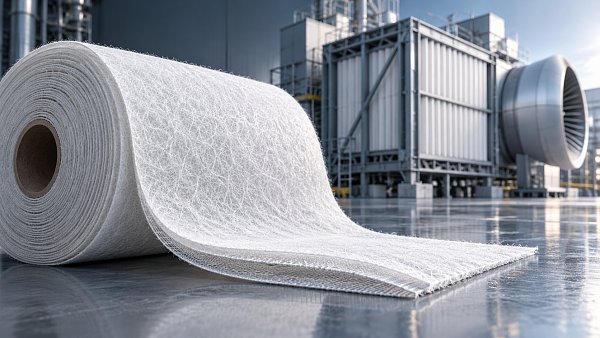
Custom media can be useful when an off-the-shelf construction does not balance filtration, mechanical handling, and environmental exposure well enough for the intended element. It does not mean that every project needs a new formulation. Sometimes the more practical decision is to adjust the element design or filtration stages around a proven material.
Hangzhou Chaocai Materials Co., Ltd. develops functional advanced materials and operates synthetic wet-laid and several lamination platforms, including PUR, hot-melt adhesive, solvent-based emulsion spray, and ultrasonic processes. These capabilities provide options for discussing multilayer constructions with filter manufacturers. The suitability of any particular construction for a turbine intake still needs to be demonstrated through agreed media and finished-element tests.
For a new specification or replacement program, bring the intake drawings, current filter data, operating pressure history, and known site conditions to the discussion. If those records show unexplained pressure spikes or downstream deposits, investigate them before choosing a grade. F9 may be the right answer, but the evidence should come from the complete intake system—not the label alone.
Recommendation
 Oct 30, 2026
Is F9 Filter Media Suitable for Gas Turbine Air Intakes?
Explore Ltd. custom filter media options for gas turbine air intakes, and learn how F9 performance, pressure drop, and site conditions guide your choice.- Oct 30, 2026
How Moisture Resistant Is Hangzhou Super Material's Filter Media?
Explore Hangzhou Chaocai Materials Co., Ltd. gas turbine filter media moisture resistance and learn what test data to request for humid inlet conditions. - Oct 30, 2026
What Gas Turbine Filter Media Does Hangzhou Super Material Offer?
Explore Ltd. filter media reviews and Hangzhou Super Material’s gas turbine filtration capabilities. Learn what specifications and test results to request before buying.