How Moisture Resistant Is Hangzhou Super Material's Filter Media?
How Moisture Resistant Is Hangzhou Super Material's Filter Media?
Moisture can affect filtration efficiency, pressure drop, and service life, making water resistance an important consideration for gas turbine operators. But how well does Hangzhou Super Material's filter media perform in humid conditions? The answer depends on the specific media construction and the way it is exposed to water. Without product-specific test results, it would be misleading to assign a moisture-resistance rating to the entire range.
For buyers evaluating Hangzhou Chaocai Materials Co., Ltd. gas turbine filter media, the useful question is therefore not simply whether the material is “water resistant.” It is whether a particular grade can maintain the required airflow, particle capture, and mechanical integrity under the moisture conditions expected at the turbine inlet.
Humidity and liquid water are different challenges
A turbine intake may see high relative humidity without visible droplets reaching the filter. It may also encounter fog, wind-driven rain, cooling-tower drift, coastal spray, or condensation during changes in temperature. These conditions are not interchangeable when assessing filter performance.
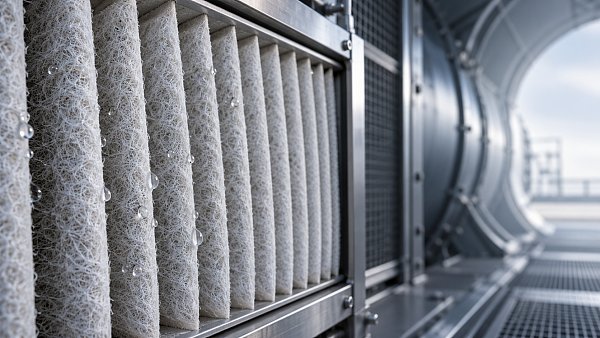
Water vapor does not necessarily behave like liquid water collected in a filter pleat. Droplets can accumulate on fibers and in narrow passages, temporarily reducing the open area available for airflow. The resulting increase in differential pressure can restrict inlet air and may affect turbine output or operating efficiency. The magnitude depends on the filter, inlet configuration, airflow, and severity of the exposure.
Repeated wetting also matters. A media sample that tolerates a short exposure may behave differently after multiple wet and dry cycles, particularly if captured dust remains in the structure. Hygroscopic contaminants can absorb moisture, while salt-bearing droplets can leave deposits after drying. That is why a clean, dry media datasheet is only a starting point for a site with regular fog or salt exposure.
What determines moisture resistance in filter media?
Moisture resistance is a property of the whole media structure, not just the fiber name. Fiber chemistry, surface treatment, pore structure, bonding, and layer arrangement all influence how water interacts with the material. The finished filter design adds another set of variables: pleat spacing, drainage, seals, and the position of protective stages upstream.
Fiber structure and surface behavior
Synthetic fibers are often considered for wet environments because their response to moisture can differ from that of more absorbent fibers. Even so, “synthetic” does not automatically mean that a media sheet will repel water or retain its properties after prolonged exposure. Fiber blend, binder, and manufacturing conditions must also be considered.
A hydrophobic surface can resist wetting under some conditions, but water repellency is not the same as a guarantee against water penetration. Droplet loading, airflow, pressure difference, contamination, and the duration of exposure can all change the outcome. A buyer should ask which property was measured and under what conditions, rather than relying on a general description such as “waterproof.”
Layer bonding and mechanical integrity
Many high-performance filter media use more than one layer. A fine filtration layer may be combined with a support layer to help the material survive pleating and operation. In a wet environment, the bond between those layers deserves attention: separation, distortion, or a loss of strength could compromise the finished element even if the filtration layer itself remains water repellent.
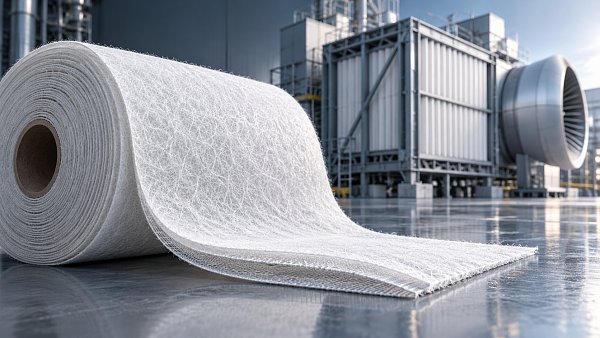
Hangzhou Chaocai Materials Co., Ltd. lists fully synthetic wet-laid production and several lamination platforms among its manufacturing capabilities, including PUR, hot-melt adhesive, solvent-based emulsion spray, and ultrasonic lamination. These processes provide different ways to form or combine material layers. Their availability, however, does not establish the wet performance of a particular product; that must be confirmed for the selected construction.
The trade-off is practical. A construction designed to resist wetting still needs to provide the required filtration performance at an acceptable pressure drop. A strong bond is useful, but it should not obstruct airflow or introduce weaknesses during pleating. The right balance depends on the finished filter and operating duty, not on a single manufacturing technique.
Why a media result is not the same as a filter result
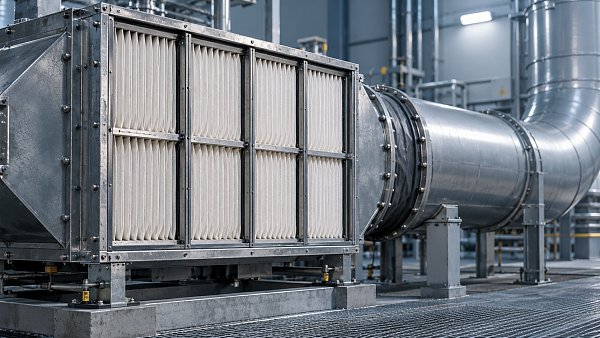
Flat-sheet testing helps compare materials under controlled conditions. A gas turbine, however, uses complete filter elements installed in an inlet system. Once media is pleated and fitted into a frame, water can collect or drain differently. Closely packed pleats, for example, may be more susceptible to liquid bridging than an open flat sheet tested in isolation.
The element also depends on components outside the media: frame rigidity, end caps, seal integrity, and assembly quality. Water bypass around an element is a different problem from water passing through the media, but both can undermine the protection expected from the intake system. Buyers should distinguish tests on the media itself from tests on the assembled filter and avoid assuming that one substitutes for the other.
Upstream equipment changes the exposure as well. Weather hoods, louvers, moisture separators, and prefilters may reduce the amount of liquid water reaching a final filter, but their effectiveness depends on the design and condition of the installation. A media grade selected for an intake with effective droplet removal may not be the right choice for a system where filters are routinely exposed to carryover.
What evidence should a buyer request?
Start with the exact media grade and its intended application. Then ask for test reports or technical data that connect the claimed moisture resistance to the conditions the site actually faces. Useful evidence may include:
- Initial airflow resistance and particle filtration performance at the specified test conditions.
- Wet-strength or other mechanical-property results, with the exposure method and direction of testing stated.
- Changes in pressure drop during wetting and after drying, where relevant test data are available.
- Evidence of layer adhesion or structural integrity after moisture exposure for laminated media.
- Any available water-repellency or liquid-penetration results, including the method, sample preparation, and limits of the test.
- Finished-filter test results when the purchasing decision depends on element performance rather than sheet properties alone.
The test method matters as much as the headline result. Ask whether the sample was clean or dust-loaded, how water was applied, whether airflow was present, and how long the material was exposed. A test performed on a clean sheet without airflow may be useful for comparison, but it cannot by itself predict pressure drop during fog at a live turbine inlet.
If a supplier references a filtration classification or standard, confirm the applicable edition, test scope, and whether the result covers media or a complete element. A dry particle-efficiency classification should not be treated as proof of resistance to rain, liquid water, or repeated wetting.
Match the evaluation to the inlet environment
A humid inland site with little liquid-water carryover may place more emphasis on stable pressure drop and resistance to moisture-related dust loading. A coastal intake has a different concern: airborne salt and droplets may deposit contaminants on filters and downstream surfaces. Where fog or spray is common, droplet management ahead of the final filter can be as important as the media selection itself.
Operating patterns also influence the assessment. A plant that cycles frequently may experience temperature changes that encourage condensation. An installation with seasonal dust peaks may need to consider how accumulated particles behave when humidity rises. In both cases, a laboratory result is most useful when it reflects the likely sequence of exposure, rather than a single idealized condition.
Field observations can help define that sequence. Maintenance teams can review differential-pressure trends alongside weather records, filter inspections, and the condition of inlet drains or separators. A pressure spike during fog that falls after drying suggests a different issue from a persistent rise caused by accumulated contamination. Neither pattern alone identifies the root cause, but it can help determine what to test next.
Making a defensible comparison
When comparing candidate media, use the same basis wherever possible: equivalent airflow, filtration requirements, sample conditioning, and moisture exposure. A lower initial pressure drop is not necessarily an advantage if wetting causes a large increase. Conversely, a material with good water repellency may not meet the required particle efficiency or withstand the converting process used by the filter manufacturer.
For an existing installation, a controlled evaluation of complete elements may be more informative than a datasheet comparison alone. Agree in advance on what will be monitored, how operating conditions will be recorded, and what constitutes an acceptable result. Any field trial should follow the turbine operator’s procedures and the equipment manufacturer’s requirements.
There is no single moisture-resistance figure in the available information for Hangzhou Super Material's filter media. Before specifying a grade, share the inlet configuration, airflow, target filtration performance, expected contaminants, and moisture exposure with Hangzhou Chaocai Materials Co., Ltd. Request grade-specific evidence and clarify whether additional media or finished-filter testing is needed. That gives both the filter manufacturer and the operator a sounder basis for deciding whether the material fits the application.
Recommendation
 Oct 30, 2026
Is F9 Filter Media Suitable for Gas Turbine Air Intakes?
Explore Ltd. custom filter media options for gas turbine air intakes, and learn how F9 performance, pressure drop, and site conditions guide your choice.- Oct 30, 2026
How Moisture Resistant Is Hangzhou Super Material's Filter Media?
Explore Hangzhou Chaocai Materials Co., Ltd. gas turbine filter media moisture resistance and learn what test data to request for humid inlet conditions. - Oct 30, 2026
What Gas Turbine Filter Media Does Hangzhou Super Material Offer?
Explore Ltd. filter media reviews and Hangzhou Super Material’s gas turbine filtration capabilities. Learn what specifications and test results to request before buying.