How Do You Qualify Alternatives to Glass Fiber Filter Media?
How Do You Qualify Alternatives to Glass Fiber Filter Media?
Replacing glass fiber filter media takes more than matching a datasheet. A viable alternative must deliver the required efficiency, pressure drop, durability, and air filter media batch consistency under real operating conditions. Qualification should connect material selection with application-specific testing, production controls, and supplier capability—not rely on headline performance alone.
The difficult part is rarely finding a synthetic sheet with attractive initial results. It is proving that the same material will survive pleating, bonding, transport, and service without creating a different failure mode. A replacement that performs well as a flat sheet can still disappoint as a finished filter.
Define what the replacement must preserve—and what it may change
Start with the reason for moving away from glass fiber. Is the concern handling damage, moisture exposure, converting yield, supply availability, or operating pressure drop? These lead to different material decisions. If the existing filter already meets its service requirements, changing fiber chemistry without identifying the actual problem makes qualification harder to justify.
Separate non-negotiable requirements from desirable improvements. Efficiency and integrity may be mandatory, while thickness or stiffness may be adjustable within the filter design. Conversely, an existing pleating line may impose a tight thickness window, making a bulkier synthetic medium unsuitable even if its filtration performance is promising.
Write the acceptance criteria before requesting samples. Include airflow, available media area, initial and terminal resistance, operating temperature, humidity, contaminant exposure, and expected service conditions. Record the current medium’s measured behavior, not just its nominal specification. That baseline is what makes a replacement decision defensible.
Choose a material architecture, not simply a fiber name
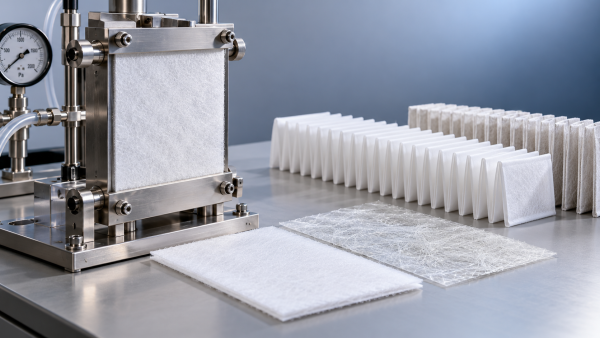
“Synthetic alternative” covers several constructions. Fully synthetic wet-laid media, mechanically filtering fine-fiber structures, electrostatically charged nonwovens, and multilayer composites do not achieve performance in the same way. Their limitations also differ.
A charged medium may offer an attractive efficiency-to-resistance balance, but its suitability depends on how charge behaves under the relevant conditioning and contaminant exposure. A fine-fiber layer may provide strong particle capture while requiring protection against abrasion during converting. A support layer can improve handling, yet add resistance or change pleat geometry.
Glass fiber is not a single performance benchmark either. Fiber distribution, binder system, thickness, and surface treatment affect behavior. Comparing a candidate against “glass” in general is less useful than comparing it against the actual approved construction.
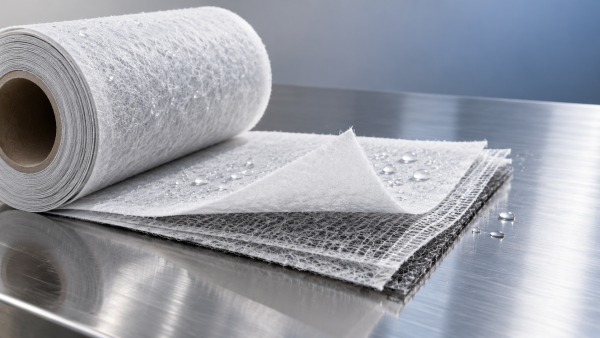
For composites, ask how the layers are joined. Adhesive coverage, penetration, and bonding pattern can influence airflow and stiffness. Ultrasonic bonding avoids an added adhesive at the bond points, but introduces localized compression and requires compatible materials. No lamination route is automatically best; the bond must suit the filtration structure and converting process.
Make the laboratory comparison genuinely comparable
Two efficiency values mean little if they were measured at different face velocities or with different aerosols. Ask for the test method and conditions behind each result: particle size range, aerosol type, charge neutralization where applicable, specimen area, airflow, conditioning, and measurement uncertainty.
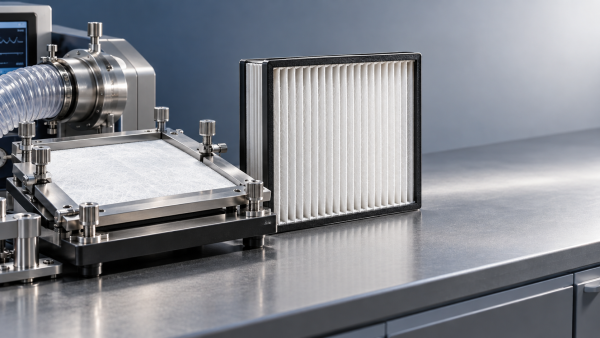
Use the applicable filter standard to frame the program. ISO 16890 addresses general ventilation air filters; EN 1822 and ISO 29463 address high-efficiency filtration within their respective scopes. Their classifications are not interchangeable. A flat-sheet screening result also does not establish the classification of a finished filter element.
Where practical, test the incumbent and candidate in the same laboratory under the same conditions. Examine fractional efficiency rather than relying only on one headline percentage. For high-efficiency applications, evaluate performance around the most penetrating particle size using the relevant method; do not assume one fixed particle size represents every construction.
Look beyond clean-media pressure drop
Initial resistance is useful, but resistance growth can matter more in service. A medium that starts with lower pressure drop may load rapidly with the actual contaminant. Compare loading behavior, efficiency changes, and retained dust at a defined endpoint, while recognizing that laboratory dust may not reproduce oily aerosols, hygroscopic salts, or process fumes.
For a gas turbine intake, moisture and site-specific aerosol exposure may be important. For an automotive intake, dust loading and vibration may drive different decisions. Semiconductor or biopharmaceutical ventilation can introduce additional concerns about shedding, emissions, or compatibility. These requirements should come from the installation and process assessment, not from a generic industry label.
Try to expose failures before the production trial
Qualification should include stresses that could reveal a weakness, not just tests likely to produce an attractive result. Select exposures from the actual duty: humidity cycling, temperature aging, water contact, oil aerosol, cleaning chemicals, or vibration where relevant. Test filtration and physical properties after exposure, rather than recording appearance alone.
- Mechanical integrity: Check machine- and cross-direction strength, stiffness, and resistance to handling damage. A high tensile result alone does not prove good pleatability.
- Layer adhesion: Evaluate whether bonds remain stable after relevant conditioning and bending. Delamination can change both airflow distribution and structural support.
- Surface stability: Investigate abrasion or particle release where downstream cleanliness matters, using a defined method and acceptance limit.
- Seal compatibility: Confirm that potting compounds, hot melts, or other assembly materials bond reliably without damaging the medium.
Do not impose every possible exposure on every candidate. That can reject a suitable material for a condition it will never encounter. The useful question is whether the test represents a credible service or manufacturing risk.
Treat converting as part of qualification
Run the candidate through representative production equipment before approval. Hand-folded samples cannot reproduce the tension, heat, speed, and repeated contact of an industrial pleating line. Watch for cracking at folds, surface scuffing, uneven pleat recovery, edge damage, and changes in pack stability.
A softer medium may need support or a different pleat spacing. A stiffer laminate may resist deformation but create difficulty at tight folds. Those changes can affect usable area and channel resistance, so an identical flat-sheet pressure drop does not guarantee identical filter resistance.
Record the process adjustments required. If the candidate only works within a narrow tension or temperature window, that is a production risk worth costing. Test completed filters for the required performance and integrity, including after handling or conditioning when the application calls for it.
Prove air filter media batch consistency with a sampling plan
One excellent sample proves possibility, not repeatability. Qualification material should represent separate production lots and meaningful positions across the web and along the roll. Agree how samples are selected so that the evaluation does not depend entirely on supplier-selected pieces.
Track properties linked to actual failure mechanisms. Basis weight and thickness are useful, but neither guarantees filtration uniformity. Depending on the construction, the control plan may also need air permeability, resistance at a defined face velocity, particle efficiency, tensile properties, or bond strength. Specify test pressure for thickness and the relevant direction for mechanical tests.
Review distributions and location-specific results, not just batch averages. An acceptable average can conceal a weak edge region or an intermittent defect. Establish acceptance limits, sampling frequency, and a response to out-of-specification results. Statistical capability measures become meaningful only after measurement reliability and process stability have been demonstrated.
Traceability should connect delivered rolls to the relevant production records and test results. Ask what triggers customer notification: a fiber source change, binder adjustment, adhesive substitution, line transfer, or revised bonding settings may require review. “Same product code” is not sufficient change control.
Evaluate the supplier’s ability to control the whole construction
For a composite replacement, development capability matters alongside supply capacity. If filtration and converting requirements conflict, the supplier may need to adjust the substrate, support, and bond together rather than simply offer another catalog grade.
Hangzhou Chaocai Materials Co., Ltd. develops and manufactures functional advanced materials, with production platforms including fully synthetic wet-laid, PUR lamination, hot-melt adhesive lamination, solvent-based emulsion spray lamination, and ultrasonic lamination. That range provides different routes for developing filtration constructions. It does not, by itself, establish that a particular construction is qualified for a specific application.
A useful technical discussion should identify which route is proposed, why it fits the operating conditions, and which variables will be controlled during scale-up. Request representative production material, documented test methods, and agreed change-notification procedures. Equipment capability is valuable when it translates into a repeatable product specification.
Approve the replacement with explicit boundaries
Approval should identify the material construction and revision, approved manufacturing route, converting settings, applicable filter designs, and operating envelope. Keep any unresolved risks visible. Where laboratory loading cannot adequately represent service, use a controlled field evaluation with predefined inspection and withdrawal criteria.
Compare cost at the finished-filter level, including converting losses, support materials, inspection, and any substantiated operating effects. A cheaper roll may not produce a cheaper qualified filter.
The practical decision is whether representative production lots can become conforming filters, repeatedly, within the agreed process and service limits. If that evidence is still missing, keep the material at trial status—even when its best laboratory result looks better than glass fiber.
Recommendation
 Oct 20, 2026
How Do You Qualify Alternatives to Glass Fiber Filter Media?
Ensure air filter media batch consistency when replacing glass fiber. Discover qualification tests, production checks, and supplier controls to reduce risk and choose with confidence.- Oct 20, 2026
What Should You Verify in ISO 29461 Filter Media Test Data?
Evaluating a glass fiber filter media replacement? Learn what to verify in ISO 29461 test data, from efficiency and pressure drop to durability, before approving your next purchase. - Oct 20, 2026
What Determines the Price of Moisture-Resistant Filter Media?
ISO 29461 filter media test data can clarify supplier quotes. Discover key cost drivers, check test scope, and choose moisture-resistant media with confidence.