What Should You Verify in ISO 29461 Filter Media Test Data?
When evaluating a glass fiber filter media replacement, a headline efficiency rating is only the starting point. First verify exactly what the supplier tested.
ISO 29461 data supports qualification only when the applicable standard part, specimen configuration, airflow, and conditioning match the comparison you intend to make.
For gas turbine filtration teams, the practical question is whether replacement media can protect equipment while delivering acceptable pressure drop, durability, and service life.
This guide explains how to review supplier reports, identify misleading comparisons, and decide what additional evidence you need before approving a material change.
Start With the Decision: What Does the Report Actually Prove?
A useful report establishes performance for an identified specimen under documented conditions. Its conclusions should remain tied to that specimen and those test conditions.
It does not automatically establish performance for every product using the same material, or predict filter life at a particular gas turbine installation.
Your first review should separate three questions: whether the material performs adequately, whether the assembled filter performs adequately, and whether production consistently reproduces that performance.
These questions require related but different evidence. Material screening, complete element testing, and manufacturing quality records should support one another throughout the qualification process.
For purchasing teams, this distinction prevents a common mistake: treating an attractive laboratory result as sufficient proof that a proposed replacement is commercially interchangeable.
Verify the Standard Part, Edition, and Scope
ISO 29461 addresses air intake filter systems for rotary machinery. A reference to the series alone does not identify which performance characteristics were evaluated.
ISO 29461-1 concerns static filter elements and their filtration performance. Other parts address additional characteristics or exposure conditions; their evidence should be reviewed separately.
Ask for the complete standard designation and publication year. Also request any amendments, declared deviations, and the specific test procedures included in the report.
If a supplier claims an ISO 29461 classification, verify its basis against the cited edition, including the required conditioning and calculations supporting that classification.
Results generated under ISO 16890, EN 1822, or ISO 29463 may provide useful context, but do not assume their classifications are directly interchangeable.
Likewise, a partial test using selected procedures should be described accurately. It should not be presented as complete conformity without the required supporting evidence.
Was the Test Performed on Flat Media or a Complete Filter?
This is often the most important question when reviewing a glass fiber filter media replacement. Flat media and assembled filters answer different engineering questions.
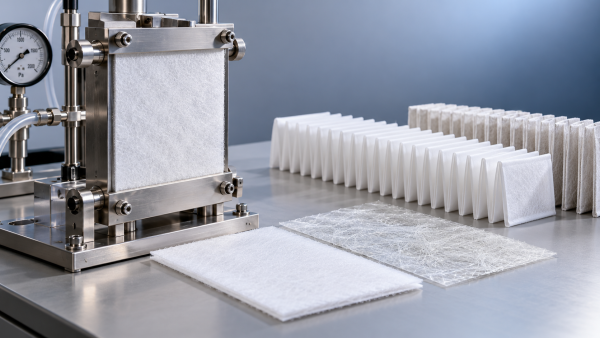
A flat sheet test helps compare material properties under controlled conditions. It cannot establish the effects of pleating, sealing, supports, or assembly defects.
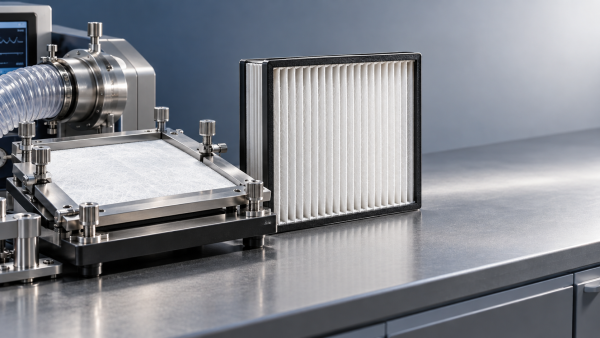
A complete filter element introduces additional variables: effective media area, pleat spacing, adhesive application, frame stiffness, gasket compression, and potential leakage around the medium.
Even when two elements use identical media, different construction can change resistance and measured efficiency. Closely packed pleats can also restrict usable filtration area.
Request specimen photographs, dimensions, model identification, media identification, and construction details. Confirm whether the laboratory tested a sheet, a miniature assembly, or a production element.
A media supplier can support initial selection with sheet data. Final qualification should include the intended filter design whenever assembly effects could influence acceptance.
Compare Airflow and Velocity Before Comparing Results
Efficiency and pressure drop depend on operating conditions. Two reports cannot support a fair comparison if their airflow or specimen dimensions differ without explanation.
For complete elements, verify volumetric airflow and the reference conditions used to report it. Compare results at the airflow relevant to your intended application.
For sheet specimens, verify media velocity and exposed test area. A lower test velocity can make a material appear less restrictive than another candidate.
Distinguish filter face velocity from media velocity. Face velocity relates to frontal area, while media velocity relates to the filtration area within the element.
When comparing assembled filters, request effective media area where available. Different pleat designs may explain apparent material advantages that disappear under equivalent operating conditions.
If your turbine operates across a broad airflow range, request a resistance curve. A single nominal point may conceal problems at higher operating flows.
Look Beyond the Headline Efficiency Rating
Overall efficiency can conceal differences across particle sizes. Request particle size efficiency data so you can assess performance against the contamination your installation encounters.
Check the reported size range, particle sizing method, test aerosol, and measurement basis. Number based and mass based efficiencies should not be compared directly.
Two filters may capture similar dust mass while differing substantially in fine particle removal. This matters when fine contamination contributes to compressor fouling.
Where the procedure includes conditioning intended to reveal dependence on electrostatic charge, review both initial and conditioned results, together with the documented conditioning method.
Some synthetic media designs use electrostatic effects, while others rely primarily on mechanical filtration. Material labels alone do not establish how efficiency will behave.
For glass fiber replacements, ask whether acceptable efficiency depends on charge and whether the submitted results represent the condition used for the claimed classification.
A difference between initial and conditioned efficiency is not automatically disqualifying. It becomes meaningful when assessed against your protection requirements and expected operating environment.
Read Pressure Drop and Dust Loading Together
Initial pressure drop describes clean resistance. It does not show how quickly resistance increases as contamination accumulates or how the filter behaves near replacement.
Request the loading curve, dust feed conditions, test dust specification, airflow, and stopping criterion. Each affects how dust holding capacity should be interpreted.
A reported capacity has limited value without its terminal pressure drop. Greater capacity achieved at a higher resistance limit may offer no operational advantage.
Compare candidates at a common airflow and relevant resistance limit. Review intermediate loading behavior because two filters can reach similar endpoints through different resistance trajectories.
Laboratory dust does not necessarily reproduce local airborne contamination. Coastal salts, combustion aerosols, agricultural dust, and seasonal mixtures can produce different filtration behavior.
Avoid converting laboratory dust capacity directly into operating months. Field life also depends on contaminant concentration, humidity, prefiltration, operating hours, and maintenance practices.
For business evaluation, consider average operating resistance and replacement frequency together. Lower purchase cost may be outweighed by inlet losses or additional maintenance interventions.
Check Moisture Resistance and Mechanical Durability Separately
Static filtration data alone cannot establish suitability for fog, rain carryover, high humidity, or demanding pressure conditions. Identify which additional exposures require supporting evidence.
For moisture related claims, ask what was measured: resistance change, structural stability, drainage, water penetration, or efficiency during exposure. These are different performance outcomes.
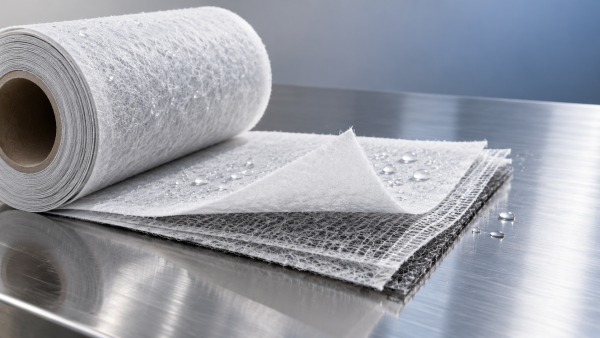
Water repellency on a flat sheet does not prove that a complete filter prevents water passage. Pleats, joints, drainage paths, and seals also matter.
For mechanical integrity, review the applied pressure conditions and acceptance criteria. Confirm whether the evidence covers the finished element and its intended support structure.
When replacing glass fiber media, assess converting behavior as well. Pleating, lamination, adhesive bonding, and handling can introduce weaknesses that material screening does not reveal.
Where relevant, request evidence for fiber shedding or material release. Do not infer cleanliness characteristics solely from filtration efficiency or the identity of the fibers.
Make Sure the Evidence Is Traceable and Comparable
Ask for the complete report rather than a cropped certificate or sales chart. You need enough detail to connect every claim with its test conditions.
The report should identify the laboratory, test dates, specimen codes, methods, results, and deviations. Supplier documentation should connect those specimen codes to offered products.
If laboratory accreditation is claimed, check whether the relevant method falls within its accredited scope. Accreditation for unrelated testing does not resolve that question.
Review sample count and any reported variability or uncertainty. One successful prototype provides limited evidence of consistency across production lots and manufacturing changes.
Use the following checks to organize supplier comparisons. Missing information should become a specific evidence request before technical approval or a purchasing commitment.
Turn the Report Into a Practical Qualification Plan
Define acceptance criteria before selecting a preferred material. Include required filtration performance, resistance limits, environmental exposures, converting requirements, and the intended finished filter configuration.
Begin with comparable media screening, then evaluate pilot elements made using the proposed manufacturing process. Resolve unexplained performance differences before expanding the qualification effort.
Where operating conditions justify it, conduct a controlled field trial. Record airflow, differential pressure, exposure conditions, maintenance events, and the condition of removed elements.
Agree on production specifications and change notification requirements before purchase. Changes to fibers, binders, laminates, or processing may require reassessment of previously accepted evidence.
Hangzhou Chaocai Materials Co., Ltd. develops functional filtration materials using fully synthetic wet laid production and multiple lamination platforms for specialized filtration applications worldwide.
For a replacement project, these capabilities should be assessed against your media specification, converting needs, and validation plan. Manufacturing capability alone does not establish ISO classification.
Approve the Replacement Only When the Evidence Matches the Application
A credible glass fiber filter media replacement needs more than a strong efficiency number. Its evidence must connect the material, finished element, and operating requirements.
Verify the method and specimen first, then compare efficiency, resistance, conditioning, and loading under equivalent conditions. Investigate environmental durability and manufacturing consistency where they affect acceptance.
When these checks align, ISO 29461 data becomes useful purchasing evidence. When they do not, request targeted testing before treating the replacement as qualified.