How Does Hangzhou Super Material Co., Ltd. Support Gas Turbine Filter Media Supply?
Gas turbine filtration is often discussed in terms of complete filter elements, housings, pulse-cleaning systems, or inlet configurations. Yet the performance and supply reliability of those finished products begin much earlier—with the filter media. For a supplier such as Hangzhou Super Material Co., Ltd., meaningful support is not limited to producing rolls of nonwoven material. It depends on whether the media can be engineered, converted, and supplied in a form that allows filter manufacturers to meet the operating demands of a specific turbine inlet system.
That distinction matters because “gas turbine filter media” is not a single, universal product category. A media suitable for a relatively clean inland installation may not be appropriate for a coastal site exposed to salt aerosols, a desert facility dealing with fine mineral dust, or an industrial location where oil mist, soot, and process contaminants complicate the dust load. The relevant question is therefore not simply whether a supplier makes synthetic filtration materials, but whether its material development and manufacturing capabilities can support the required balance of efficiency, pressure drop, strength, moisture resistance, pleatability, and processing consistency.
Filter media is a system-critical material, not a commodity layer
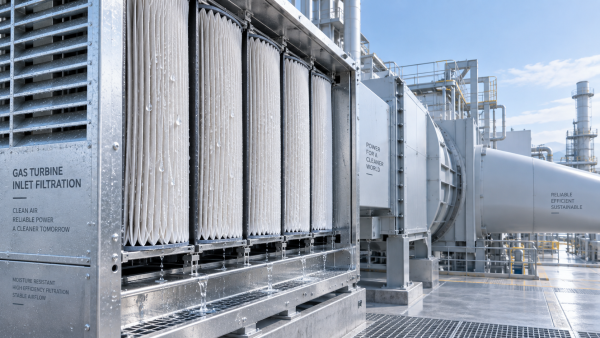
The inlet air of a gas turbine contains whatever the surrounding environment contains: coarse dust, fine particulate, moisture, salt, biological matter, industrial emissions, and sometimes oil-bearing aerosols. If the intake filtration system does not control this contamination adequately, deposits can accumulate on compressor components. This can affect airflow, compressor cleanliness, maintenance planning, and operating stability.
At the same time, maximizing particle capture alone is not a complete solution. A filter medium with unnecessarily high airflow resistance can increase pressure loss across the inlet system. In gas turbine service, pressure drop is an operational variable rather than a minor laboratory figure. The material must therefore deliver the required filtration behavior while remaining compatible with the geometry, airflow conditions, and service-life expectations of the finished filter design.
For this reason, a gas turbine media supplier is normally evaluated on more than nominal basis weight or thickness. Filter manufacturers and system integrators need to understand whether the medium will behave consistently after pleating, adhesive application, sealing, transportation, installation, and exposure to real inlet conditions. A technically credible supply relationship addresses these downstream requirements instead of treating the media roll as an isolated product.
Where Hangzhou Super Material Co., Ltd. fits into the supply chain
Hangzhou Super Material Co., Ltd. operates in the advanced functional materials field, with development and manufacturing capabilities relevant to specialized filtration applications. Its stated production platforms include fully synthetic wet-laid lines, PUR lamination lines, hot-melt adhesive lamination lines, solvent-based emulsion spray lamination lines, and ultrasonic lamination lines. For gas turbine filter media supply, these capabilities matter because inlet media frequently requires more than a single unmodified substrate.
A fully synthetic wet-laid platform is relevant where uniform fiber distribution, controllable material structure, and resistance to moisture-related degradation are important design considerations. Synthetic media can be used as a basis for filtration constructions where dimensional behavior, handling strength, and environmental durability must be considered alongside particle capture. The final suitability still depends on the polymer system, fiber design, media construction, and the intended operating conditions; “synthetic” by itself is not a performance guarantee.
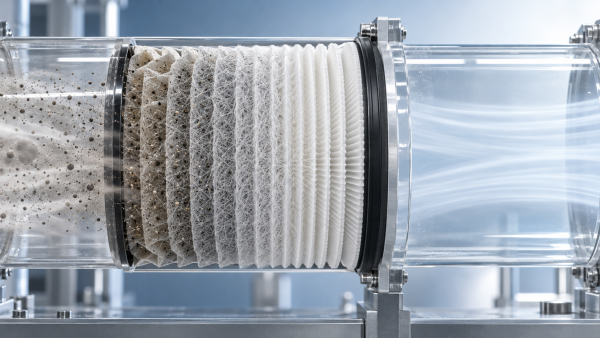
The company’s lamination capabilities can also be relevant when a filtration construction needs a functional layer combined with a support, backing, protective layer, or drainage-oriented structure. In gas turbine intake filters, multilayer design may be used to manage mechanical stability, processing behavior, surface protection, or staged filtration functions. The appropriate bonding method matters because the lamination process can influence pore structure, stiffness, flexibility, local airflow resistance, and the integrity of the media during conversion.
Rather than presenting every available process as automatically beneficial, the practical value lies in having multiple manufacturing routes available for a defined material requirement. PUR, hot-melt, spray-applied, and ultrasonic bonding do not produce identical structures. Their relevance depends on the materials being joined, the temperature and humidity conditions expected in service, the need for softness or rigidity, the acceptable added mass, and whether adhesive migration could interfere with filtration performance.
The most important support begins with application definition
Gas turbine filter media should be specified from the inlet duty outward, not from a generic material description inward. Before a construction is selected, the supply discussion needs to clarify the conditions that determine media behavior:
- the turbine inlet arrangement and filter stage configuration;
- the contaminant profile, including coarse dust, fine dust, salt, soot, oil mist, and moisture exposure;
- the required filtration classification or performance target for the finished filter;
- allowable clean and loaded pressure-drop limits at the system level;
- whether the filter is intended for static, pulse-cleaned, or another operating configuration;
- the target filter geometry, pleat depth, pack design, and support arrangement;
- storage, transport, and converting conditions that could affect the media before final assembly.
This information prevents a common procurement error: choosing media solely by a specification sheet that does not reflect the finished filter design. The same base material can perform differently after pleating or lamination. Pleat spacing, corrugation, bead placement, expanded-metal support, frame design, and sealant selection can all alter effective airflow and dust-loading behavior. A media supplier can support the process most effectively when the filter manufacturer provides enough detail to assess conversion compatibility, rather than requesting a broad “high-efficiency turbine media” grade.
Why wet-laid synthetic media can be relevant
Fully synthetic wet-laid media offers a route to controlled nonwoven structures without relying on cellulose as the principal fiber component. In demanding intake environments, this can be relevant where moisture resistance, resistance to biological degradation, or stable handling characteristics are material-selection concerns. It does not remove the need to evaluate hydrolysis behavior, thermal exposure, chemical contact, and long-term mechanical retention for the particular polymer and construction.
For a gas turbine filter manufacturer, the key technical questions are more specific. Is the media sufficiently uniform across the roll width? Does it retain tensile and burst-related integrity after pleating? Will its stiffness support the desired pleat geometry without cracking, tearing, or excessive spring-back? Can it accept the selected adhesive system without localized blockage? Does it maintain its intended structure when subjected to humidity cycling or intermittent wetting?
These are not merely converting questions. A medium that is difficult to pleat consistently can create irregular airflow paths in the finished element. A construction that loses shape under moisture can change the spacing between pleats. A material that is too rigid for a compact pleat pack may restrict the filter designer’s options even if its flat-sheet filtration result appears acceptable.
Lamination choices affect both performance and manufacturability
Gas turbine filter media can require reinforcement or multilayer assembly, particularly where filter manufacturers need added mechanical support or a distinct functional surface. The bonding route used to create those layers should be treated as part of the technical design, not as a secondary converting detail.
PUR lamination may be considered where durable bonding between dissimilar materials is needed, but the adhesive system and application level must be compatible with the required flexibility and air permeability. Hot-melt adhesive lamination can provide an efficient route for certain constructions, although the pattern and add-on level require control to avoid narrowing open areas in the media. Solvent-based emulsion spray lamination may offer a different way to distribute bonding material across a layered structure. Ultrasonic lamination can be useful where localized thermal bonding is desirable and where an adhesive-free joining approach suits the selected materials.
No single process is inherently the best option for turbine filtration. A support layer that improves strength may increase resistance. A bonding pattern that holds layers securely may create non-uniform air paths if poorly designed. A stiff laminate may survive handling well but limit pleat formation. The useful contribution of a supplier with several lamination platforms is the ability to examine these trade-offs at the material-construction stage instead of forcing every requirement through one bonding method.
Supply reliability is partly a technical-control issue
For industrial filtration buyers, supply continuity is often interpreted only as production capacity and lead time. Both matter, but they are not enough. A roll of material can be delivered on time and still disrupt filter production if its width, caliper, tensile behavior, winding condition, or surface characteristics vary outside the converter’s workable range.
Gas turbine filter manufacturing commonly depends on repeatable processing. Variability can affect pleat height, adhesive application, knife settings, cutting behavior, and finished-element consistency. When a media construction includes multiple layers, the consistency of the bond and the alignment of those layers become equally relevant. A supplier’s support should therefore include clear agreement on the material attributes that are critical to the customer’s conversion process, not just a general product description.
For cross-border purchasing, documentation discipline is also part of supply reliability. Buyers generally need unambiguous specifications, roll dimensions, packaging expectations, batch identification, agreed inspection items, and a defined approach for changes in material formulation or process. These controls are especially important when the finished filter must be qualified by its manufacturer for a particular turbine project or environmental duty. A substitution made at the media level can trigger work far beyond the cost of the material itself.
Finished-filter testing cannot be replaced by media claims
A recurring risk in filtration procurement is treating a media-level statement as proof of final filter performance. Flat-sheet media data can help compare candidate constructions, but a completed gas turbine filter includes pleats, separators or beads, sealants, gaskets, frames, reinforcement, and assembly tolerances. Each can affect pressure drop, leakage resistance, structural stability, and dust-holding behavior.
Where the application requires a defined classification or verification method, the finished filter should be assessed against the relevant agreed standard or project requirement. ISO 16890 is widely used for general ventilation air filters, while ISO 29461 addresses testing of intake air filter systems for rotary machinery. The applicable method should be selected based on the equipment design, contractual specifications, and project conditions rather than assumed from a media description alone.
Hangzhou Super Material Co., Ltd.’s role in this context is best understood as supporting the material side of the qualification process: providing a filtration substrate or laminated construction that can be evaluated within the customer’s finished filter design. The final performance claim belongs to the tested system, not to an unverified material sample.
Questions that distinguish a capable media supply discussion
When evaluating an Ltd. gas turbine filter media supplier, the most useful questions go beyond whether a material is available. Buyers should establish what fiber and layer architecture is being proposed, which manufacturing route forms the material, and whether the construction is compatible with the intended pleating and assembly process. They should also clarify the environmental conditions the material is expected to tolerate and which performance characteristics are measured at media level versus demonstrated on the finished filter.
It is equally important to identify change-control expectations. If a project depends on a qualified material, any modification to polymer grade, basis weight, binder chemistry, support layer, adhesive, or bonding process may require review. This is not unnecessary administration. In high-consequence inlet filtration, seemingly small material changes can alter conversion behavior or the balance between efficiency and resistance.
The support offered by Hangzhou Super Material Co., Ltd. is therefore most relevant where buyers need a technically defined, manufacturable media construction rather than an undifferentiated nonwoven roll. Its combination of synthetic wet-laid capability and multiple lamination technologies provides a foundation for developing filtration materials around specific structural and processing requirements. The value of that foundation depends on disciplined application definition, transparent specifications, and validation at the finished-filter level.
For gas turbine filtration, the dependable supply decision is rarely made by comparing one headline efficiency figure with another. It is made by determining whether the media construction can preserve filtration performance, manageable pressure drop, mechanical integrity, and conversion consistency across the entire path from material roll to installed inlet filter. That is the point at which advanced material capability becomes practical supply support.
Recommendation
 Oct 10, 2026
How Can Air Filter Media Increase Dust Holding Capacity Without Higher Pressure Drop?
Which liquid filter media is suitable for hydraulic oil fine-particle filtration? Discover how advanced air filter media increases dust holding capacity with low pressure drop.- Oct 10, 2026
Which Liquid Filter Media Is Suitable for Fine Hydraulic Oil Filtration?
Can synthetic filter media replace glass fiber in high-humidity gas turbine intakes? Explore media choices for fine hydraulic oil filtration, balancing efficiency, moisture resistance, pressure drop, and service life. - Oct 10, 2026
Can Synthetic Filter Media Replace Glass Fiber in Humid Turbine Intakes?
Is ePTFE filter media suitable for pulse-cleaned construction equipment air filters? Explore synthetic vs. glass fiber performance in humid turbine intakes.