What Should OEMs Look for in Custom Air Filter Media?
Custom air filter media should be selected as a working component of the finished filter, not as an isolated sheet material. A media sample can show strong particle capture in a laboratory test yet create problems after pleating, bonding, vibration, moisture exposure, or extended dust loading. The useful question is whether the media will maintain the required airflow, efficiency, shape, and service behavior in the actual housing and duty cycle.
For custom filter media for OEM air filters, the starting point is a defined application window: contaminant type and concentration, airflow range, acceptable restriction, temperature, humidity, chemical exposure, installation orientation, pulse or vibration conditions, and intended replacement interval. Without those conditions, terms such as “high efficiency” or “low resistance” are too broad to support a sound material decision.
Read Efficiency Together with Airflow Resistance
Filtration efficiency describes how well a medium captures particles of a stated size or size distribution. Pressure drop describes the resistance to airflow through that medium at a stated face velocity. Neither result is meaningful on its own. A denser fiber structure, finer fibers, added electrostatic charge, or greater basis weight can improve initial capture, but each route affects resistance and long-term behavior differently.
A low initial pressure drop is attractive because it reduces energy demand and leaves room for dust loading. However, unusually low resistance can indicate a coarse pore structure that allows problematic particles to pass through, especially when the downstream component is sensitive to abrasive dust, optical contamination, or deposits. Conversely, a very efficient layer with high initial resistance may force a fan to operate outside its intended range or shorten the practical service interval.
Face velocity must remain consistent during comparison. The same media can behave very differently in a compact panel, a deeply pleated element, a cylindrical cartridge, or a large-area cassette. Media area, pleat spacing, and housing geometry alter the real air velocity through the sheet. Comparing only supplier data measured at different velocities is a common source of incorrect material selection.
Initial efficiency also needs to be separated from conditioned efficiency. Some charged synthetic media rely partly on electrostatic attraction. This can provide high capture at low resistance, but oil mist, solvent vapor, humidity cycling, or certain aerosols may reduce the charge contribution. Where the filter must perform after exposure to such conditions, testing should reflect that state rather than relying solely on an as-produced result.
Dust-Holding Capacity Is a System Property
Dust-holding capacity is often treated as a simple media specification, yet it is strongly influenced by the contaminant and the filter construction. Fibrous, dry, coarse dust behaves differently from fine mineral dust, soot, oily aerosol, sticky process residue, or a mixed contaminant stream. A material that loads gradually with one dust may form a rapid surface cake with another.
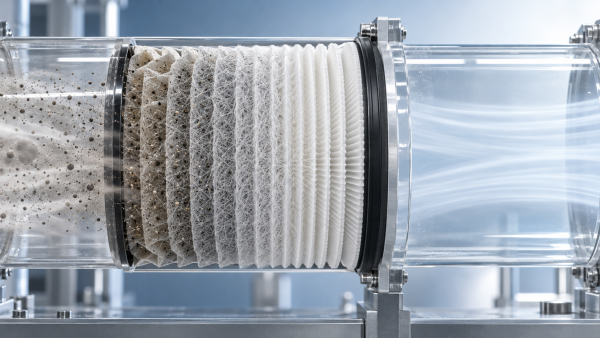
Depth-loading media generally distribute particles through part of the fiber matrix, allowing resistance to rise progressively. Surface-loading structures capture more material near the upstream face. Neither mechanism is inherently better. Surface loading can be useful where collected material must be cleaned by a pulse or where fine particulate should not migrate deeply into the medium. Depth loading can extend usable life when dust is dry and the structure remains open under load.
The end-of-life condition must be specified before choosing a media target. Some assemblies are replaced at a defined restriction level; others are changed after a planned operating interval; still others must protect a downstream part until an operational signal is triggered. These conditions produce different optimization priorities. Maximizing grams of test dust retained is not sufficient when the decisive failure mode is a steep late-stage pressure rise, dust shedding, media cracking, or bypass around the filter pack.
Distinguish Media Loading from Filter-Pack Loading
Pleat geometry can either preserve or waste the potential of a high-capacity medium. If adjacent pleats close as dust accumulates, airflow is restricted through a smaller active area and pressure drop rises earlier than bench-sheet data would suggest. Excessive pleat height, insufficient spacing, weak embossing, uneven adhesive beads, and distortion during curing can all contribute to this behavior.
A media trial should therefore evaluate the converted element under representative loading conditions. The test should observe restriction growth, dust distribution, pleat stability, and evidence of localized loading. A uniform increase in pressure drop points to one set of causes; isolated dark bands, collapsed pleats, or edge deposits point to another. Changing the fiber web alone will not correct a construction-related loading problem.
Match the Fiber System to the Environment
Cellulose, synthetic fibers, glass fibers, composite structures, and multilayer media each bring different strengths and limitations. The best choice depends on exposure conditions and conversion requirements, rather than on a generic hierarchy of materials.
Cellulose-containing media can offer a useful fiber network and good stiffness in dry service. Its response to water, high humidity, and repeated moisture cycling requires careful evaluation. Loss of rigidity can change pleat geometry, while swelling or binder effects can alter airflow. Where condensate, wash-down exposure, or humid intake conditions are credible, wet strength and dimensional stability deserve direct attention.
Fully synthetic media often provide strong moisture resistance and good compatibility with many lightweight construction approaches. Their thermal response, solvent resistance, charge stability, and weldability vary by polymer and formulation. A media designed for ultrasonic bonding, for example, may need a compatible thermoplastic component and sufficient local fusion strength without creating brittle weld zones or blocked airflow paths.
Fine-fiber or nanofiber surface layers can raise fine-particle efficiency and influence how the dust cake forms. They must be assessed for flex durability, adhesion to the support layer, and damage during pleating. A delicate surface can lose consistency if it is stretched over sharp pleat tips, rubbed during handling, or exposed to aggressive cleaning pulses. The relevant question is not merely whether the coating adheres in a flat sample, but whether it remains continuous after conversion and service stresses.
Temperature should be considered as a combination of steady exposure, short excursions, airflow heating, and proximity to hot equipment. Adhesives, sealants, wire supports, end caps, and reinforcement layers can become limiting components before the filter media itself does. Chemical compatibility follows the same logic: a material may tolerate a vapor in isolation while the laminate bond, resin treatment, or gasket interface degrades first.
Mechanical Strength Must Survive Conversion
Air filter media is pulled, compressed, scored, pleated, bonded, trimmed, and assembled before it reaches the air stream. Tensile strength alone does not describe its converting behavior. Tear resistance, elongation, burst resistance, compressive recovery, stiffness in the machine and cross directions, and surface friction may each affect production yield and finished-filter consistency.
Directionality matters. A wet-laid or nonwoven web may have different strength, stretch, and folding response along the machine direction than across it. If roll orientation changes during converting, pleat formation and pack stability may change as well. Clear orientation marking and an agreed unwinding direction prevent a material that performed well in development from behaving differently in routine production.
Media stiffness needs a balanced interpretation. Greater rigidity can help pleats remain open, maintain pack geometry, and resist deformation under airflow. Too much stiffness can lead to cracking at fold lines, spring-back after pleating, poor conformity to curved elements, or difficulty in compact designs. The finished element must be evaluated after thermal exposure and humidity conditioning, since stiffness can shift with temperature and absorbed moisture.
Bonding compatibility deserves early trials. Polyurethane reactive adhesive, hot-melt adhesive, solvent-based systems, ultrasonic welding, and mechanical attachment impose different thermal, chemical, and surface-energy demands. An adhesive that bonds strongly to a flat coupon can wick into an open medium, creating a hard zone or reducing local permeability. A weak bond may survive initial pull tests but fail under thermal cycling or vibration. Bond-line width, adhesive add-on, cure conditions, and contact pressure should be treated as part of the media validation window.
Specify the Structure Rather Than a Single Number
A durable specification combines performance targets with the physical attributes that keep those targets repeatable. Basis weight, thickness, air permeability, tensile behavior, fiber composition, treatment or coating description, surface finish, roll width, roll length, and winding quality may all be relevant. The necessary detail depends on the application, but the document should distinguish critical characteristics from informational ones.
Acceptable variation should be realistic and linked to functional consequences. Extremely narrow limits may create supply difficulty without improving the filter. Broad limits can cause inconsistent pleat counts, adhesive penetration, or pressure-drop scatter. The useful tolerance is the one that protects finished-element performance and stable processing, not simply the one that looks precise on paper.
Validate at the Finished-Filter Level
Development should move from sheet characterization to small conversion trials, prototype filter testing, and confirmation under the most demanding credible operating conditions. This sequence exposes interactions that are invisible in media data: separator contact marks, adhesive strike-through, media abrasion against support screens, gasket compression effects, and deformation at elevated airflow.
Representative samples should include expected manufacturing variation rather than a single carefully prepared prototype. A material that requires unusually tight pleater settings, narrow adhesive control, or delicate handling may introduce avoidable production instability even when its laboratory filtration results are attractive. Process capability is part of product capability.
When a filter underperforms, the observed symptom should guide the investigation. Early restriction can come from excessive face velocity, inadequate effective area, blocked pores from bonding, or a dust type that forms a dense cake. Dust downstream can result from insufficient efficiency, damage to the web, pleat separation, sealing defects, or leakage at the housing interface. Treating every issue as a media-efficiency problem often leads to an expensive and ineffective redesign.
Keep Material Changes Under Control
Once a media construction is approved, changes in fiber grade, binder chemistry, treatment level, coating weight, support scrim, or production method can affect performance even when basic thickness and basis weight remain close to prior values. Change notification requirements should identify which characteristics need review and which type of validation is expected before use in finished filters.
Traceability should connect the finished filter to the media lot, conversion conditions, and relevant assembly materials. This is especially useful when a field concern appears only in a certain production period or environment. It narrows the investigation from a broad product question to a defined combination of material and process conditions.
The strongest selection process defines the airborne challenge, operating window, filter geometry, assembly method, and end-of-life behavior together. That approach produces a media specification tied to the actual filter function, where filtration performance, energy use, durability, and manufacturability reinforce rather than undermine one another.
Recommendation
 Oct 10, 2026
How Can Air Filter Media Increase Dust Holding Capacity Without Higher Pressure Drop?
Which liquid filter media is suitable for hydraulic oil fine-particle filtration? Discover how advanced air filter media increases dust holding capacity with low pressure drop.- Oct 10, 2026
Which Liquid Filter Media Is Suitable for Fine Hydraulic Oil Filtration?
Can synthetic filter media replace glass fiber in high-humidity gas turbine intakes? Explore media choices for fine hydraulic oil filtration, balancing efficiency, moisture resistance, pressure drop, and service life. - Oct 10, 2026
Can Synthetic Filter Media Replace Glass Fiber in Humid Turbine Intakes?
Is ePTFE filter media suitable for pulse-cleaned construction equipment air filters? Explore synthetic vs. glass fiber performance in humid turbine intakes.