How Much Can Nano Meltblown Media Improve Dust Holding Capacity?
Nano meltblown composite media can improve dust holding capacity, but no universal percentage applies. Some constructions deliver meaningful gains; others restrict airflow or load prematurely.
For heavy-duty engine intake filters, suitability depends on the complete media architecture, filtration efficiency, operating airflow, and resistance increase as dust accumulates during service.
The most useful comparison measures dust retained before reaching the same terminal restriction, while confirming that particle penetration remains acceptable throughout the loading cycle.
For equipment manufacturers, filter designers, and procurement teams, the decision should therefore rest on comparable testing and application requirements rather than fiber size alone.
How Much Improvement Can You Realistically Expect?
Without matched test data, assigning a percentage improvement would be speculation. The term “nano meltblown” does not establish a particular dust capacity or service life.
Performance depends on fiber diameter distribution, layer thickness, pore structure, substrate support, and bonding. Changing any of these variables can alter the final result substantially.
Consider an illustrative comparison: a baseline element retains 400 grams of dust, while a candidate retains 500 grams at the same specified terminal restriction.
That represents a 25% increase in measured dust holding capacity. These figures demonstrate the calculation only; they are not performance claims for any commercial material.
The calculation is straightforward: subtract baseline capacity from candidate capacity, divide by baseline capacity, and multiply by 100. Always identify the conditions behind the result.
A valid comparison also requires equivalent airflow, test dust, conditioning, and efficiency requirements. Differences in element dimensions or media area must be disclosed and evaluated.
Even a verified capacity gain does not translate directly into an identical service interval extension. Actual dust exposure, moisture, vibration, and maintenance practices influence field performance.
Is Nano Meltblown Composite Media Suitable for Heavy-Duty Engine Intake Filters?
Yes, nano meltblown composite media can be suitable when its efficiency, restriction, durability, and loading behavior satisfy the requirements of the intended engine intake system.
Heavy-duty applications demand more than high initial particle capture. The element must protect the engine through changing airflow, sustained dust exposure, and mechanical stress.
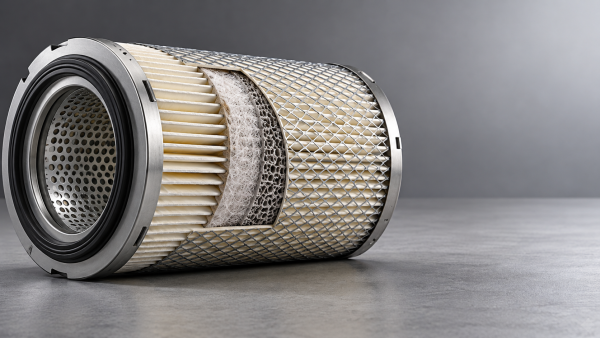
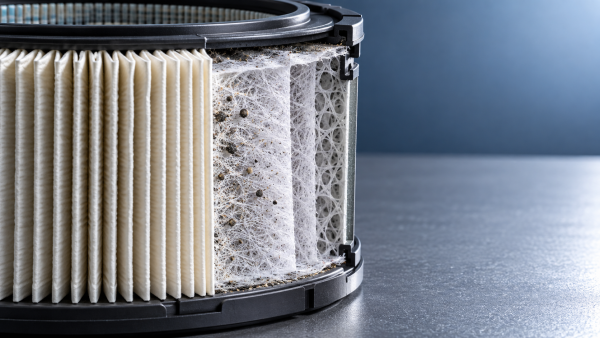
A well-designed composite may combine a fine-fiber capture layer with a more open supporting structure, distributing filtration functions across layers with different pore characteristics.
However, an excessively dense fine-fiber layer can become the main flow restriction. If dust quickly blocks that layer, usable capacity may decrease despite higher initial efficiency.
The practical question is whether the composite reaches the required protection level while retaining more dust before the engine system reaches its allowable intake restriction.
Equipment operating in quarries, agricultural fields, construction sites, and transport fleets may encounter very different contaminants. Suitability for one duty cycle does not establish suitability for another.
Media selection must also consider the housing, seals, support structure, and any precleaner. Effective material cannot compensate for bypass leakage or a poorly integrated element.
Why Fine Fibers Can Improve Capture Without Guaranteeing Greater Capacity
Fine fibers provide substantial surface area relative to their mass and can improve particle capture through mechanisms including interception, inertial impaction, and diffusion, depending on conditions.
The resulting efficiency depends on particle size, air velocity, fiber arrangement, and potentially electrostatic charge. Smaller fibers alone do not determine the complete filtration response.
Dust holding capacity concerns how much contaminant the construction accommodates before reaching a defined endpoint. It therefore depends strongly on accessible pore volume and loading distribution.
An open upstream layer can intercept larger particles and spread deposits through its depth, helping preserve access to finer downstream filtration structures for longer periods.
Conversely, a dense surface layer may accumulate a restrictive dust cake rapidly. Whether this improves or reduces useful life depends on the application and cleaning strategy.
For disposable intake elements, the goal is controlled restriction growth with adequate protection. For serviceable systems, dust release and resistance to cleaning damage also matter.
Which Composite Design Features Matter Most?
Start with the pore structure across the full thickness. A suitable gradient can support progressive particle capture, although its effectiveness must be demonstrated under representative loading.
Layer orientation matters because the upstream surface encounters incoming dust first. Reversing a composite can change deposition patterns, restriction growth, and the amount retained before termination.
The support layer must provide strength without unnecessarily obstructing airflow. Its stiffness and dimensional stability also influence pleat formation, spacing, and resistance to deformation during operation.
Lamination introduces another trade-off. Adhesive coverage or bonding patterns can reduce open flow area, while insufficient bonding can allow separation during pleating or service exposure.
Ask suppliers how the chosen bonding process affects permeability, flexibility, and layer adhesion. Manufacturing capability becomes valuable when these properties remain consistent across production batches.
Do not assume the “nano” label describes every fiber. Request measured fiber diameter distributions and clarification of whether the construction contains a distinct fine-fiber layer.
If electrostatic enhancement contributes to performance, evaluate its stability under relevant conditioning. Initial efficiency alone may not reveal how the media behaves after environmental exposure.
Which Test Results Should You Request Before Approving the Media?
For heavy-duty engine intake applications, ISO 5011 provides a relevant framework for evaluating air cleaner performance. Specify the applicable procedure and edition in purchasing documentation.
Request complete test conditions alongside reported capacity: airflow, dust specification, feed conditions, terminal restriction, element configuration, conditioning, and the method used to determine retained dust.
The terminal criterion deserves particular attention. Determine whether the test ends at an absolute restriction or a specified restriction increase, because these produce different comparison boundaries.
Compare initial restriction and the full restriction-versus-dust-loading curve. Two candidates with similar final capacities may impose substantially different airflow penalties during most of their operating lives.
Review initial and cumulative efficiency together with downstream dust measurements. Where particle-size-resolved performance is important, request appropriate additional testing rather than relying only on gravimetric efficiency.
Capacity improvements are valuable only if engine protection remains acceptable. A construction that stores more dust by allowing greater particle penetration may fail the application requirement.
Request repeated results or an agreed sampling plan when qualifying production material. A single favorable prototype cannot establish manufacturing consistency or the expected spread in performance.
Why Flat-Sheet Results May Change After Pleating
Flat-sheet tests help screen candidate materials, but finished elements introduce pleat geometry, adhesive beads, supports, seals, and housing effects that influence usable capacity and restriction.
Increasing nominal media area does not always increase effective filtration area proportionally. Closely packed pleats can restrict access, create uneven flow, or bridge with dust.
Fine-fiber layers must also survive converting. Creasing, abrasion, or localized delamination may compromise performance even when the original roll material meets its laboratory specification consistently.
A fair development program therefore uses sheet testing to identify promising constructions, followed by finished-element testing at the required airflow and agreed acceptance criteria.
When the new media requires different pleat spacing or support, evaluate that optimized design separately. Report whether gains arise from the material, element redesign, or both.
Will Laboratory Gains Survive Moisture, Vibration, and Real Dust?
Standardized dust provides a repeatable basis for comparison, but field contaminants vary in particle distribution, shape, abrasiveness, and moisture content. Those differences can change loading behavior.
A composite that performs well with dry mineral dust may respond differently to damp soil, fibrous debris, or oily contamination encountered around particular equipment operations.
Water exposure can alter pore blockage and restriction, while temperature cycling and vibration can challenge layer bonds. Qualification should reflect credible conditions within the intake system.
If operators clean and reuse the element, verify that the manufacturer permits the intended method. Cleaning can damage fine-fiber structures or weaken the finished construction.
Field trials should record operating hours, restriction trends, maintenance actions, and relevant exposure conditions. Comparing hours alone can be misleading when machines experience different dust concentrations.
Use laboratory testing to establish controlled comparisons and field trials to check operational relevance. Neither dataset, taken alone, answers every question about long-term service performance.
How Should Buyers Judge the Business Value?
The commercial benefit comes from achieving required engine protection with acceptable restriction and maintenance cost. Additional dust capacity is one contributor to that broader operating outcome.
Potential savings include fewer replacement elements, reduced maintenance labor, and less scheduled downtime. Their value depends on whether validated performance supports a practical change in servicing.
For example, raising element price from $20 to $25 requires more than a promising capacity figure. Calculate annual filter consumption, labor, and downtime under comparable use.
A premium construction may be worthwhile where servicing is expensive or access is difficult. Its economics may be less attractive where replacement costs and dust exposure are low.
Before purchasing, define the minimum acceptable capacity gain, maximum restriction, required efficiency, and durability criteria. These thresholds make supplier comparisons clearer and reduce qualification disputes.
Ask whether existing precleaning or housing limitations dominate service life. Correcting those constraints may deliver greater value than changing media within an otherwise unchanged system.
What Should You Discuss With a Media Development Partner?
Provide the target airflow, element envelope, allowable restriction, efficiency requirements, expected contaminants, and environmental conditions. Include converting constraints and current field failure modes wherever available.
Hangzhou Chaocai Materials Co., Ltd. develops functional advanced materials and operates fully synthetic wet-laid production alongside PUR, hot-melt adhesive, solvent-based emulsion spray, and ultrasonic lamination platforms.
These capabilities provide options for developing composite constructions, but any proposed nano meltblown solution still requires application-specific evidence. Production processes alone do not establish a capacity improvement.
Request a documented baseline comparison, construction tolerances, validation results, and agreed production controls. A useful supplier discussion connects material design choices directly to measurable filter requirements.
Choose on Verified Capacity, Protection, and Restriction
Nano meltblown composite media can support heavy-duty engine intake filtration, but the achievable dust holding improvement must be established for the actual construction and operating requirements.
Select the candidate that retains more dust at comparable protection and restriction, survives relevant stresses, and delivers measurable maintenance value in the finished filter system.