Is Nano Meltblown Composite Media Fit for Heavy-Duty Engine Intakes?
Nano meltblown composite media can be suitable for heavy-duty engine intakes, but high initial filtration efficiency is not enough to establish suitability. The decisive question is whether the finished filter can limit dust penetration while maintaining acceptable airflow restriction throughout its service interval—and retain that performance after moisture exposure, vibration, and dust loading.
A fine-fiber layer can improve particle capture without making the entire media structure dense. It can also become a bottleneck if dust accumulates on a thin surface layer faster than the underlying structure can accommodate it. Suitability therefore depends on the complete composite, the filter element design, and the intake system—not the “nano” or “synthetic” label alone.
What “nano meltblown composite” actually describes
The term does not define a single, standardized media construction. Meltblowing produces a fibrous web by attenuating molten polymer with high-velocity air, but the resulting fiber diameter distribution depends on the polymer and process conditions. A material described as “nano meltblown” should not automatically be assumed to contain predominantly nanoscale fibers, nor should it be treated as equivalent to an electrospun nanofiber coating.
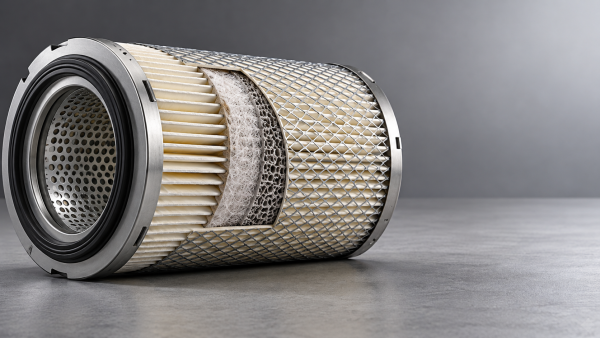
For selection purposes, the useful information is the actual construction: fiber diameter distribution, fine-layer basis weight, substrate composition, layer sequence, bonding method, and whether electrostatic charge contributes materially to filtration efficiency. These details explain how the media works and which mechanisms could degrade in service.
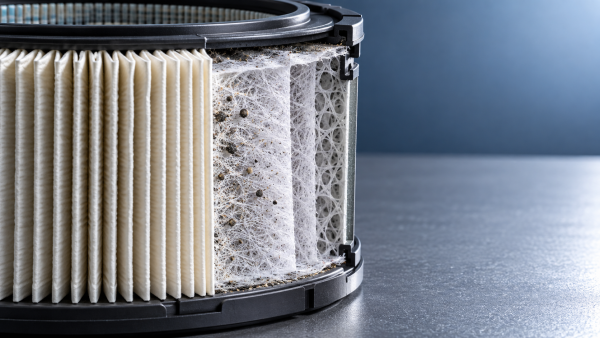
The fine-fiber layer provides capture sites; the supporting layers provide some combination of depth filtration, stiffness, pleatability, and mechanical protection. Their functions must be coordinated. A highly efficient layer supported by a substrate that deforms under restriction is not a durable engine-intake solution. Neither is a robust substrate laminated in a way that blocks too much usable airflow area.
Does synthetic media hold more dust than cellulose?
There is no universal ranking. Synthetic media can offer greater dust holding capacity when its fiber structure provides substantial accessible void volume and distributes dust through the media thickness. A dense synthetic composite can hold less dust before reaching its restriction limit than a well-designed cellulose medium.
Dust holding capacity is not simply the mass of dust a material can contain. For an engine air cleaner, it is the amount retained before a defined terminal restriction is reached under specified test conditions. Changing the airflow, test dust, terminal restriction, or exposed media area changes the comparison.
Cellulose filter media can be engineered through fiber selection, resin treatment, thickness, and pore structure. Synthetic media offers different opportunities to control fiber geometry and moisture response, but those opportunities do not guarantee a better finished filter. Cellulose/synthetic blends further weaken any simple division between the two categories.
A claim that synthetic media holds more dust than cellulose is therefore incomplete without the test conditions and efficiency results. Higher capacity achieved by allowing more dust to pass downstream is not an improvement in engine protection.
The central trade-off is where dust accumulates
A fine-fiber layer can intercept particles before they enter the supporting structure. As a dust cake develops, filtration efficiency can increase, but airflow resistance also rises. Whether that behavior is useful depends on how quickly the cake forms and how much restriction the intake system can tolerate.
In a disposable filter exposed to sustained heavy dust, concentrating capture in a very thin upstream layer may leave much of the substrate’s storage volume unused. A more open upstream structure or a graded arrangement may distribute loading more effectively. However, reversing the layer sequence is not automatically an improvement: it can change initial penetration, fine-layer protection, and the ability to remove accumulated dust.
Surface-loading designs can be attractive where the filter is specifically engineered and validated for cleaning. That does not mean any nano-coated or meltblown composite is cleanable. Compressed-air cleaning can damage fine fibers, separate layers, or create local penetration paths without obvious visible damage. Cleaning must be part of the approved element design and service procedure, not an assumption based on surface appearance.
The relevant loading curve is therefore more informative than a single capacity figure. A medium with low clean restriction but a steep early rise may reach its service limit sooner than a slightly more restrictive medium with a steadier loading response.
Heavy-duty intake conditions challenge more than particle capture
Moisture changes both airflow and structural behavior
Low moisture absorption by a polymer does not make a filter assembly immune to water. Liquid can bridge pores, interact with deposited dust, and increase restriction. Water repellency also depends on surface chemistry and contamination; it cannot be inferred from the word “synthetic.”
The composite needs to retain adequate stiffness, layer adhesion, and dimensional stability under the humidity and wetting conditions relevant to the intake. After drying, the important questions are whether restriction recovers and whether particle penetration or mechanical integrity has changed. A wet filter that remains intact but becomes excessively restrictive can still be unsuitable.
Vibration exposes weaknesses in the composite and the element
Engine and equipment vibration can cause pleat movement, contact abrasion, or fatigue around bonded regions. If a fine layer is exposed to repeated rubbing, local damage may undermine the efficiency measured on an undisturbed laboratory sample.
Bonding requires a balance. Insufficient bonding can permit delamination; excessive adhesive coverage can obstruct pores and create uneven airflow. Bond patterns, adhesive chemistry, and converting conditions should therefore be evaluated alongside tensile strength and permeability. A strong flat sheet is not proof of a stable pleated element.
Temperature and contaminants require material-specific limits
The relevant temperature is the exposure at the installed air cleaner, including heat soak and transient conditions—not a generic ambient rating. The usable limit is set by the weakest component in the composite or assembly, which may be the adhesive, treatment, or seal rather than the filtration fiber.
Where oil mist or other aerosols can reach the intake, their effects also deserve evaluation. They can alter wetting behavior, dust adhesion, and electrostatic capture. A composite that relies significantly on electret charge needs evidence that its efficiency remains adequate after representative exposure and aging.
Why a better media sample can produce a worse air filter
Flat-sheet measurements are useful for screening materials, but heavy-duty intake performance is determined by the finished element. Pleating changes local flow distribution, compresses some regions, and introduces folds that can stress a fine-fiber layer.
Adding more media area does not necessarily increase usable capacity in proportion. Closely packed pleats can restrict dust access, encourage bridging between adjacent surfaces, and reduce effective flow area as loading proceeds. If the replacement composite has different thickness or stiffness, retaining the previous pleat count may be the wrong design choice.
The complete intake also has a restriction budget. Ducting, inlet protection, a precleaner, and any safety element consume part of that allowance. Media evaluation should use the airflow and service limits specified for the intended engine and intake configuration, rather than selecting a convenient face velocity that makes a laboratory result look favorable.
A precleaner can materially change the dust challenge reaching the main element. Removing a coarse fraction does not eliminate fine-particle loading, and the remaining particle distribution may favor a different media structure. Testing only with untreated feed dust can miss this interaction.
Sealing remains equally important. Bypass at an end cap or housing interface can defeat a high-efficiency medium. Any move to a new composite should preserve the dimensional control and structural support needed for reliable sealing under loading and vibration.
The evidence needed before approving a substitution
ISO 5011 provides an established framework for evaluating inlet air-cleaning equipment for internal combustion engines and compressors. A report should identify the applicable edition, test configuration, airflow, dust specification, and endpoint. “Tested to ISO 5011” without results and conditions is not sufficient evidence of suitability.
The most useful comparison is between complete candidate elements and the incumbent filter under matched conditions. The evidence should connect engine protection, restriction, capacity, and durability rather than treating them as separate marketing claims.
- Clean restriction across the required airflow range: this establishes the starting pressure-drop penalty and its compatibility with the intake system.
- Efficiency and dust penetration during loading: overall efficiency should be accompanied by information on early-life performance and downstream dust, with particle-size-resolved assessment where the application requires it.
- Restriction versus retained dust: the complete curve shows loading behavior and capacity at the agreed service endpoint.
- Performance after conditioning: relevant humidity, wetting, temperature, and vibration exposure should be followed by checks of filtration and structural integrity.
- Element integrity under differential pressure: pleats, bonds, supports, and seals must withstand the specified loading and foreseeable service conditions.
Test dust selection deserves particular attention. Coarse mineral dust and fine dust can produce different loading patterns, so one favorable result should not be generalized to every operating environment. The test program should reflect the intended duty without pretending that a laboratory dust reproduces every field contaminant.
Sample consistency also matters. Qualification data from one carefully prepared element does not establish manufacturing repeatability. Production controls should cover the characteristics that drive performance: permeability, basis weight, layer uniformity, bond quality, and converting damage. For charge-dependent media, storage and aging conditions also need definition.
Where the case for adoption is strongest
Nano meltblown composites merit consideration when an existing filter has an identifiable limitation that the construction can address—for example, inadequate initial fine-particle capture, unacceptable moisture-related deformation, or insufficient service life within a fixed housing. The candidate still needs to demonstrate improvement without sacrificing another critical requirement.
The case is weaker when the only evidence is a high initial efficiency result, a low clean pressure drop, or an unqualified claim of greater dust holding capacity. None establishes how the element behaves near its service limit.
Commercial comparison should follow technical qualification. A higher media price may be justified by longer validated service intervals or a more compact element; a lower price can be misleading if earlier restriction increases replacement frequency. Neither outcome can be inferred from laboratory sheet properties alone.
The acceptance criterion is not whether nano meltblown is more advanced than cellulose. It is whether the proposed element delivers sufficiently low dust penetration, acceptable restriction throughout loading, and durable construction under the intended duty. If it meets those requirements consistently, it is a credible heavy-duty intake option. If the evidence stops at the material label, suitability remains unproven.
Recommendation
 Oct 20, 2026
Is Nano Meltblown Composite Media Fit for Heavy-Duty Engine Intakes?
How does synthetic media compare with cellulose media in dust holding capacity? Explore nano meltblown filters, dust loading, and durability to choose the right heavy-duty engine intake media.- Oct 20, 2026
How Much Can Nano Meltblown Media Improve Dust Holding Capacity?
Is nano meltblown composite media suitable for heavy-duty engine intake filters? Discover how dust capacity, airflow resistance, and ISO 5011 testing guide smarter filter selection. - Oct 20, 2026
How Do You Select Filter Media for High-Humidity Coastal Sites?
How much can nano meltblown media improve dust holding capacity? Discover how to select coastal filter media that withstand humidity, manage salt exposure, and control pressure drop.