How harsh environment filtration solutions prevent premature filter failure
How Harsh Environment Filtration Solutions Prevent Premature Filter Failure
Harsh Environment Filtration Solutions are essential when filtration systems must operate through conditions that ordinary media were never designed to tolerate. For technical evaluators, the issue is rarely just whether a filter can achieve a target efficiency rating on a clean test rig. The practical question is whether it can maintain airflow, particle capture, shape, and sealing integrity after repeated exposure to moisture, salt, dust, temperature swings, vibration, or chemically active contaminants.
Premature filter failure often begins as a small material-level weakness. Fibers can lose their structure when wet. A binder can soften or become brittle. Fine dust can block the upstream surface before the depth of the media is used. Salt-laden moisture can alter pressure-drop behavior or contribute to corrosion elsewhere in the intake system. In manufacturing machinery, gas turbine installations, outdoor process equipment, and other demanding assets, these effects can shorten maintenance intervals and create operating uncertainty long before the nominal service life expected from a conventional filter.
A durable solution therefore has to be engineered around the exposure profile, not selected solely from a filtration-class label. Efficiency remains important, but it must be considered alongside dust holding capacity, wet stability, hydrophobic behavior, mechanical strength, and the way the full filter assembly responds under actual operating conditions.
Why filters fail early in demanding service
“Harsh environment” is not one condition. A dry inland desert and a humid coastal site can both produce early filter replacement, but through different mechanisms. Desert sites usually combine high particulate loading with fine mineral dust, wind-driven ingress, and occasional sharp temperature changes. Coastal installations face salt fog, humidity, and wet-dry cycling. Rainy tropical environments add persistent moisture, biological exposure, and the risk of media loading with agglomerated dust. Outdoor machinery may see all of these conditions over a single annual cycle.
The most common failure modes are connected rather than isolated:
- Surface blinding: fine particles form a dense layer near the air-entry face, rapidly increasing resistance and reducing usable media depth.
- Moisture-induced loading: water causes particles to adhere, bridge pores, or compact into deposits that are harder to release or distribute through the media.
- Media deformation: inadequate wet strength or poor pleat support can lead to sagging, channeling, or unstable pressure-drop performance.
- Salt-related degradation: salt fog can challenge both filter media and surrounding components, especially where moisture remains trapped after exposure.
- Weak system interfaces: a sound media design can still underperform if lamination, adhesive compatibility, gasket sealing, or frame construction is not suited to the environment.
It is tempting to interpret every early replacement as evidence that a higher-efficiency filter is needed. That is not always correct. A finer media may capture more small particles, yet it can also build resistance too quickly if the dust profile, moisture level, face velocity, or prefiltration arrangement has not been considered. In difficult service, a filter that remains structurally stable and loads predictably can be more useful than one that performs impressively only under clean, dry conditions.
The material decisions that make the difference
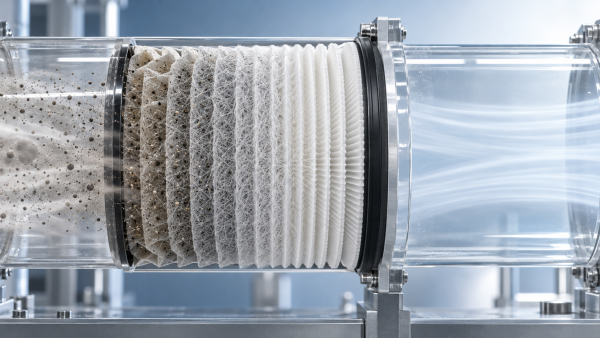
Durable filtration starts with fiber architecture. Gradient media are often valuable because they distribute particles through the thickness of the material rather than concentrating all loading at the surface. The intended effect is not simply more capacity on paper; it is a slower and more manageable rise in differential pressure when the incoming air contains a mixture of coarse and ultra-fine dust.
Synthetic structures can offer advantages in wet and weather-exposed applications, particularly when hydrophobicity and three-dimensional pore stability are part of the design. A moisture-resistant medium should not be evaluated only by whether it repels a visible water droplet. Technical review should also consider whether its pore structure remains open after humid exposure, whether layers stay bonded, and whether the media retains enough stiffness to support the chosen pleat geometry.
Composite constructions add another level of control. A nano meltblown layer, for example, can help intercept ultra-fine particles, while a more open supporting layer contributes strength and dust accommodation. The trade-off is critical: each layer changes resistance, adhesion requirements, and the way contaminants migrate through the filter. For this reason, selecting a material stack is a system-engineering task rather than a simple comparison of basis weight or thickness.
Lamination technology also deserves attention. PUR, hot-melt adhesive, solvent-based emulsion spray, and ultrasonic methods do not produce identical interfaces. The appropriate process depends on the substrate, intended flexibility, thermal exposure, humidity, and the degree to which adhesive migration could affect pore openness. A filtration material can lose practical value if a bonding process creates inconsistent airflow paths or becomes the weak point during wet-dry cycling.
Evaluate the operating environment before specifying the filter
The most useful evaluation begins with what reaches the intake, not with a catalog selection. Technical teams should identify the dominant contaminant, its approximate particle-size distribution where available, likely moisture sources, seasonal changes, and upset conditions. Nearby roads, construction activity, sea exposure, cooling towers, process emissions, and maintenance practices can all change the filtration challenge.
This review should include airflow and velocity at the filter face. Even a well-chosen medium can load unevenly when air distribution is poor. Bypass leakage, damaged housings, incorrect installation, or insufficient drainage can look like a media problem. Separating those causes early prevents unnecessary changes to the filter specification.
Gas turbine intake filtration requires a balanced specification
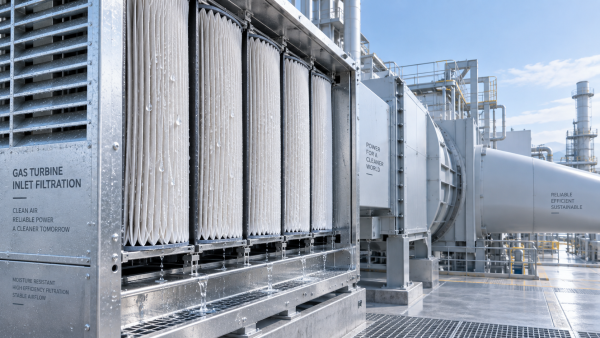
Gas turbine intake systems make the consequences of poor filtration especially visible. Fine contaminants that pass through the intake can affect compressor cleanliness, while excessive restriction can reduce available airflow and complicate operational planning. The filtration objective is therefore a balance: capture the relevant particle fraction, manage high dust loads, resist weather exposure, and maintain a stable pressure drop over a reasonable service interval.
For projects spanning inland desert, extreme coastal, and rainy outdoor environments, the media needs are not identical. Wet-laid gradient media can support controlled dust loading; moisture-resistant 3D synthetic media such as HidroSal or HydroSoil designs can be relevant where water and salt fog are persistent concerns; nano meltblown composite media may be considered where interception of ultra-fine dust is required. The final choice still depends on the filter configuration and local operating conditions, not on a material name alone.
An example of this approach can be seen in Gas Turbine Intake Filtration media developed for F9 to E12 filtration requirements. Its stated design focus includes moisture resistance, salt-fog resistance, ultra-fine particle interception, high dust holding capacity, and stable low pressure drop. Where ISO29461 alignment is required, the applicable test scope and project documentation should be reviewed rather than assuming that one stated filtration grade answers every gas-turbine intake requirement.
This distinction matters during technical comparison. Two media may carry similar efficiency designations but behave differently after humidity exposure or under sustained dust loading. Ask for the conditions behind performance claims: dry or conditioned state, test aerosol, airflow, pressure-drop basis, and whether the values apply to raw media or a finished element. Those details are often more useful than a headline grade.
Avoid the specification habits that create hidden risk
One recurring mistake is treating initial pressure drop as the main measure of energy performance. Initial resistance matters, but the operating curve matters more. A medium with an attractive starting value may accumulate dust in a way that produces a steep rise in restriction. Conversely, a slightly different initial profile may deliver more stable operation if it uses its depth effectively and avoids premature surface blinding.
Another weak practice is separating media selection from conversion and assembly. Filter media needs to be evaluated with its intended pleating, spacing, adhesive, frame, and seal. Moisture can expose problems at the interfaces between these elements. If a filter is likely to experience rain ingress, high humidity, or washdown-adjacent conditions, the technical review should include how the complete construction handles drainage and mechanical stress.
Finally, supply continuity should be treated as an engineering consideration. A technically acceptable imported medium with uncertain lead times can create maintenance risk when replacement planning is tight. Qualified alternatives are valuable only when material consistency, performance verification, and manufacturing control are understood. Stable availability does not replace validation, but it can reduce avoidable operational exposure after the specification has been confirmed.
From material development to a more reliable filtration system
Material suppliers can contribute more effectively when they understand the full use case. Hangzhou Chaocai Materials Co., Ltd. develops functional advanced materials for applications where manufacturing complexity and performance requirements create a high technical threshold. Its production capabilities include fully synthetic wet-laid lines as well as PUR, hot-melt adhesive, solvent-based emulsion spray, and ultrasonic lamination platforms. That breadth is relevant because filtration performance is often shaped by the interaction of fibers, coatings, supporting layers, and joining processes.
The same development logic applies across specialized filtration fields, including gas turbines, automotive systems, new energy, semiconductors, and biopharmaceutical applications: identify the real stressors, design the material architecture around them, then verify the finished solution against the application’s technical requirements. There is no universal “harsh-duty” filter. There are only combinations of contaminants, climate, airflow, maintenance constraints, and performance priorities that must be resolved with appropriate evidence.
Before approving a harsh-environment filtration solution, confirm the target efficiency range, initial and loaded pressure-drop expectations, dust challenge, moisture and salt exposure, mechanical construction, applicable standards, and replacement strategy. That process is more demanding than selecting the lowest-cost media, but it is the practical route to preventing filters from failing before their intended service interval.
Recommendation
 Oct 10, 2026
How Can Air Filter Media Increase Dust Holding Capacity Without Higher Pressure Drop?
Which liquid filter media is suitable for hydraulic oil fine-particle filtration? Discover how advanced air filter media increases dust holding capacity with low pressure drop.- Oct 10, 2026
Which Liquid Filter Media Is Suitable for Fine Hydraulic Oil Filtration?
Can synthetic filter media replace glass fiber in high-humidity gas turbine intakes? Explore media choices for fine hydraulic oil filtration, balancing efficiency, moisture resistance, pressure drop, and service life. - Oct 10, 2026
Can Synthetic Filter Media Replace Glass Fiber in Humid Turbine Intakes?
Is ePTFE filter media suitable for pulse-cleaned construction equipment air filters? Explore synthetic vs. glass fiber performance in humid turbine intakes.