Is F9 Filter Media Suitable for Gas Turbine Intake Filtration?
Yes, F9 filter media can be suitable for gas turbine intake filtration, provided the complete filter meets the turbine’s air-cleanliness requirements and operates within the intake system’s pressure-drop limits. F9 describes a filtration efficiency class under an older test system; it does not, by itself, establish whether a filter will withstand moisture, capture site-specific contaminants, or perform adequately throughout its service life.
For an intake exposed to fine dust, salt mist, fog, or industrial aerosols, choosing a filter on the F9 label alone can lead to two different problems: insufficient protection against the contaminants reaching the compressor, or excessive inlet resistance that affects turbine operation. The useful question is not simply whether F9 is “good enough,” but where the filter sits in the system and how the assembled element performs under the expected conditions.
What does an F9 rating tell you about a filter?
F9 is a fine-filter class from the former EN 779 classification system. It describes performance measured under that standard’s specified laboratory conditions, not a guaranteed capture rate for every particle size or operating environment. A rating assigned under one test method should not be treated as an exact equivalent of a rating assigned under another.
For current comparisons, ask suppliers for the applicable test standard and the complete test report or relevant performance data. ISO 16890 uses particle-size-based efficiency groups, while ISO 29461 addresses filtration systems for rotary machinery. A supplier may provide data to one or more of these standards, but the test method, airflow, and tested item must be identified before the results can be compared.
Pay particular attention to whether a claim applies to a flat sheet of media or a complete filter element. Media data helps assess the material, but the finished filter also depends on pleat geometry, frame construction, seals, and possible bypass paths. A well-performing sheet cannot compensate for leakage around a poorly fitted element.
Where can F9 media fit in a gas turbine intake system?
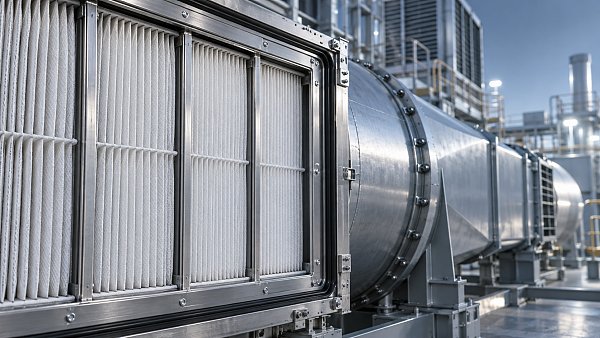
F9 media may be used in a fine-filtration stage, often downstream of equipment intended to remove larger particles or water. In some installations, the required final filtration performance may be higher, or the environmental exposure may call for additional stages. The turbine manufacturer’s intake specifications and the site’s operating objectives determine whether an F9-class filter is an appropriate final stage or only part of a broader arrangement.
Consider a dusty intake where a fine filter loads rapidly. A suitable upstream prefilter may reduce the dust reaching that fine stage, but adding a stage also introduces its own resistance and maintenance needs. A prefilter should therefore be selected as part of the full system, not simply added in the hope of extending the final filter’s life.
In a coastal or frequently foggy location, the first concern may be keeping liquid water and salt-laden droplets from reaching the fine media. Separators, weather protection, drainage, and appropriate upstream stages can be important. Their suitability depends on the size and form of the contamination; no dry particle-filter rating alone establishes salt-removal performance.
Is F9 enough to protect a turbine from fine particles?
Sometimes, but the class alone cannot answer that question. Fine particles that pass through an intake filter can contribute to compressor fouling, while other contaminants may introduce erosion or corrosion risks. The consequences depend on particle composition and concentration, local humidity, turbine design, operating hours, and maintenance practices.
Start with the turbine manufacturer’s specified intake air quality and approved filtration arrangement. Then compare that requirement with the finished filter’s documented efficiency over the relevant particle-size ranges. Where the specification calls for a higher-efficiency final filter, an F9 designation is not a substitute merely because the media is described as “fine filtration.”
Also consider efficiency during use. Some media rely partly on electrostatic effects, and their measured efficiency can change as the media is conditioned or loaded. Ask how efficiency was measured and whether the reported value reflects the condition required by the applicable test method. Avoid comparing an initial media result from one supplier with a conditioned complete-filter result from another as though they were directly interchangeable.
How much pressure drop is acceptable?
There is no universal acceptable pressure drop for F9 media. The relevant limit comes from the turbine and intake-system design, including the available allowance for all intake components. The installed filter must be assessed at the actual operating airflow, not just at a convenient laboratory flow rate.
Initial pressure drop is only the starting point. As particles collect, resistance generally rises. The operating team needs to know the permitted final pressure drop, expected loading conditions, and change-out procedure. A filter with a low initial resistance may not deliver the lowest operating cost if it loads quickly; conversely, a filter with more media area may offer a different loading profile but still needs to fit the housing and airflow distribution.
When comparing proposals, request pressure-drop data for the complete element at the specified airflow. Check whether the figures cover clean conditions only or include loading information, and whether the reported airflow is per element or for the entire filter bank. These distinctions prevent an apparent improvement from being caused merely by a different test basis.
What happens when F9 media gets wet?
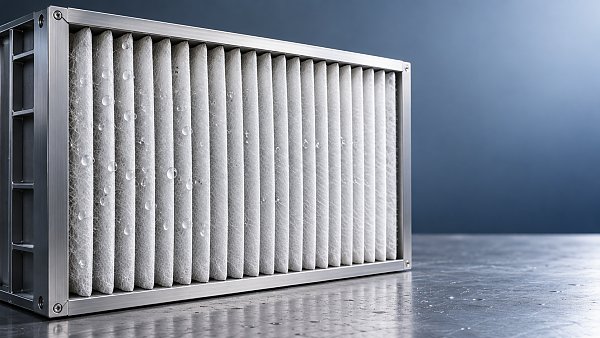
Water can change airflow resistance, redistribute deposited dust, and place stress on media and filter construction. A wet filter may also behave differently after drying. The effect depends on the media, binder or laminate, pleat support, exposure duration, and the amount of water reaching the filter.
Moisture resistance should not be inferred from the F9 label. Ask for evidence relevant to the expected exposure, such as wet-strength or water-resistance information and, where available, performance of the assembled filter under a representative test. A material that tolerates humid air is not necessarily suitable for repeated liquid-water impingement.
If differential pressure rises during rain or fog and falls again as conditions dry, investigate water entry as well as dust loading. Inspect upstream weather protection, separators, drains, and housing seals in accordance with site procedures. Replacing the fine filter without addressing the water path may leave the cause unchanged.
Does F9 media remove salt, oil mist, or gases?
An F9-class particle filter may capture some contaminant-bearing droplets or particles, but the rating does not establish performance against every form of salt or oil. Salt dissolved in small airborne droplets, dry salt particles, and water carrying salt into the housing present different challenges. Oil mist can also alter loading and pressure-drop behavior, depending on concentration and droplet size.
Gaseous contaminants require a separate assessment. A particle-efficiency class does not demonstrate removal of corrosive gases or vapors. Where those contaminants are a concern, identify their source and concentration, then determine whether a specifically designed gas-phase treatment stage is needed and whether it is compatible with the turbine intake.
For mixed contamination, provide the supplier with the likely contaminant forms rather than a general description such as “coastal air” or “industrial pollution.” Useful details include visible liquid carryover, seasonal fog, nearby dust sources, and any available site-monitoring data. If the composition is unknown, avoid assuming that an F9 efficiency claim addresses the complete exposure.
How should a buyer compare F9 filter media?
Begin with the filter element and housing specification, then work backward to the media. A useful inquiry includes the required airflow, filter dimensions, available depth, sealing arrangement, allowable pressure drop, and any constraints on replacement intervals. Supply the expected temperature and humidity ranges and describe exposure to rain, washdown, salt, oil, or process emissions where relevant.
For Hangzhou Chaocai Materials Co., Ltd. custom filter media, as with any proposed material, request application-specific data rather than assuming that a manufacturing capability establishes suitability for a particular turbine. The media supplier and filter assembler may need to align on pleatability, bonding, mechanical support, and the tests required for the finished element.
Compare submissions against the same operating basis:
- Efficiency: Identify the standard, particle-size information, conditioning method, and whether the tested sample was media or a complete filter.
- Airflow and resistance: Match the stated flow rate to the proposed element and obtain initial pressure-drop data at that flow.
- Environmental exposure: Ask what evidence supports performance after moisture exposure and whether the construction is appropriate for the contaminants present.
- Mechanical fit: Confirm dimensions, pleat stability, frame compatibility, and the sealing arrangement that prevents unfiltered air from bypassing the media.
- Operating limits: Establish the permitted final pressure drop and replacement criteria with reference to the intake and turbine requirements.
Do not treat a more efficient media sheet as an automatic improvement if it causes the completed filter to exceed the available pressure allowance. Equally, do not accept lower resistance as a benefit without confirming that the required particle capture and sealing performance remain intact.
Can an F9 filter replace the existing intake filter directly?
Not solely on the basis of its class or external dimensions. A replacement should match the specified airflow, mechanical interface, gasket compression, and pressure-drop requirements. Check that the frame can withstand the operating conditions and that the proposed media and pleat pack do not obstruct the housing’s intended airflow path.
Review the arrangement as a filter bank as well as an individual element. Gaps between frames, damaged gaskets, incorrect latching, or poorly seated elements can allow bypass air downstream of otherwise suitable media. Inspection and replacement must follow site isolation and safety procedures; opening an operating intake can create equipment and personnel hazards.
Where the replacement changes filtration class, construction, or pressure-loss characteristics, confirm compatibility with the turbine manufacturer’s requirements and the site’s engineering approval process before installation. Retain the supplier’s documentation so subsequent pressure-drop trends and service-life observations can be compared on a consistent basis.
When should the filter arrangement be reviewed rather than the media alone?
Review the whole intake when filters repeatedly load much faster than expected, moisture reaches the fine stage, or downstream fouling persists despite apparently acceptable filter efficiency. Those symptoms can point to upstream separation problems, air bypass, unexpected contaminants, uneven airflow, or an unsuitable maintenance interval—not necessarily a defect in the media.
Record differential pressure alongside operating airflow and weather conditions, and inspect removed elements for uneven loading, damaged seals, wet areas, or deformation. Compare observations with the installation specification and available test data. If the cause remains unclear, an intake-system assessment can establish whether the appropriate change is a different media, a revised filter element, better water management, or a different combination of stages.
Recommendation
 Nov 02, 2026
Is F9 Filter Media Suitable for Gas Turbine Intake Filtration?
Explore Ltd. custom filter media for gas turbine intakes. Learn when F9 filtration is suitable and how to assess efficiency, pressure drop, and moisture resistance.- Nov 02, 2026
How Moisture-Resistant Is Hangzhou Super Material's Filter Media?
Ltd. gas turbine filter media: How well does Hangzhou Super Material's filter media handle moisture? Explore key tests and selection factors. - Nov 02, 2026
What Gas Turbine Filter Media Does Hangzhou Super Material Offer?
Explore Ltd. filter media reviews and discover Hangzhou Super Material’s synthetic and laminated media capabilities for gas turbine inlet filtration.