What Causes Moisture-Resistant Filter Media to Fail Early?
What Causes Moisture-Resistant Filter Media to Fail Early?
What causes moisture-resistant filter media to fail early? Humidity is often blamed first, but moisture alone is rarely the whole explanation. Premature failure usually develops through an interaction between the media structure, resin or coating chemistry, lamination method, contaminant load, airflow conditions, and the way the finished filter is assembled and operated. A material may look stable during incoming inspection, then soften, delaminate, lose stiffness, or show an unexpected pressure-drop increase after weeks of condensation cycling in service.
For filter manufacturers, system designers, and maintenance teams, the practical question is not simply whether a medium is “moisture resistant.” It is whether the complete material construction can retain filtration performance under the actual combination of water exposure, temperature, airflow, dust, chemicals, vibration, and mechanical stress. That distinction matters in demanding applications such as gas turbines, automotive air systems, battery manufacturing, semiconductor facilities, and biopharmaceutical environments, where an early filter failure can affect equipment availability as well as air quality.
Moisture Resistance Is a System Property, Not a Single Material Feature
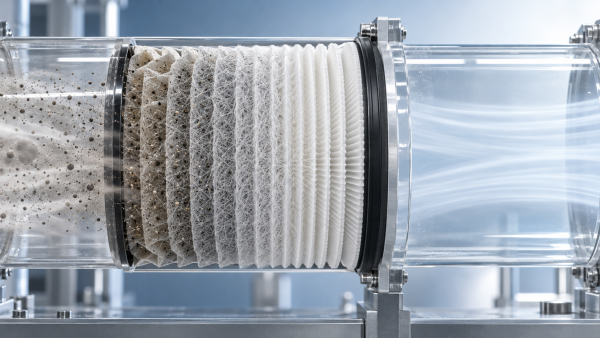
A filter medium can resist brief contact with water yet still fail in a wet operating environment. Water repellency at the surface is only one part of the picture. The fiber web must maintain its geometry, binders must remain intact, layers must stay bonded, and the media must tolerate repeated wetting and drying without excessive loss of strength or pore stability.
This is particularly relevant for composite media. A filtration layer may be paired with a support substrate, a drainage layer, a protective scrim, or an adhesive lamination. If one layer absorbs water or expands differently from another, internal stress can build at the interface. The filtration layer may not visibly crack, but a weakened bond can later become delamination during pleating, pulse cleaning, vibration, or high-velocity airflow.
The phrase moisture-resistant filter media therefore needs to be interpreted in context. Is the exposure occasional splash, sustained high relative humidity, liquid water carryover, condensation, washdown, salt-laden air, or repeated thermal cycling? These conditions demand different material decisions. A medium designed for humid intake air is not automatically suitable for an application where droplets impinge directly on the filter face.
Weak Fiber Bonding Can Turn Humidity into Structural Failure
One of the most common root causes is insufficient or unstable fiber bonding. In wet-laid nonwovens and other fibrous media, bonding determines how well the web retains its pore structure under handling and service load. When binder distribution is uneven, or when the bonding mechanism is not compatible with the fibers and intended environment, moisture can accelerate loss of integrity.
The symptoms are not always dramatic. A filter may exhibit fuzzing, localized thinning, fiber shedding, pleat deformation, or a gradual shift in pressure drop. In severe cases, portions of the media can compact under airflow. Compaction changes the open structure that initially provided the required balance between particle capture and air permeability. The filter may then load faster than expected, even though the dust challenge has not changed.
Bonding must also be evaluated after conversion, not only in flat-sheet form. Slitting, pleating, embossing, frame assembly, and adhesive curing can impose heat and mechanical stresses that reveal marginal cohesion. If a moisture-resistant medium performs acceptably as a roll but loses stiffness after the filter-making process, the problem may lie in the interaction between material construction and downstream manufacturing conditions.
Coatings Can Protect the Media—or Create a New Failure Path
Hydrophobic coatings are widely used to reduce wetting, but a coating should not be treated as a universal fix. Its chemistry, add-on level, coverage uniformity, flexibility, and adhesion to the substrate all influence long-term behavior. A coating that is too light may leave vulnerable regions. One that is too heavy may restrict airflow, alter dust-release characteristics, or make the media less flexible during pleating.
Poor compatibility between the coating and the underlying fiber or binder is another concern. Under high humidity, condensate exposure, or temperature swings, the interface can weaken. Small cracks or discontinuities may develop where the coating cannot move with the web. Once water reaches the underlying structure, the material can behave very differently from its initial surface test result.
Chemical exposure complicates the issue further. Air streams may contain cleaning residues, oil mist, process vapors, salts, plasticizers, or other contaminants that affect surface energy and coating stability. A medium selected only on the basis of water repellency may be poorly matched to its actual chemical environment. Where the air composition is uncertain, a realistic compatibility review is more useful than relying on a generic moisture-resistance claim.
Lamination Quality Often Determines Whether a Composite Survives
Many high-performance filter materials are multilayer constructions because no single layer can provide every required characteristic. A fine filtration web may need a stronger backing. A drainage layer may be added to help manage liquid exposure. A protective layer may improve handling. These structures can be highly effective, but only when the bonding process is suited to the materials and service conditions.
Early failure frequently appears at the lamination interface. Inadequate adhesive coverage, uneven curing, excessive adhesive penetration, or a bond line that becomes brittle at low temperature can all reduce durability. Moisture may enter from cut edges, pinholes, or damaged sections created during converting. The resulting separation is sometimes mistaken for poor base-media quality, even though the real issue is the composite assembly.
The choice of lamination route deserves application-specific attention. PUR lamination, hot-melt adhesive lamination, solvent-based emulsion spray lamination, and ultrasonic bonding each create different bond characteristics. The best approach depends on substrates, desired softness or rigidity, porosity requirements, thermal exposure, chemical conditions, and the geometry of the finished filter. A process that works for a relatively dry automotive cabin application may not be the right choice for a humid industrial intake system.
This is why manufacturing capability has value beyond production capacity. Hangzhou Chaocai Materials Co., Ltd. develops functional advanced materials using fully synthetic wet-laid lines alongside PUR, hot-melt, solvent-based emulsion spray, and ultrasonic lamination platforms. For specialized filtration projects, access to multiple process routes can make it easier to assess whether a failure risk comes from the filtration layer itself, the support layer, or the bonding method joining them.
Condensation Creates More Damage Than Uniform Humidity
A stable humid environment and a condensing environment are not equivalent. Condensation delivers liquid water to localized parts of the media, often at cold surfaces or during startup and shutdown. These repeated wet-dry cycles can cause more stress than consistently elevated humidity because the medium experiences changing mass, surface tension effects, and dimensional movement.
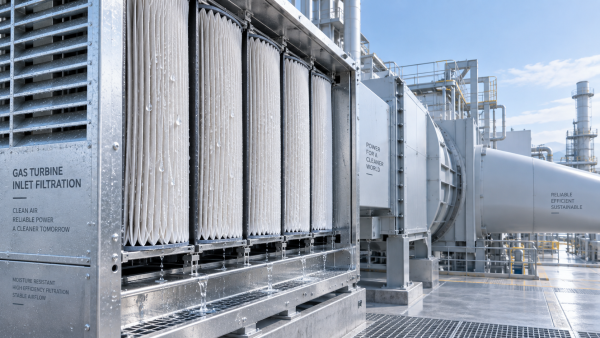
In intake filtration, condensation can occur when warm moist air encounters a colder housing or when weather conditions shift rapidly. In process equipment, shutdown periods may allow moisture to settle before airflow resumes. If accumulated water is then pushed through the filter at high velocity, the media can distort or force contaminants deeper into the structure. A water-resistant surface does not eliminate the need for sound housing drainage, pre-separation, airflow management, and proper installation orientation.
Filter design should therefore consider where water will go, not merely whether the media can repel it. Drainage behavior, pleat spacing, face velocity, gasket sealing, and frame construction can all influence the outcome. A robust medium can still fail prematurely in a system that repeatedly directs liquid water toward the same area of the filter pack.
High Airflow, Dust Loading, and Moisture Can Reinforce Each Other
Water changes how dust behaves. Hygroscopic particles may swell or become sticky, forming a denser surface layer. Fine particles can bridge pores more readily when mixed with moisture. Oily or salt-containing contaminants can create deposits that are difficult to release and may interfere with water-repellent treatments. The result is often a faster-than-expected rise in differential pressure.
High face velocity makes this worse. It increases mechanical stress on wet or partially wetted media and can drive droplets and contaminant agglomerates into the filter structure. In pulse-cleaned systems, the material must also tolerate reverse-pressure events without losing layer adhesion or pleat geometry. A medium that is suitable for static HVAC-style filtration may not be appropriate for dynamic industrial duty without further assessment.
When a filter clogs early, maintenance teams may assume the medium is too fine. That is possible, but not always correct. The more useful investigation asks whether the particle type changed, whether liquid water is present, whether face velocity is within the design range, and whether the installed filter has sufficient drainage and dust-holding geometry for the environment.
Conversion and Storage Problems Are Easy to Overlook
Not every early failure originates in field operation. Storage under uncontrolled humidity, compression damage during transport, contamination on converting equipment, or unsuitable adhesive application can affect the finished filter before it reaches the end user. Rolled media may absorb moisture at exposed edges. Improper tension during unwinding can stretch a delicate web. Excessive heat during pleat formation may change the behavior of a coating or laminate.
These variables are especially important where filter media is converted into complex shapes. Automotive filters, turbine intake elements, and compact equipment filters may use deep pleats, folds, seals, or molded end caps. The media must be selected with its conversion route in mind. Material data from a flat sample cannot fully predict how the same structure will behave after pleating and assembly.
How to Investigate an Early Failure Without Guesswork
A useful failure review begins with evidence from the installed filter. Examine whether damage is uniform or concentrated near edges, lower sections, pleat tips, seals, or the air-entry face. Localized damage often points to water pooling, bypass leakage, mechanical abrasion, or uneven airflow. Uniform softening or pressure-drop increase may suggest a broader media, contaminant, or environmental compatibility issue.
Before changing materials, gather the operating details that most affect selection:
- Whether the filter sees high humidity, visible condensation, direct droplets, or washdown exposure.
- Temperature range and the frequency of startup, shutdown, and thermal cycling.
- Airflow direction, face velocity, pressure fluctuations, and pulse-cleaning conditions where relevant.
- Dust type, oil mist, salt exposure, chemical vapors, and any process changes near the failure period.
- Filter construction details, including pleat design, adhesives, sealants, support layers, and drainage features.
- The form of failure: delamination, collapse, fiber release, swelling, loss of efficiency, odor, corrosion, or rapid loading.
This information helps separate a material limitation from a system problem. It also supports more meaningful laboratory evaluation. Testing should reflect the suspected failure mode where possible: repeated humidity exposure, wet-dry cycling, airflow under moisture, layer-adhesion checks after conditioning, or chemical contact relevant to the application. The exact method and acceptance criteria should be agreed against the product’s operating requirements rather than assumed from a broad category label.
Selecting for Durability Means Looking Beyond Initial Efficiency
Initial filtration efficiency and initial pressure drop remain important, but neither tells the full durability story in wet service. The material selection process should also consider wet strength retention, dimensional stability, coating adhesion, interlayer bond durability, drainage behavior, and resistance to the actual contaminant mixture. In many projects, a slightly different construction delivers a more reliable service life because it avoids a known failure pathway rather than merely maximizing one laboratory metric.
For advanced filtration fields, the right answer may require adjusting fiber formulation, basis structure, support design, or bonding technology together. Companies such as Hangzhou Chaocai Materials Co., Ltd., which focus on differentiated functional materials for technically demanding filtration uses, can evaluate these choices as a material system rather than as isolated layers. That is particularly relevant when requirements span gas turbines, automotive systems, new energy manufacturing, semiconductors, or biopharmaceutical applications, where moisture exposure and cleanliness expectations may differ sharply.
Early failure is rarely solved by adding a stronger water-repellent finish after the fact. The more durable approach is to identify the actual exposure mechanism, review the entire composite construction and filter design, and verify performance under conditions close to service. When those details are defined early, moisture-resistant filter media can be specified for a realistic operating environment instead of an optimistic one.
Recommendation
 Oct 10, 2026
How Can Air Filter Media Increase Dust Holding Capacity Without Higher Pressure Drop?
Which liquid filter media is suitable for hydraulic oil fine-particle filtration? Discover how advanced air filter media increases dust holding capacity with low pressure drop.- Oct 10, 2026
Which Liquid Filter Media Is Suitable for Fine Hydraulic Oil Filtration?
Can synthetic filter media replace glass fiber in high-humidity gas turbine intakes? Explore media choices for fine hydraulic oil filtration, balancing efficiency, moisture resistance, pressure drop, and service life. - Oct 10, 2026
Can Synthetic Filter Media Replace Glass Fiber in Humid Turbine Intakes?
Is ePTFE filter media suitable for pulse-cleaned construction equipment air filters? Explore synthetic vs. glass fiber performance in humid turbine intakes.