What Should You Do If Liquid Filter Media Starts Shedding Fibers?
What Should You Do If Liquid Filter Media Starts Shedding Fibers?
What should I do if liquid filter media sheds fibers? Stop treating the issue as a cosmetic defect. Fiber shedding can contaminate product, reduce filtration reliability, and create costly downstream failures.
The immediate priority is to contain the affected batch, confirm whether released fibers are entering the process stream, and identify whether the cause is material damage, inadequate bonding, or unsuitable operation.
For industrial users, shedding is rarely solved by simply changing a filter element. A durable correction requires reviewing media construction, liquid chemistry, pressure conditions, installation practices, and validation methods.
This guide explains how to investigate liquid filter media fiber shedding, reduce production risk, and select filtration materials that remain stable in demanding industrial liquid applications.
Why Fiber Shedding Requires Immediate Attention
Liquid filter media is expected to retain contaminants without becoming a contaminant itself. When fibers detach, they can travel downstream and interfere with product quality, equipment performance, and process control.
In high-purity processes, even small amounts of loose fiber can be unacceptable. Coatings, chemicals, pharmaceutical intermediates, electronic materials, and precision fluids may all be sensitive to particulate contamination.
Fiber release can also create misleading process data. Operators may believe the filter is capturing upstream contamination when particle counts actually include material released from the filtration media.
That confusion makes root-cause analysis harder. It may trigger unnecessary cleaning, chemical treatment, or equipment maintenance while the actual problem remains inside the filter construction or operating conditions.
Shedding can increase pressure drop as detached fibers accumulate in downstream components. Pumps, valves, nozzles, sensors, membrane filters, and final polishing stages may experience premature fouling or restricted flow.
The business impact can extend beyond one filter change. A contaminated production lot may require rework, additional testing, disposal, customer notification, or investigation under quality-management procedures.
For this reason, treat visible fibers, rising downstream particle counts, or unexplained residue as a process-quality event. The response should be controlled, documented, and based on evidence rather than assumptions.
First Actions When You Discover Shedding
First, isolate the affected filtration train when product specifications or contamination limits could be compromised. Hold potentially exposed material according to your internal quality procedures until the risk is understood.
Record the filter part number, lot number, installation date, service time, fluid type, operating temperature, differential pressure, flow rate, and any recent process changes.
These details matter because fiber shedding may result from a specific manufacturing lot, but it can also be caused by conditions outside the filter’s intended operating envelope.
Inspect both upstream and downstream sides of the housing. Determine whether fibers are loose on the media surface, caught near seals, present in the outlet stream, or accumulating after downstream equipment.
Do not assume all visible fibers originated from the filter. Gaskets, hoses, protective packaging, cleaning cloths, tank linings, and upstream process materials can also release fibrous contaminants.
Collect representative samples using clean, compatible containers. Preserve an unused filter from the same lot whenever possible, since comparison with a new element can accelerate supplier analysis.
For critical applications, use microscopy, particle analysis, gravimetric testing, or material identification methods to compare the released fibers with the filter media and other process-contact materials.
If the filter is still installed, avoid aggressive handling. Pulling, twisting, high-pressure flushing, or removing the media without documentation can destroy evidence needed to identify the failure mechanism.
Confirm Whether the Filter Media Is the Source
A proper investigation begins by distinguishing actual media shedding from captured contamination. This requires comparing fiber appearance, size, color, composition, and morphology with the layers used in the filter construction.
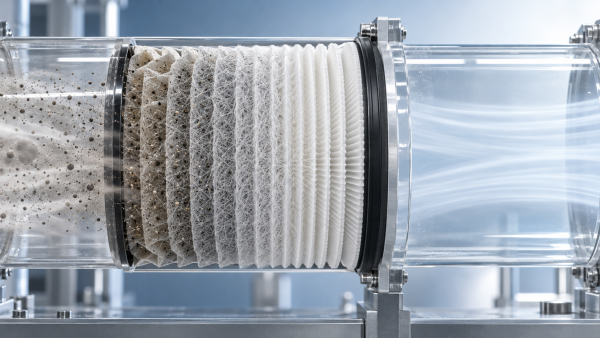
Wet-laid nonwoven media may release fibers differently from woven fabrics, meltblown layers, cellulose-containing sheets, or laminated composite structures. Construction details strongly influence the failure pattern.
Look for directional evidence. Fibers found only downstream are more concerning than fibers trapped on the inlet face, especially when downstream counts increase after filter installation or replacement.
Examine the filter pleats, seams, end caps, support layers, and adhesive boundaries. Localized shedding near a seam may indicate mechanical damage or an adhesion problem rather than broad media instability.
Review whether the filter was pre-flushed according to the supplier’s instructions. Some media types require controlled flushing to remove loose manufacturing residue before service, particularly in clean applications.
However, excessive initial release should not be dismissed automatically as normal conditioning. The acceptable level depends on application requirements, media design, and the supplier’s documented cleanliness performance.
Ask the supplier for retained-sample data, lot traceability, material specifications, and relevant release tests. A capable manufacturer should help determine whether the media meets the agreed construction and cleanliness requirements.
When the fluid is valuable or regulated, send samples to an independent laboratory. Objective analysis can prevent disputes and support a technically defensible decision about disposition and corrective action.
Common Root Causes of Liquid Filter Media Shedding
Insufficient fiber bonding is one of the most common causes. If fibers are not adequately bonded through thermal, chemical, mechanical, or resin-based processes, liquid flow can gradually separate them.
Bonding performance depends on more than adhesive quantity. Fiber type, binder distribution, curing conditions, web density, layer compatibility, and manufacturing consistency all affect resistance to fiber release.
In composite media, weak lamination interfaces can cause delamination or edge fraying. This risk is especially important when multiple functional layers provide filtration, drainage, support, or chemical protection.
Mechanical stress is another frequent cause. Excessive differential pressure can compress, deform, or rupture filter media, releasing fibers from the surface or damaging the internal support structure.
Pressure spikes can be more destructive than steady operating pressure. Rapid valve changes, pump starts, blocked outlets, or poorly controlled backwashing may expose the media to short-term overloads.
Incorrect flow direction can also damage some filter designs. A media stack intended for inside-out flow may not have adequate support when used in reverse, increasing the chance of fiber migration.
Chemical incompatibility can weaken fibers, binders, coatings, adhesives, or laminating layers. Solvents, oxidizers, acids, alkalis, surfactants, and elevated temperatures can affect stability in different ways.
Compatibility should be assessed for the complete filter, not only the primary fiber. A chemically resistant synthetic web may still fail if its binder, adhesive, sealant, or support material is incompatible.
Improper storage can contribute to shedding before installation. Heat, ultraviolet exposure, moisture, dust, crushing, and prolonged storage can degrade materials or damage media edges and pleat geometry.
Finally, handling damage must be considered. Filters can be compromised by forced insertion, contact with sharp housing components, incorrect tightening, contaminated gloves, or attempts to clean the media manually.
How Operating Conditions Can Accelerate Fiber Release
Operating pressure should remain within the filter manufacturer’s specified limits. Monitor both normal differential pressure and transient events, since repeated cycling can fatigue media and bonding interfaces over time.
High flow rates may generate localized velocity through restricted areas of the media. This can create shear forces that are far greater than those predicted by average system flow calculations.
Viscosity changes matter as well. A colder, thicker fluid can increase pressure drop, while temperature shifts can change chemical behavior and soften or weaken certain binder systems.
Solid loading influences media stress. Heavy contaminant loading may form a dense cake that raises differential pressure and creates uneven force across the filter surface, pleats, or support structure.
Some processes contain abrasive particles that mechanically erode exposed fibers. Metal fines, mineral particles, crystalline solids, and hard pigments can abrade media surfaces under high-velocity conditions.
Cleaning and regeneration practices require separate review. Backflushing, air scouring, ultrasonic cleaning, or chemical washing can damage media that was designed only for single-pass or single-use service.
Do not extend filter life solely because flow remains acceptable. If a filter has reached its recommended pressure limit, operating longer may save one changeout while increasing contamination and equipment-risk exposure.
A trend chart is more useful than a single reading. Track flow, pressure drop, temperature, particle counts, and replacement intervals to identify whether shedding follows a repeatable operating condition.
Material Selection: Build Stability into the Filter Design
The most effective long-term solution is usually selecting media designed for the actual liquid, contamination profile, pressure range, temperature, and cleanliness target of the process.
Synthetic wet-laid media can provide a controlled fiber structure and strong process flexibility. Its performance depends on fiber selection, basis weight, pore structure, binder system, and downstream conversion quality.
For demanding applications, evaluate tensile strength, burst resistance, wet strength, abrasion resistance, extractables, and fiber-release performance alongside nominal filtration rating and flow capacity.
Nominal micron rating alone does not define filter quality. Two media products with similar retention ratings may behave very differently when exposed to pressure cycling, solvents, aggressive chemistry, or prolonged wet service.
Layered constructions can improve performance when engineered correctly. A protective upstream layer may reduce abrasion, while a fine downstream layer can improve retention without exposing fragile fibers directly to the flow.
Lamination technology is critical in multilayer media. PUR lamination, hot-melt adhesive lamination, solvent-based emulsion spray lamination, and ultrasonic methods each create different bonding characteristics and compatibility profiles.
The appropriate bonding process depends on fluid chemistry, temperature, required flexibility, pore preservation, and whether extractable adhesive components are acceptable in the final application.
For highly sensitive liquid systems, ask whether the supplier can provide low-shedding or low-extractable designs. Validation should include the finished media, not only individual raw materials.
Advanced filtration suppliers can also tailor media architecture for specialized sectors. Automotive fluids, turbine systems, semiconductor chemicals, battery manufacturing, and biopharmaceutical processes have materially different failure risks.
Questions to Ask Your Filter Media Supplier
Start with a direct technical question: what test methods demonstrate that the media will resist fiber shedding in my fluid and operating conditions? General product claims are not enough.
Ask for documentation covering fiber composition, binder chemistry, layer construction, recommended pressure limits, flow direction, operating temperature, and chemical compatibility for the complete filter media system.
Request information about quality control during manufacturing. Relevant controls may include basis-weight consistency, visual inspection, bond-strength testing, cleanliness checks, dimensional control, and lot traceability.
For critical applications, ask whether the supplier can conduct application-specific testing. Pilot trials using the actual liquid often reveal risks that standard laboratory tests cannot fully reproduce.
Discuss particle-release acceptance criteria before approving a new product. Define sampling methods, flush volume, particle size range, fiber identification criteria, and allowable contamination levels in writing.
Ask how the supplier handles a suspected quality event. A strong partner should provide retained samples, technical investigation, corrective-action support, and clear communication about findings and containment measures.
Evaluate manufacturing capability, not only price. Suppliers with expertise in wet-laid media, lamination, process development, and specialized filtration applications can better control the variables behind long-term media stability.
Hangzhou Chaocai Materials develops functional advanced materials and high-performance filtration media using multiple production platforms, supporting differentiated designs for specialized and technically demanding filtration requirements.
Establish a Practical Troubleshooting Workflow
Create a standard response procedure so operators do not need to improvise when fibers are observed. The procedure should define containment actions, evidence collection, escalation criteria, and restart authorization.
Step one is verification. Confirm that the material is fibrous, determine where it was detected, and compare it with possible sources including filter media, packaging, seals, hoses, and upstream materials.
Step two is operating review. Compare actual pressure, flow, temperature, chemistry, and service duration with approved conditions. Pay particular attention to recent changes, alarms, and maintenance activities.
Step three is physical inspection. Examine the spent filter and housing carefully for tears, collapsed pleats, displaced seals, edge damage, delamination, or unusual deposits that indicate chemical or mechanical attack.
Step four is material assessment. Review the media specification, supplier documentation, lot history, and compatibility data. Determine whether the selected filter construction was appropriate for the duty.
Step five is corrective action. This may involve changing media construction, reducing pressure spikes, revising startup procedures, improving pre-flushing, adding upstream protection, or modifying changeout intervals.
Step six is verification after changes. Run controlled trials, monitor downstream particle levels, inspect early-life filters, and document whether the corrective action eliminated shedding under representative process conditions.
Do not close the investigation based only on a single successful run. Confirm performance over enough operating cycles to show that the improvement remains effective during normal production variation.
How to Prevent Repeat Failures and Reduce Total Cost
Prevention begins at specification stage. Define the actual process duty rather than selecting filters only by micron rating, unit price, or a generic compatibility chart.
Include pressure excursions, startup conditions, cleaning chemicals, temperature ranges, solids loading, fluid aging, and downstream cleanliness requirements in the technical specification sent to potential suppliers.
Use incoming inspection for critical media. Check packaging integrity, product identification, visible damage, lot documentation, and any agreed certificates before filters are released to production.
Train installation personnel on orientation, handling, housing inspection, seal placement, and torque requirements. Many apparent media failures begin with a preventable installation error.
Maintain clean storage conditions. Keep filter media protected from moisture, direct sunlight, compression, airborne contamination, and incompatible chemicals until it is ready for controlled use.
Set replacement criteria using condition data, not only calendar intervals. Differential pressure, flow stability, particle trends, fluid quality, and process criticality should guide maintenance decisions.
Consider the total cost of filtration. A lower-cost medium that sheds fibers can create expenses in product loss, labor, downtime, laboratory analysis, equipment cleaning, and customer-quality risk.
Reliable media can improve process confidence, reduce unplanned interventions, protect downstream equipment, and support consistent product quality. Those benefits often outweigh a modest difference in filter purchase cost.
Conclusion: Treat Shedding as a System Problem
If liquid filter media starts shedding fibers, isolate the risk, verify the source, and investigate the complete filtration system. Avoid assuming that the filter alone is responsible before evidence is collected.
The most common causes include weak bonding, unsuitable media construction, excessive pressure, chemical incompatibility, improper flow conditions, handling damage, and unsupported cleaning or regeneration practices.
Long-term prevention depends on matching filtration media to the real process environment. Material selection, lamination quality, operating discipline, and supplier technical support all influence shedding resistance.
For high-value or contamination-sensitive applications, specify particle-release expectations early and validate performance with the actual fluid. This approach protects quality, reduces maintenance exposure, and supports dependable production.
Recommendation
 Oct 10, 2026
How Can Air Filter Media Increase Dust Holding Capacity Without Higher Pressure Drop?
Which liquid filter media is suitable for hydraulic oil fine-particle filtration? Discover how advanced air filter media increases dust holding capacity with low pressure drop.- Oct 10, 2026
Which Liquid Filter Media Is Suitable for Fine Hydraulic Oil Filtration?
Can synthetic filter media replace glass fiber in high-humidity gas turbine intakes? Explore media choices for fine hydraulic oil filtration, balancing efficiency, moisture resistance, pressure drop, and service life. - Oct 10, 2026
Can Synthetic Filter Media Replace Glass Fiber in Humid Turbine Intakes?
Is ePTFE filter media suitable for pulse-cleaned construction equipment air filters? Explore synthetic vs. glass fiber performance in humid turbine intakes.