When custom filter media is justified for an unusual dust load
When Custom Filter Media Is Justified for an Unusual Dust Load
A dust problem becomes a filtration-design problem when the material being collected no longer behaves like the “typical” particulate assumed by a standard filter grade. The warning signs are familiar to technical evaluators: pressure drop rises earlier than predicted, clean-side particle counts fluctuate, pulse cleaning becomes less effective, media blinding appears in patches, or filter life varies widely from one production run to the next.
In these situations, Custom Filter Media is not simply a preference for a more specialized product. It can be a justified engineering response—provided the design is based on measurable dust characteristics and the real operating envelope. A tailored construction may improve particle capture, stabilize airflow resistance, reduce premature replacement, and protect downstream equipment. But customization also introduces qualification work, so the decision needs to be disciplined rather than instinctive.
The central question is not, “Can a custom media be made?” In advanced materials manufacturing, the answer is often yes. The useful question is: Which failure mechanism in the current filtration system cannot be resolved by changing filter size, operating practice, or an available standard media grade?
Start with the dust, not the filter catalog
“Unusual dust load” can mean many different things. It may describe an unusually high mass concentration, but more often it refers to a difficult combination of particle size, shape, surface chemistry, moisture sensitivity, temperature exposure, or loading behavior. Two dusts with the same average particle size can produce entirely different filter performance if one is fibrous, electrostatically charged, sticky, abrasive, hygroscopic, or prone to forming a compact cake.
Before selecting a media structure, technical teams should build a dust profile that includes more than a nominal micron rating. Useful inputs include:
- Particle-size distribution, including the fine fraction that may drive penetration or deep loading.
- Particle morphology: spherical, irregular, plate-like, fibrous, porous, or sharply abrasive.
- Bulk density and dust concentration over normal, start-up, upset, and peak-load conditions.
- Moisture content, dew-point excursions, oil mist exposure, and potential for hygroscopic behavior.
- Surface tackiness, resin content, plasticizer content, or other factors that cause adhesion.
- Temperature, airflow velocity, pressure cycling, and chemical exposure in the filter housing.
- Whether the collected material must be recovered, safely contained, or kept from cross-contaminating the process.
This work may feel slower than moving directly to a trial sample, yet it usually shortens the overall selection cycle. A media designed around incomplete dust assumptions can create a costly loop of field modifications. In contrast, a clear dust profile helps distinguish between a capture problem, a dust-release problem, a structural-strength problem, and a system-control problem.
The point at which standard media reaches its limit
Standard media is often the right commercial choice when the dust is dry, relatively stable, and within the loading range anticipated by the filter design. It offers predictable supply, established converting methods, and familiar performance expectations. Customization becomes more credible when a standard grade repeatedly forces a compromise that matters to production reliability or total operating cost.
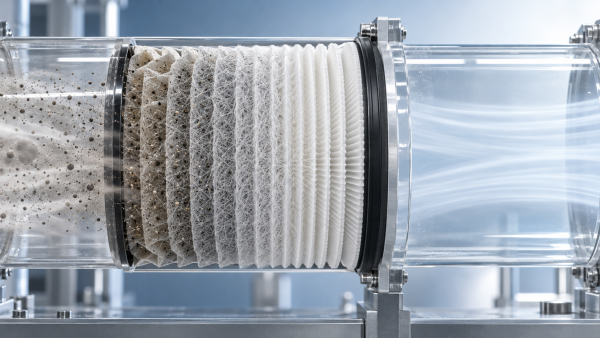
One common example is a mixed dust stream containing both coarse, abrasive particles and a large ultrafine fraction. A coarse, open media may keep initial pressure drop low but permit too much fine-particle passage. A dense media may meet efficiency targets but load internally and reach terminal resistance before the expected maintenance interval. A layered or gradient construction can sometimes place larger fibers or a more open structure upstream for depth loading, while using a finer downstream layer for final capture.
Another difficult case involves dust that is not consistently dry. Small moisture excursions can turn otherwise free-flowing particles into a cohesive layer. The filter may initially appear acceptable, then blind abruptly after a process change or humid operating period. Here, the relevant custom variables may include fiber chemistry, surface treatment, pore architecture, wet strength, and the integrity of bonds between layers—not merely a higher efficiency rating.
For pulse-cleaned systems, the issue may be cake release rather than initial filtration efficiency. A media that captures particles effectively but holds them too tightly can demand more frequent cleaning, consume more compressed air, and experience accelerated fatigue. A surface-oriented construction, appropriate finishing treatment, or a laminate engineered for controlled release may be more valuable than simply increasing basis weight.
Evaluate the four trade-offs that matter most
A robust Custom Filter Media specification does not aim to maximize every property at once. Higher efficiency, low pressure drop, long life, dust release, strength, and low material cost pull the design in different directions. The task is to define which balance is most important for the application.
1. Capture efficiency versus airflow resistance
Finer fiber diameters and tighter pore structures can improve fine-particle capture, but they may also raise initial resistance or promote rapid surface loading. For dust with a broad particle distribution, a gradient structure often offers a more useful balance than a uniform sheet. The upstream region accepts bulk loading; the downstream region acts as a finer barrier. This concept must still be verified at the intended face velocity, because a media that performs well in a laboratory coupon test may behave differently in a full filter geometry.
2. Depth loading versus surface filtration
Depth filtration can hold substantial contaminant mass within the media, which may be desirable for dry, non-sticky particulate in applications where replacement is scheduled. Surface filtration is often preferred where cleaning, cake release, or consistent downstream protection is critical. Neither approach is universally better. Deep penetration may extend useful capacity for some dusts, while the same behavior can become irreversible blinding when particles are tacky or moisture-affected.
3. Mechanical durability versus media openness
High airflow, pressure fluctuations, pleating, vibration, and cleaning pulses place mechanical demands on the sheet. Reinforcement, lamination, or a stronger substrate may be necessary, but excessive reinforcement can reduce permeability or interfere with pleat formation. Evaluators should consider tensile properties, tear resistance, flex fatigue, dimensional stability, and bond durability under the actual temperature and humidity conditions—not only the flat-sheet handling characteristics.
4. Material compatibility versus nominal performance
Fiber selection affects far more than strength. Cellulose may offer useful filtration behavior in appropriate dry-duty applications, while synthetic fibers can contribute moisture resistance and durability. Glass fibers may support fine filtration requirements, and engineering polymers such as PBT can be considered where chemical, thermal, or structural needs justify them. Blends can be especially valuable because they allow a media to combine functions rather than rely on one fiber type to solve every requirement.
The key is compatibility with the full process environment. A dust collector may see cleaning agents, lubricant aerosol, intermittent condensate, volatile compounds, or elevated temperature that are absent from a basic dust sample. If those exposures are ignored, an initially promising media can degrade, delaminate, swell, or lose its intended pore structure in service.
A practical decision screen before commissioning a custom program
Customization is generally justified when at least one of the following conditions is present and can be linked to a meaningful operational consequence:
- Standard media cannot simultaneously meet the required filtration efficiency and the allowable pressure-drop window.
- Filter changes are occurring too frequently because of abnormal loading, blinding, abrasion, or structural damage.
- Dust characteristics vary enough that a conventional grade produces unstable service life or inconsistent clean-side performance.
- Cleaning cycles are ineffective, excessively frequent, or damaging the existing media.
- Downstream equipment, product quality, safety controls, or energy use makes filtration variability unacceptable.
- The filter must fit a particular converting process, pleat geometry, sealing method, or compact equipment envelope.
Conversely, custom development may not be the first move when the root cause is poor air distribution, an undersized filter area, bypass leakage, incorrect cleaning settings, damaged seals, or a poorly controlled source process. A premium media cannot compensate indefinitely for a housing that channels airflow or a dust source that periodically overwhelms the system. The most credible evaluation separates media limitations from system-level defects.
Translate operating data into a media specification
Technical evaluators often receive a request such as “make the filter more efficient” or “extend lifetime.” These goals are too broad to guide material development. A stronger request defines performance boundaries and test conditions. It should identify the target particle range, allowable initial and final pressure drop, airflow rate, duty cycle, temperature range, exposure conditions, cleaning method, and preferred failure mode.
For example, a project may prioritize predictable pressure-drop growth over maximum gravimetric holding capacity. Another may accept a higher initial resistance in exchange for better submicron protection. In a recoverable-material process, the media may need to release collected particles cleanly without introducing fiber shedding or chemical contamination. Such distinctions shape the fiber blend, basis weight, layering sequence, bonding technology, coating choice, and converting behavior.
Material suppliers with multiple process platforms can explore these variables more intelligently than suppliers restricted to a single sheet-making method. Fully synthetic wet-laid production can support controlled fiber dispersion and blend development. PUR, hot-melt, solvent-based emulsion spray, and ultrasonic lamination methods offer different routes for joining functional layers. The right method depends on the required permeability, bond pattern, chemical resistance, thickness control, and long-term laminate integrity.
Hangzhou Chaocai Materials develops advanced functional materials for specialized filtration fields, including gas turbine, automotive, new energy, semiconductor, and biopharmaceutical applications. That cross-sector experience is relevant because difficult filtration assignments often involve competing demands: fine capture without excessive restriction, low extractables where cleanliness matters, or structural stability under demanding process conditions. The goal should not be to transfer a design blindly from one sector to another, but to apply the underlying material-engineering logic to the new dust challenge.
Do not skip validation: a custom sheet is still a hypothesis
Even a well-reasoned media design should move through staged validation. Begin with material characterization and representative dust testing, then assess the construction in the intended filter format. Flat-media results are useful for screening, but pleat spacing, support layers, adhesive interaction, gasket sealing, and housing flow distribution can change real-world behavior.
A practical test plan may compare candidate media on initial resistance, fractional efficiency, loading curve, dust-holding capacity, penetration at critical particle sizes, burst or tensile behavior, and cleaning response where applicable. If the process experiences variable loads, test both normal and severe conditions. The most valuable result is often not the highest single performance number, but a repeatable performance envelope that shows how the media behaves as dust accumulates.
Field trials should include a defined inspection plan. Record pressure drop, airflow or process performance, cleaning frequency, replacement timing, and visible evidence of cake formation, leakage, abrasion, or deformation. When a trial ends, examine the used media rather than treating replacement as the only outcome. The distribution of dust through the cross-section can reveal whether the chosen design is surface-loading, depth-loading, or failing in an unexpected way.
Where liquid-filtration development can inform material thinking
Some technical teams work across air and liquid filtration programs, particularly in new energy manufacturing, where contamination control and material compatibility are closely linked. In those cases, knowledge developed for liquid systems can be useful when considering fiber blends, wet strength, layer integrity, and chemical exposure—although performance conclusions must never be transferred directly from liquid duty to dust collection.
For example, GF1218 is a filter-media option developed for liquid filtration and new energy liquid filtration. Its material options may incorporate cellulose, synthetic fibers, glass fibers, and PBT, including blended constructions tailored to requested specifications. For evaluators, the relevant lesson is not that a liquid media should be used for an airborne dust load; it is that fiber selection and multi-material construction can be deliberately tuned when an application has unusual mechanical, chemical, or contaminant-control requirements.
The decision should be economic as well as technical
A custom media program deserves approval when its value can be stated in operational terms. Consider filter replacement labor, downtime, disposal, compressed-air use, fan energy associated with pressure drop, risk to downstream assets, yield losses, and the cost of inconsistent process control. In some applications, a modest improvement in service stability is more valuable than a dramatic change in nominal filter life because it allows maintenance to be planned rather than triggered by an unpredictable upset.
At the same time, avoid judging the option only by purchase price per square meter. A more sophisticated construction may cost more initially, and it may require qualification time. The relevant comparison is the cost of achieving required filtration performance over the full operating cycle. If a standard media already delivers stable, compliant performance, customization may add complexity without a proportionate benefit. If it repeatedly creates unplanned intervention, the economics look very different.
Custom Filter Media is justified when it turns a poorly defined filtration risk into a controlled, testable material specification. The strongest projects begin with representative dust data, identify the actual mode of failure, define the operating boundaries, and validate performance in the final filter configuration. That approach gives technical evaluators a defensible basis for choosing a tailored solution—one designed not for an abstract dust category, but for the conditions their process genuinely has to survive.
Recommendation
 Oct 10, 2026
How Can Air Filter Media Increase Dust Holding Capacity Without Higher Pressure Drop?
Which liquid filter media is suitable for hydraulic oil fine-particle filtration? Discover how advanced air filter media increases dust holding capacity with low pressure drop.- Oct 10, 2026
Which Liquid Filter Media Is Suitable for Fine Hydraulic Oil Filtration?
Can synthetic filter media replace glass fiber in high-humidity gas turbine intakes? Explore media choices for fine hydraulic oil filtration, balancing efficiency, moisture resistance, pressure drop, and service life. - Oct 10, 2026
Can Synthetic Filter Media Replace Glass Fiber in Humid Turbine Intakes?
Is ePTFE filter media suitable for pulse-cleaned construction equipment air filters? Explore synthetic vs. glass fiber performance in humid turbine intakes.