Which Filter Media Performs Best in Salt Fog Environments?
The Short Answer: Fully Synthetic Media Usually Performs Best
For sustained salt fog exposure, fully synthetic filter media is generally the strongest starting point. Polyester and polypropylene-based nonwovens are usually more resistant to moisture uptake, wet-strength loss, and biological degradation than cellulose-dominant media. In demanding coastal, marine, offshore, and high-humidity industrial environments, a synthetic substrate combined with a moisture-stable binder and corrosion-resistant filter construction will usually provide more dependable service than conventional paper-based media.
That conclusion has important limits. “Synthetic” is not a complete specification, and a high-efficiency material can still fail early if its binder, pleat support, adhesive, wire mesh, end caps, or frame are vulnerable to salt-laden moisture. The best filter media for salt fog is therefore the one whose full construction remains stable through repeated wetting, drying, pressure cycling, and salt deposition at the required filtration efficiency.
For buyers comparing media, the practical question is less about which fiber sounds more advanced and more about what happens after salt aerosol enters the filter, deposits on the surface, absorbs moisture, and remains there during operation or shutdown.
Why Salt Fog Creates a Different Filtration Problem
Salt fog is more aggressive than ordinary humid air. Fine saline droplets can travel with the air stream, deposit on fibers, collect in pleat valleys, and form conductive moisture films on nearby metal parts. When the filter is exposed to repeated humidity changes, deposited salt can dissolve and recrystallize. This cycle can increase pressure drop, weaken unsuitable media, distort pleats, and accelerate corrosion in supporting components.
In a dry dust application, a filter may be evaluated mainly by initial efficiency, dust-holding capacity, and clean pressure drop. Salt fog conditions add another set of failure mechanisms:
- Water absorption can soften or swell certain fibers, papers, and binders.
- Wet media may lose stiffness, allowing pleats to collapse, bridge, or shift under airflow.
- Salt deposits can create localized blockage and raise resistance faster than dry particulate loading alone.
- Corrosion can begin at wire screens, metal frames, fasteners, and exposed cut edges even when the filter sheet itself remains intact.
- Moisture can impair adhesive bonds between the media, separators, gaskets, and end caps.
- Shutdown periods can be as damaging as operating periods because stagnant humid air allows salt deposits to remain wet for longer.
This is why a filter that performs well in a warehouse, inland factory, or vehicle cabin system may not be suitable for an intake system near the coast, a vessel engine room, an offshore enclosure, or an industrial site exposed to saline process air.
How Common Media Families Compare
Cellulose media: often the wrong default for persistent salt exposure
Cellulose media remains useful in many filtration products because it can provide good particle capture characteristics, stiffness, and cost efficiency. However, when salt fog is continuous or recurring, cellulose-rich media deserves close scrutiny. Natural fibers can absorb moisture, and that moisture exposure may alter dimensional stability and mechanical strength. Resin treatment can improve performance, but it does not automatically make a paper-based construction suitable for marine duty.
A cellulose-synthetic blend may be adequate where exposure is brief, salt concentration is low, and the system can dry reliably between events. It should not be selected simply because it is familiar or because it has delivered acceptable results in ordinary ambient conditions. The operating environment must be treated as part of the media specification.
Polyester: a practical baseline for durable pleated filtration
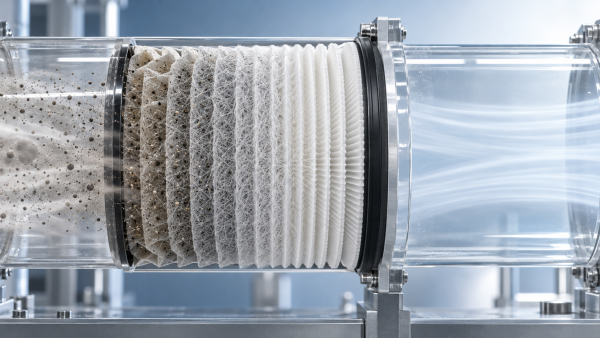
Polyester nonwoven media is often a sensible baseline for salt fog environments because it has low moisture absorption and can retain its structure more effectively than cellulose under wet conditions. It is available in forms suited to pleating, depth filtration, surface filtration, and laminated composite designs. For air intake filters, prefilters, and industrial cartridges, polyester can provide the mechanical stability needed to resist pleat movement when humidity and pressure vary.
Its suitability still depends on the media architecture. A coarse polyester layer may protect a downstream fine filter from larger droplets and particulate contamination, while a denser synthetic layer captures finer salt-bearing aerosol. In some designs, a surface treatment is used to improve drainage or limit deep penetration of wet contaminants. Those choices can improve durability, but they also affect pressure drop and dust-holding behavior.
Polypropylene: strong against moisture, but check the operating window
Polypropylene has very low moisture uptake and strong resistance to many aqueous exposures, making it attractive for wet or humid filtration conditions. It is commonly used in meltblown and spunbond structures, including fine-fiber layers. In salt fog duty, its moisture resistance can be valuable, especially where the filter sees repeated condensation.
The tradeoff is that polypropylene is not automatically the best structural material for every air filter. Its temperature tolerance, stiffness, creep behavior, and compatibility with the rest of the filter design must match the application. A hot intake stream, elevated enclosure temperature, or demanding pulse-cleaning cycle may favor polyester or a composite construction instead.
Glass fiber: appropriate for efficiency-driven systems, with construction controls
Glass fiber media can be used successfully in high-efficiency air filtration, including systems where fine aerosol capture matters. The fibers themselves do not absorb water in the way cellulose does, but the media is rarely just loose glass fiber. Binder chemistry, separator design, pleat support, frame materials, and sealing all influence whether the filter remains serviceable in salt-laden humidity.
For high-efficiency applications, buyers should avoid assuming that a glass-fiber filter is inherently salt-fog-proof. A fine glass-fiber pack may retain salt deposits effectively, yet still suffer from pressure rise, uneven wetting, or structural damage if the assembly was designed for dry indoor service. Efficiency requirements and environmental resistance must be evaluated together.
Media Selection Depends on Where the Filter Sits
The same salt fog environment can call for different media depending on the filter’s position in the system. A coarse inlet filter near an exposed air intake has a different task from a final filter protecting sensitive equipment downstream.
For outdoor machinery intakes, generator enclosures, coastal HVAC systems, and general industrial air handling, a robust synthetic nonwoven often makes sense as the first filtration stage. It needs to manage moisture, retain its pleat geometry, and prevent large droplets or salt-contaminated debris from reaching downstream components. Here, durability and drainage may matter as much as fine-particle efficiency.
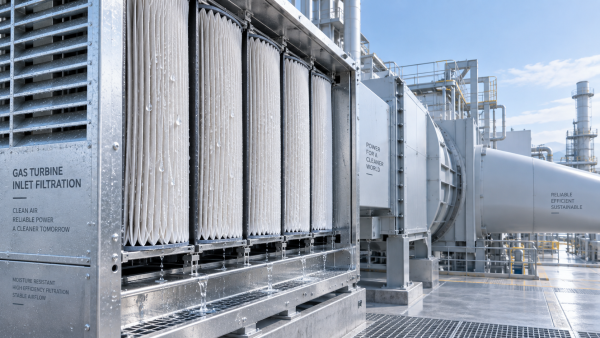
Gas turbine intake systems are more demanding because salt carryover can contribute to downstream corrosion and performance loss. A staged design is often more appropriate than relying on one dense filter layer. The upstream stage may remove larger droplets and coarse contaminants, while a downstream high-efficiency stage addresses finer aerosol. The media must be evaluated with the intake housing, water-separation strategy, drainage path, and corrosion protection of the complete system.
In automotive, new-energy equipment, electronics manufacturing, pharmaceutical production, and semiconductor facilities, the question may be less about direct outdoor salt fog and more about whether contaminated make-up air can reach protected spaces or critical components. Media selection must then consider the required cleanliness level, particle size range, allowable pressure drop, maintenance interval, and the consequences of corrosion or ionic contamination downstream.
Do Not Evaluate the Fiber Alone
A filter supplier may describe a product as polyester, polypropylene, synthetic, or high-efficiency. That description identifies only one part of the construction. Salt fog service exposes weaknesses that are often outside the base fiber layer.
Before approving a filter, examine the following elements as one system:
- Binder system: The resin or bonding approach must maintain adhesion and stiffness under humidity and salt exposure. A moisture-sensitive binder can undermine an otherwise suitable synthetic substrate.
- Pleat geometry: Tight pleat spacing can create sites where water and salt accumulate. Pleat depth, spacing, separators, and support layers should allow stable airflow without trapping excessive moisture.
- Lamination and adhesive: Multi-layer media depends on bond durability. PUR, hot-melt, solvent-based, and ultrasonic bonding methods can produce different results depending on material compatibility and exposure conditions.
- Support components: Galvanized steel, untreated wire, and exposed metal edges may corrode quickly in saline air. The media may survive while the filter loses integrity through frame or support failure.
- Frame and end-cap material: Corrosion-resistant metals, plastics, or suitably protected constructions may be needed for extended service.
- Gasket and seal: A filter that remains intact but allows bypass around its perimeter does not protect downstream equipment.
For this reason, procurement teams should request information on the full filter assembly and intended environment rather than selecting from a media datasheet alone. A media supplier with wet-laid, lamination, and bonding capability may be able to tailor the layers and bonding method to the service condition, but the finished filter still needs validation in its actual configuration.
Efficiency Alone Can Produce the Wrong Choice
It is tempting to specify the highest available efficiency when salt contamination is a concern. That can be appropriate for sensitive downstream equipment, but a finer medium also creates more resistance and can load rapidly if it is placed directly in a wet, salt-laden airstream without suitable prefiltration.
A dense final-stage filter may capture fine saline aerosol effectively, yet it can become the first point of failure if large droplets and coarse contamination reach it unchecked. As salt deposits build, airflow resistance rises. Higher fan energy, reduced intake flow, uneven face velocity, and premature replacement can follow. In machinery applications, inadequate airflow may create operational consequences beyond the filter itself.
The more durable approach is frequently a graded filtration system: remove larger droplets and particles early, preserve the fine stage for smaller contaminants, and ensure that collected moisture has a path to drain rather than remain in the media pack. This does not mean every application requires multiple stages. It means the filtration strategy should match the aerosol size, exposure duration, equipment sensitivity, and maintenance access.
Questions That Expose Weak Salt-Fog Specifications
When reviewing a proposed filter media or finished filter, broad claims such as “water resistant” or “suitable for humid conditions” are insufficient. The following questions lead to a more useful technical discussion:
- Will the filter face direct salt spray, salt aerosol, condensation, or only elevated humidity?
- Is exposure continuous, seasonal, intermittent, or limited to shutdown periods?
- What particle and droplet sizes are expected at the intake or process point?
- Must the filter remain structurally stable after wetting and drying cycles?
- What is the maximum acceptable pressure drop at the required airflow?
- Are there upstream louvers, weather hoods, coalescers, mist eliminators, or drainage features?
- Which materials are used in frames, supports, separators, end caps, and fastening hardware?
- What failure is most costly: corrosion downstream, loss of airflow, contamination, unplanned replacement, or filter bypass?
These questions also clarify when a conventional synthetic media may be sufficient and when a purpose-designed composite is justified. A coastal equipment enclosure with protected intake geometry may need a durable pleated polyester filter. An exposed marine intake protecting high-value rotating equipment may require a more elaborate arrangement with droplet control, staged filtration, and corrosion-resistant construction throughout.
What to Validate Before Release
Laboratory filtration ratings remain important, but salt fog suitability should be validated through environmental and mechanical performance as well. The filter should be assessed for dimensional stability, pressure-drop change after exposure, pleat retention, bond integrity, visible corrosion of supporting parts, and seal condition. Where the system is critical, evaluation should reflect the actual orientation, airflow direction, cycling pattern, and maintenance practice.
Pay particular attention to the condition after exposure rather than only the initial condition. A clean filter may show acceptable efficiency and resistance before installation, while its behavior after moisture cycling tells a different story. The question is whether it continues to protect equipment without collapsing, bypassing, corroding, or becoming too restrictive to operate.
For most salt fog applications, the selection path is clear: begin with a fully synthetic, moisture-stable media; avoid treating cellulose-rich paper as the default choice for persistent saline exposure; and specify the filter as a complete corrosion-resistant assembly. The final decision should be driven by the actual salt load, temperature, moisture pattern, required efficiency, and consequences of pressure loss. That is the difference between selecting a filter that captures particles on day one and one that remains dependable through the environment it is meant to serve.
Recommendation
 Oct 10, 2026
How Can Air Filter Media Increase Dust Holding Capacity Without Higher Pressure Drop?
Which liquid filter media is suitable for hydraulic oil fine-particle filtration? Discover how advanced air filter media increases dust holding capacity with low pressure drop.- Oct 10, 2026
Which Liquid Filter Media Is Suitable for Fine Hydraulic Oil Filtration?
Can synthetic filter media replace glass fiber in high-humidity gas turbine intakes? Explore media choices for fine hydraulic oil filtration, balancing efficiency, moisture resistance, pressure drop, and service life. - Oct 10, 2026
Can Synthetic Filter Media Replace Glass Fiber in Humid Turbine Intakes?
Is ePTFE filter media suitable for pulse-cleaned construction equipment air filters? Explore synthetic vs. glass fiber performance in humid turbine intakes.