



Which hydraulic filter media protects servo valves from fine contamination?
The Short Answer: Fine Glass Microfiber Depth Media Is the Primary Choice
Servo valves are best protected from fine particulate contamination by high-efficiency, graded-density glass microfiber hydraulic filter media, normally specified through a validated multi-pass test rather than by a nominal micron label alone. In demanding systems, the relevant question is not whether a filter is marked “3 µm” or “5 µm,” but whether its element maintains a high Beta ratio at the particle sizes capable of interfering with servo-valve clearances, while retaining acceptable pressure loss and dirt-holding capacity over its service interval.
A well-designed synthetic or cellulose-supported glass microfiber medium generally provides the most reliable combination of fine-particle capture, depth loading, flow stability, and compatibility with mineral hydraulic oils. Stainless-steel wire mesh, cellulose paper, and coarse synthetic media can each have legitimate roles in a hydraulic circuit, but they are not interchangeable with high-efficiency microfiber media where proportional or servo valves must sustain repeatable positioning, pressure, or speed control.
The selection challenge is that servo-valve protection is a system-level requirement. Filter media must address not only particle size, but also contamination generation, flow transients, fluid condition, bypass behavior, installation location, and the consequences of pressure drop as the element loads.
Why Servo Valves Need a Different Filtration Standard
Servo valves contain closely matched moving components, metering edges, pilot stages, and narrow hydraulic passages. Fine hard particles can lodge in small clearances, obstruct orifices, accelerate abrasive wear, and disturb the force balance of sensitive internal components. The resulting symptoms are not limited to complete valve failure. They can include hysteresis, drift, unstable actuator movement, poor repeatability, elevated leakage, slow response, or intermittent sticking that is difficult to diagnose.
Contamination damage is strongly influenced by particle size relative to the clearances and flow restrictions within the valve. A filter that is effective only against visibly coarse debris may keep a reservoir looking clean while allowing the particle population most relevant to servo performance to circulate. This is why filter media for these circuits must be evaluated for fine-particle efficiency and consistency across the full element life.
ISO 4406 is commonly used to describe hydraulic-fluid cleanliness by reporting particle counts in size ranges of 4 µm(c), 6 µm(c), and 14 µm(c). It is useful for monitoring system cleanliness, but it does not itself define what a filter can remove. The filtration performance of an element is more directly assessed through its Beta ratio under ISO 16889 multi-pass testing. These two measures answer different questions and should not be treated as substitutes.
What Makes Glass Microfiber Media Effective Against Fine Contamination
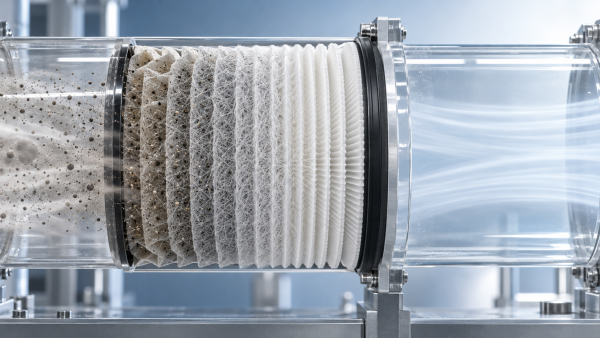
Glass microfiber media uses fine inorganic fibers arranged into a porous structure that captures particles through several mechanisms. Larger particles may be intercepted near the upstream surface, while smaller particles are retained deeper within the media matrix through interception, impaction, and diffusion-related effects. This depth-filtration behavior is central to its value in servo applications: contamination is distributed through the thickness of the medium rather than concentrated immediately on the surface.
A high-performing hydraulic filter medium is not simply a dense sheet with very small pores. Excessively tight and uniform structures can create unacceptable clean pressure drop and may block quickly under real contamination loads. Better servo-valve protection usually comes from a graded pore structure, in which the upstream region accepts larger particles and the finer downstream structure captures smaller particles. Such a gradient can extend usable service life without sacrificing fine-particle efficiency.
In hydraulic elements, glass microfiber is often supported by a backing layer or combined with protective layers that improve pleat stability, flow distribution, and mechanical durability. The full laminate design matters. A highly efficient media layer can still perform poorly if it sheds fibers, deforms under differential pressure, suffers uneven pleat spacing, or permits leakage around end caps and seals.
Compared with cellulose-dominant media, glass microfiber structures can offer more controlled fine-particle performance and strong dirt-holding behavior when properly engineered. Cellulose-containing papers remain applicable in many general hydraulic duties, particularly where cost, water absorption behavior, or established equipment specifications support their use. However, they are not automatically the preferred option for high-precision servo circuits, especially where sustained fine filtration is required under varying flow and pressure conditions.
Do Not Select by Micron Rating Alone
“Micron rating” is among the most misunderstood specifications in hydraulic filtration. A stated 5 µm rating may be nominal, absolute, or tied to a particular test method and Beta ratio. Without the associated efficiency definition, two elements with the same micron label may have materially different particle-removal performance.
The practical metric is the Beta ratio:
Betax = number of particles upstream at size x and larger ÷ number of particles downstream at size x and larger.
A Beta ratio of 200 at a given particle size means that, under the specified multi-pass test conditions, 200 particles are counted upstream for every one particle counted downstream. This corresponds to an efficiency of 99.5% at that particle size. A Beta value of 1,000 corresponds to 99.9% efficiency. The test result should identify the particle size at which the ratio applies.
The designation “(c)” refers to calibration based on ISO 11171, which uses certified test dust and a defined particle-counting basis. When comparing hydraulic filter media, matching test standards and reporting conventions is essential. A claimed rating without a test reference, particle size basis, or Beta ratio provides limited technical confidence.
A very fine rating is not automatically better. If the selected media raises clean pressure drop too much, the system may experience excessive energy loss, delayed cold starts, frequent bypass-valve opening, or shortened element life. Once bypass opens, fluid can pass around the media rather than through it, defeating the purpose of fitting a high-efficiency element. The correct choice is the finest efficient media that the circuit can operate with reliably across expected viscosity, temperature, flow, and contamination conditions.
Media Structure Matters More Than Fiber Type Alone
Two glass microfiber media products can differ substantially even when both are described as “fine filtration.” Technical assessment should examine the functional structure rather than relying on the base material name.
Fiber diameter and pore distribution influence particle capture and flow resistance. Finer fibers can improve efficiency for smaller particles, but a workable medium requires controlled porosity and thickness to avoid an excessive pressure-drop penalty.
Basis weight and thickness affect the available depth for contaminant storage. A thin, tight medium may initially deliver excellent efficiency but have limited capacity for distributed loading. A thicker depth medium can retain more contaminants, though it must be designed so that flow distribution remains uniform through the pleated element.
Binder system is not a minor detail. Hydraulic filter media must retain fiber integrity under continuous fluid exposure, temperature variation, cyclic differential pressure, and chemical additives in the fluid. Binder instability can affect pore structure, release material into the circuit, or weaken the sheet under stress.
Support and protective layers influence fatigue resistance and pleat geometry. In high-flow or pulsating circuits, unsupported media can flex repeatedly. Mechanical degradation may raise the risk of cracks, media migration, pleat collapse, or changes in filtration performance over time.
Electrostatic behavior also requires careful interpretation. Some synthetic media structures can initially capture particles through electrostatic attraction. This can be useful, but performance claims should remain valid after charge effects diminish or operating conditions change. For critical servo protection, stable mechanical filtration performance supported by recognized testing is more dependable than a claim based only on initial electrostatic capture.
Where the Filter Is Installed Changes What the Media Must Do
Fine hydraulic filter media cannot compensate for poor filter placement. A return-line filter protects the reservoir by capturing contaminants returning from actuators and wear surfaces, but it does not necessarily provide the immediate, tightly controlled cleanliness required at a servo valve inlet. It may be part of an effective contamination-control strategy, yet it is not automatically sufficient as the final protective barrier.
A pressure-line filter positioned upstream of a servo valve can provide direct component protection. This location imposes demanding requirements on media strength, element collapse resistance, sealing reliability, and pressure-drop performance. The element must withstand normal operating pressure and transient events without deformation or bypassing.
Offline or kidney-loop filtration is valuable for maintaining bulk fluid cleanliness, especially in systems with large reservoirs, intermittent operation, or contamination introduced during service. Because offline units can operate at lower, controlled flow rates, they may use highly efficient fine media without imposing the same pressure-drop burden on the main hydraulic circuit. Their limitation is response time: they improve reservoir cleanliness continuously but do not replace point-of-use protection where contamination can be generated downstream.
Filters on pilot circuits, case-drain lines, and reservoir breathers can also affect servo reliability. Ingress through a poorly controlled breather, contamination from cylinder seal wear, or particles released during maintenance can quickly undermine the performance of a carefully selected main-line filter.
Pressure Drop Must Be Assessed at the Worst Fluid Condition
Clean-element pressure drop is often measured under specified test flow and fluid viscosity. In service, the most restrictive moment may occur during cold start, when fluid viscosity is higher, or during a fast machine cycle that produces a short-term flow surge. The media selection must account for both conditions.
A low clean pressure drop is desirable, but it should not be achieved by reducing efficiency below the level required to control fine contamination. The more useful assessment is the full differential-pressure curve across the expected flow and viscosity range, combined with the element’s terminal pressure-drop limit and bypass-valve setting.
Contaminant holding capacity deserves equal scrutiny. Capacity figures are only comparable when the test dust, terminal differential pressure, flow conditions, and reporting method are known. A media design that has high capacity in a laboratory test may behave differently in a system dominated by soft wear debris, oxidation products, water-related deposits, or intermittent contamination slugs. Capacity should be treated as a design input for maintenance planning, not as a stand-alone quality ranking.
Particle Filtration Does Not Solve Every Servo-Valve Contamination Problem
A filter medium can remove solid particles, but it cannot fully correct fluid degradation. Water, dissolved oxidation products, varnish precursors, entrained air, and incompatible fluid additives can all affect valve performance through mechanisms that differ from hard-particle abrasion.
Water can promote corrosion, reduce lubricity, alter additive behavior, and contribute to deposit formation. Depending on the medium construction, cellulose-containing filter materials may absorb water differently from fully synthetic or glass-based constructions. That characteristic should be considered alongside the system’s water-control method; it is not a substitute for dehydration where water contamination is significant.
Varnish and soft contaminants are more complex. Standard particulate filtration may capture insoluble material, but dissolved oxidation by-products require other fluid-management measures. If a servo valve sticks while particle counts remain within the intended cleanliness range, the investigation should include fluid oxidation, electrohydraulic deposits, air release behavior, temperature history, and chemical compatibility rather than assuming the micron rating is inadequate.
How to Evaluate Hydraulic Filter Media Before Release
A technically defensible evaluation begins with the valve manufacturer’s cleanliness requirement and the operating envelope of the hydraulic circuit. From there, the media and element should be assessed as a combined filtration system.
- Confirm the required fluid cleanliness target and the particle-size ranges that matter for the valve.
- Request ISO 16889 multi-pass data, including the Beta ratios at relevant sizes, rather than accepting a micron label without context.
- Review clean and loaded differential-pressure behavior at maximum flow and at the highest expected operating viscosity.
- Verify collapse resistance, burst capability, fatigue performance, and bypass-valve behavior for the installation location.
- Check compatibility between the media, binder, adhesive, seals, and the specified hydraulic fluid and temperature range.
- Evaluate the complete element construction, including pleat spacing, end-cap bonding, seam integrity, and anti-static or conductive provisions where the application requires them.
- Define how cleanliness will be monitored after installation, since a filter specification without particle-count verification cannot demonstrate actual control.
Incoming-fluid cleanliness also matters. New hydraulic oil should not be assumed clean enough for direct transfer into a servo system merely because it is unused. Storage, transportation, container handling, and transfer equipment can introduce contamination before the oil reaches the reservoir. Filling through appropriately rated filtration is often necessary to preserve the intended level of protection.
The Most Defensible Selection Principle
For servo-valve circuits, the preferred hydraulic filter media is usually a high-efficiency, graded glass microfiber depth medium with demonstrated fine-particle performance under ISO 16889, sufficient contaminant capacity, stable fluid compatibility, and mechanical support suited to the circuit’s pressure and flow conditions.
That conclusion should not be reduced to a universal micron number. The correct media grade depends on the valve cleanliness requirement, the location of the filter, the flow profile, cold-fluid viscosity, allowable differential pressure, expected contamination sources, and the consequences of bypass. A filter that is highly efficient on paper but operates near bypass during normal transients offers less real protection than a properly sized element whose media remains in controlled filtration service.
The decisive standard is sustained control of the damaging particle population at the valve inlet—not an attractive nominal rating, not reservoir appearance, and not initial efficiency measured without considering the operating circuit.
Recommendation
 Oct 10, 2026
How Can Air Filter Media Increase Dust Holding Capacity Without Higher Pressure Drop?
Which liquid filter media is suitable for hydraulic oil fine-particle filtration? Discover how advanced air filter media increases dust holding capacity with low pressure drop.- Oct 10, 2026
Which Liquid Filter Media Is Suitable for Fine Hydraulic Oil Filtration?
Can synthetic filter media replace glass fiber in high-humidity gas turbine intakes? Explore media choices for fine hydraulic oil filtration, balancing efficiency, moisture resistance, pressure drop, and service life. - Oct 10, 2026
Can Synthetic Filter Media Replace Glass Fiber in Humid Turbine Intakes?
Is ePTFE filter media suitable for pulse-cleaned construction equipment air filters? Explore synthetic vs. glass fiber performance in humid turbine intakes.