How to choose liquid filter media for abrasive process fluids
An abrasive process fluid can look acceptable at the machine sump while still carrying enough hard contamination to shorten pump life, score precision components, clog nozzles, or create unstable surface quality. This is especially common in grinding, honing, lapping, machining, and transmission-oil circulation systems, where metal fines, carbon residue, abrasive grains, and degraded fluid components do not behave like ordinary soft dirt.
The right Liquid Filter Media is therefore not chosen by micron rating alone. Start with the contaminant type and loading pattern, then match the media to fluid chemistry, required cleanliness, available pressure drop, operating temperature, and service interval. A filter that captures smaller particles but blinds prematurely may be less effective in production than a slightly more open medium with greater dirt-holding capacity and stable flow.
Begin with the failure mode, not the filter grade
Before selecting a media construction, identify what the filtration system is meant to prevent. Different problems point to different priorities. A machine with rapidly worn pumps may require better control of hard particles in the recirculating fluid. A process suffering from nozzle blockage may need retention of coarse debris before it reaches narrow passages. When the concern is visible scratches or inconsistent finish quality, the key issue may be fine abrasive carryover that is small enough to pass through an overly open medium.
It is also important to separate contaminant generation from contaminant accumulation. A high rate of particle generation can overload an otherwise suitable filter. In that situation, moving immediately to a finer grade may increase replacement frequency and reduce flow. Upstream separation, staged filtration, improved sump cleaning, or changes to fluid maintenance may solve the loading issue more effectively.
Review the operating condition at the point where the filter actually works:
- Which particles are present: metallic fines, hard abrasive grains, carbon residue, fibers, sludge, or mixed debris?
- Are particles predominantly coarse and irregular, or fine and persistent?
- Does the load rise steadily, or does it spike after a particular machining operation, startup, or maintenance event?
- Is the fluid a lubricating oil, transmission oil, water-based coolant, synthetic fluid, or another chemistry?
- What happens when the filter becomes loaded: low flow, bypass opening, pump noise, temperature increase, or deteriorating process results?
These observations give more useful direction than selecting a material simply because it is commonly used in a similar machine category.
Understand what a micron rating does—and does not—tell you
A nominal micron figure is often treated as a complete performance description. It is not. Two media grades with the same stated rating can behave differently because pore structure, thickness, fiber blend, resin treatment, basis weight, and test method can all affect capture efficiency and flow resistance.
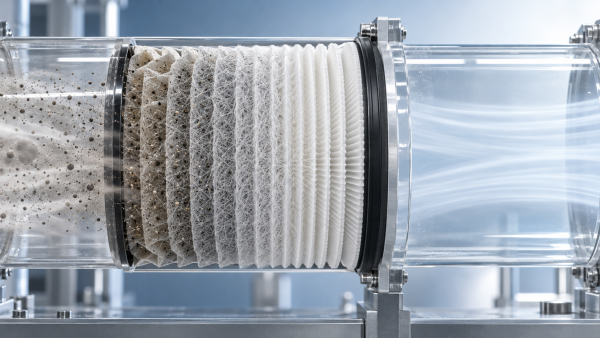
For abrasive fluids, the practical question is not only “What is the smallest particle the media can retain?” It is also “How does the media retain a mixed particle population over its working life?” A depth-loading construction can trap contaminants throughout the thickness of the medium, often providing useful dirt capacity where particle sizes vary. A more surface-oriented structure may remove targeted particles efficiently but can form a restrictive cake quickly when loading is high.
Project specifications should request efficiency information at relevant particle sizes where available, together with initial pressure drop and the differential-pressure limit used for service decisions. If the filter supplier can only provide a single micron number, compare actual operating behavior carefully rather than assuming equivalent performance between media types.
Do not over-filter by default
Using the finest available medium is not automatically a safer choice. Restrictive media can raise differential pressure, reduce delivered flow, increase energy demand, and encourage bypass operation in systems designed with relief protection. Once bypass occurs, contaminated fluid may circulate with little or no effective filtration. In abrasive operations, this can be worse than using a properly selected, moderately open grade that remains in service and maintains flow.
A reasonable target is the cleanliness level required to protect the most sensitive downstream component or preserve the process result. That component may be a high-pressure pump, servo valve, bearing, injection passage, precision nozzle, or finished surface—not necessarily the machine as a whole.
Match fiber composition to the fluid and duty cycle
Material selection matters because abrasive fluid filtration is both a mechanical and chemical challenge. Cellulose-based media can offer effective particle capture and a practical balance of cost and performance in many oil-filtration applications. However, its suitability depends on moisture exposure, fluid additives, temperature, pressure pulsation, and the expected service environment.
Cellulose/synthetic blends can provide a different balance of pore control, strength, and fluid compatibility. Synthetic components may be useful where greater consistency under demanding fluid conditions is needed, or where the process requires resistance to deformation as the filter loads. Constructions combining cellulose, synthetic fibers, and PBT may be considered when the application needs a tailored balance of retention, structural support, and liquid handling characteristics.
The fiber blend should be reviewed alongside the binder system. Resin treatment affects wet strength, stiffness, pleat stability, and resistance to fluid exposure. Acrylic, non-cured approaches and phenolic, cured approaches do not serve exactly the same purpose. The relevant choice depends on filter design, fluid temperature, mechanical stresses, and the required durability of the finished element. Do not treat resin type as a cosmetic product detail; it can influence how the media holds its shape and maintains filtration performance over time.
For example, OS320500 is available in cellulose, cellulose/synthetic, and cellulose/synthetic/PBT material options for oil and liquid-filtration uses. Its listed capability to use phenolic cured or acrylic non-cured material makes it a relevant starting point when the filter-element design needs to be aligned with fluid conditions rather than selected from one generic media construction.
Check flow and pressure drop under real loading conditions
Initial flow performance is only the beginning. A new filter may show acceptable pressure drop, yet become restrictive too quickly once abrasive particles enter the system. This is why media selection should consider the entire loading curve: clean-state resistance, contaminant retention behavior, and the point at which flow becomes unacceptable or the bypass valve opens.
Several conditions can make an apparently adequate filter underperform:
- High viscosity at startup: Cold oil increases resistance through the media. A grade that works at normal temperature may create excessive restriction before the system warms.
- Fine particle concentration: Fine metallic or abrasive particles can fill pores gradually and create a dense internal blockage.
- Coarse debris bursts: Chips and fragments can build a surface layer quickly, especially where no upstream strainer or separator is installed.
- Water contamination or fluid degradation: Changes in fluid condition can alter contaminant behavior and may affect media strength or loading characteristics.
- Pulsating flow: Repeated pressure variation can challenge pleat geometry and media support in poorly matched filter designs.
Ask for a test arrangement that reflects actual viscosity, expected flow range, and contaminant type as closely as practical. A fine test dust may not represent sharp metallic fines, carbonaceous residue, or abrasive slurry. The aim is not to duplicate every process condition perfectly, but to avoid selecting media on a test condition unrelated to the problem being solved.
Use staged filtration when the fluid contains mixed debris
One filter stage is often asked to remove every type of contamination, from large chips to persistent fine particles. That approach can be inefficient when the fluid carries a broad distribution of debris. A coarse prefiltration stage can protect the main filter from large fragments, while a downstream finer stage controls the particles that threaten precision components or surface quality.
This arrangement is particularly useful when the process produces occasional heavy debris but requires stable fine-filtration performance during normal operation. The upstream stage does not need to deliver final cleanliness; its role is to protect flow and extend the useful loading capacity of the downstream media.
Magnetic separation may also be relevant where ferrous particles are a major contaminant. It should not be viewed as a replacement for filter media, because it will not remove non-ferrous particles, abrasive grains, carbon residue, or fluid degradation products. Instead, it can reduce the mass of magnetic debris presented to the liquid filter and help preserve media capacity.
Translate process requirements into a media specification
A useful specification does more than state filter dimensions and a target micron level. It records the operating assumptions that determine whether the material will work in the assembled filter element.
Filter geometry deserves close attention. The same media can perform differently in a compact element and in a larger cartridge because effective area, pleat spacing, support layers, bonding method, and flow distribution are different. A media sample should therefore be evaluated in a representative element design whenever the process is sensitive to downtime or fluid cleanliness.
Look beyond media cost when comparing options
The least expensive media per square meter may not produce the lowest operating cost. Frequent element changes create labor demand, disposal volume, process interruption, and a greater chance of incorrect installation or delayed maintenance. On the other hand, a high-capacity medium is not economical if it allows damaging particle levels to reach critical components.
Compare alternatives on the basis of usable service life, flow stability, protection level, and failure risk. A practical evaluation can track differential-pressure rise, visible fluid condition, inspection findings on protected components, and the nature of debris found in the removed element. These observations help distinguish a media limitation from an upstream contamination problem.
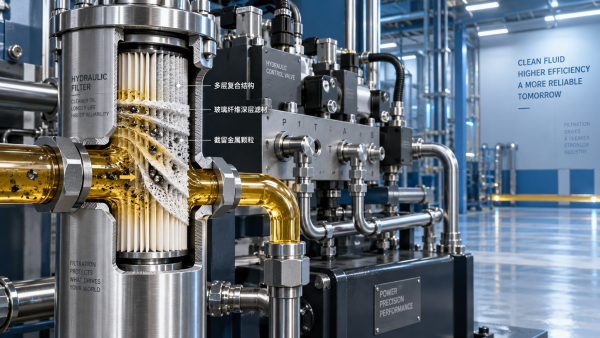
When the fluid contains carbon residue and metal particles, confirm that the chosen construction is intended to retain such impurities without losing the structural integrity needed in the filter element. Media used for engine-oil and transmission-oil duties may be selected around this requirement, but the final decision still depends on actual fluid condition, temperature, and element configuration.
Signs that the current media choice should be reviewed
A filter problem is not always visible as a torn element or an immediate machine alarm. Review the media selection when replacement intervals become unpredictable, differential pressure rises unusually fast, or a system shows recurring signs of contamination despite regular filter changes. Other warning signs include frequent bypass events, poor fluid delivery at startup, nozzle fouling, unusual pump wear, and a sharp difference between clean-fluid performance and loaded-fluid performance.
First inspect the removed filter element and identify whether contamination is concentrated on the surface or distributed through the media. Surface caking can indicate a need for upstream removal of coarse debris, more area, or a different pore structure. Deep discoloration and internal plugging may point to fine-particle loading, degraded fluid, or a grade that is too restrictive for the contaminant concentration. The corrective action should follow the observed loading pattern, not an assumption that a smaller micron rating is always the answer.
Recommendation
 Oct 10, 2026
How Can Air Filter Media Increase Dust Holding Capacity Without Higher Pressure Drop?
Which liquid filter media is suitable for hydraulic oil fine-particle filtration? Discover how advanced air filter media increases dust holding capacity with low pressure drop.- Oct 10, 2026
Which Liquid Filter Media Is Suitable for Fine Hydraulic Oil Filtration?
Can synthetic filter media replace glass fiber in high-humidity gas turbine intakes? Explore media choices for fine hydraulic oil filtration, balancing efficiency, moisture resistance, pressure drop, and service life. - Oct 10, 2026
Can Synthetic Filter Media Replace Glass Fiber in Humid Turbine Intakes?
Is ePTFE filter media suitable for pulse-cleaned construction equipment air filters? Explore synthetic vs. glass fiber performance in humid turbine intakes.