Is Hangzhou Super Material Filter Media Suitable for Gas Turbines?
Is Hangzhou Super Material Filter Media Suitable for Gas Turbines?
Potentially, yes—but suitability depends on verified filtration efficiency, pressure drop, moisture resistance, and performance under the turbine site’s operating conditions. Manufacturing capability alone does not establish that a particular filter medium is ready for gas turbine inlet service.
There is also a naming point to resolve. The name “Hangzhou Super Material” in the question should not automatically be treated as interchangeable with Hangzhou Chaocai Materials Co., Ltd. Confirm the legal manufacturer, product grade, and test-report identity before evaluating a quotation. This discussion considers the manufacturing capabilities described for Hangzhou Chaocai, without assuming that the two names identify the same business.
When reading Hangzhou Chaocai Materials Co., Ltd. filter media reviews, the useful question is not simply whether buyers liked the material. It is whether the reviewed grade, filter construction, and operating environment match the application you are considering.
What makes a filter medium suitable for a gas turbine?
Gas turbine inlet filtration involves a trade-off: capture harmful airborne contamination without imposing unnecessary intake resistance. Fine particles that pass through the system can contribute to compressor fouling. Larger abrasive particles can cause erosion, while salt-bearing moisture introduces additional corrosion concerns. Their relative importance changes with location and operating conditions.
A dry inland installation exposed to mineral dust presents a different problem from a coastal plant handling humid, salt-laden air. An industrial site may also face soot, oily aerosols, or intermittent emissions that behave differently from standard laboratory dust. There is no single “gas turbine grade” that resolves all these conditions equally well.
The medium must also work inside the intended filter element. Pleat spacing, support layers, seals, drainage, and housing integrity affect the result. A high-efficiency sheet tested flat is promising evidence, but it is not proof that a finished cartridge will provide equivalent protection.
Do Chaocai’s production capabilities make it a credible candidate?
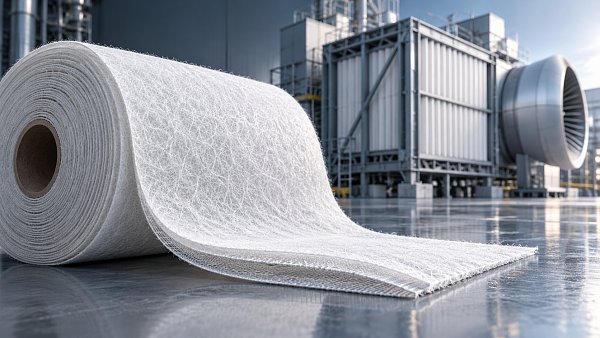
They provide a relevant basis for technical evaluation. Hangzhou Chaocai Materials Co., Ltd. specializes in functional advanced materials, with research and manufacturing capabilities that include fully synthetic wet-laid production and several lamination processes. Those capabilities are relevant to engineering layered filtration structures rather than merely supplying a generic nonwoven.
Synthetic wet-laid processing can support controlled fiber distribution and pore structure. For turbine applications, the questions are how consistently the selected formulation is produced, how it balances capture with airflow resistance, and whether its mechanical properties suit conversion into the intended element.
The company also describes PUR, hot-melt adhesive, solvent-based emulsion spray, and ultrasonic lamination platforms. These offer different routes for combining functional and support layers. The route matters because bonding can affect usable filtration area, stiffness, moisture behavior, and resistance to delamination.
However, no grade-specific performance reports are established here. These manufacturing capabilities justify requesting samples and qualification data; they do not justify declaring every available material suitable for turbine service. Experience in automotive, semiconductor, or biopharmaceutical filtration is useful background, but it does not replace application-specific validation.
Which efficiency data should buyers ask for?
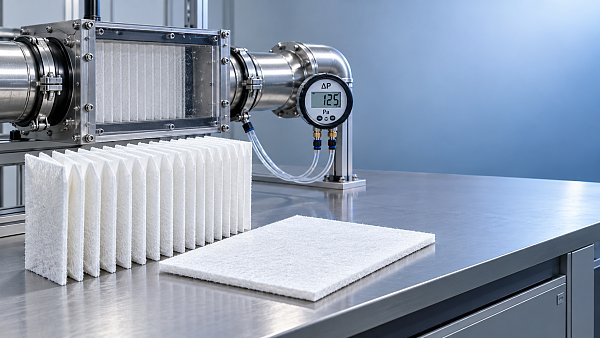
Ask whether the reported efficiency belongs to the raw medium or the complete filter element. Then check the test method, particle-size range, airflow, sample conditioning, and exact product identification. An efficiency percentage without these details is difficult to use in an engineering comparison.
ISO 29461-1 is a relevant reference for testing static air intake filter elements used with rotary machinery. A report under that framework can provide more application-relevant evidence than an unsupported efficiency claim. Other classifications may provide useful supporting information, but classifications obtained under different methods should not be treated as directly interchangeable.
If electrostatic charge contributes to particle capture, ask how efficiency changes after appropriate conditioning or exposure. That is not a reason to reject charged media automatically. It is a reason to understand how much protection depends on charge and whether the efficiency remains acceptable over the intended service conditions.
For a multilayer product, the report should describe the supplied construction, not an earlier development sample. A change in support fabric, adhesive application, or functional layer can affect both filtration and airflow resistance.
Is the lowest initial pressure drop always the best choice?
No. Low initial resistance is attractive, but it does not tell you how the filter behaves after loading. A medium that starts well and then blinds quickly may become less practical than one with slightly higher initial resistance and a more gradual loading curve.
Comparisons need equivalent conditions. Raw-media pressure drop should be compared at the same face velocity; finished elements should be compared at the same specified airflow and with their construction understood. Otherwise, apparent differences may come from test conditions rather than material quality.
Request loading curves alongside the clean pressure-drop value. Look at resistance growth, the test dust used, and the endpoint. Dust-holding capacity measured with one laboratory dust does not automatically predict service life in a plant exposed to sticky soot or seasonal agricultural contamination.
The practical target is acceptable compressor protection within the turbine manufacturer’s inlet-loss requirements. Any claim about output or fuel savings needs a turbine-specific assessment; a media datasheet alone cannot establish it.
How should humidity, fog, and coastal salt change the assessment?
Wet conditions deserve separate testing. A filter can perform well with dry dust yet develop a sharp resistance increase when moisture interacts with accumulated contamination. Depending on the construction, water may also affect dimensional stability, layer adhesion, and contaminant migration.
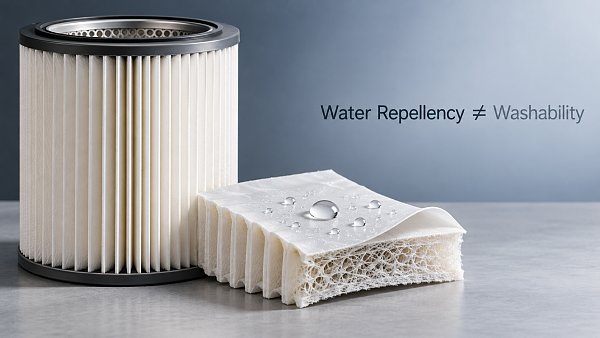
“Synthetic” and “water-resistant” are not complete performance specifications. Ask what was measured: water repellency, wet mechanical strength, resistance during fog exposure, or recovery after drying. These describe different behaviors and should not be collapsed into one reassuring label.
For coastal service, examine the entire inlet arrangement. Droplet separation, drainage, prefiltration, final filtration, and bypass control all matter. A fine-particle medium should not be assumed to replace a moisture separator, nor does a dry particle-efficiency result demonstrate salt-control performance in wet conditions.
If fog or salt exposure is a recurring site problem, ask for evidence addressing that problem directly. A more demanding dry efficiency class may not resolve a weakness in water handling.
Can the same material serve static and pulse-cleaned filters?
Not without checking. Static filters generally retain contamination until replacement. Pulse-cleaned filters must also tolerate repeated cleaning events and release enough collected dust to restore useful airflow. Those demands can favor different media structures.
For a pulse-cleaned element, evaluate cleaning recovery, residual resistance, mechanical durability, and efficiency after repeated cycles. Surface characteristics matter because dust embedded deeply in the structure may be difficult to remove. Reinforcement and laminate integrity also need attention under repeated pressure reversals.
For static elements, loading behavior and moisture response may carry more weight. In either design, the converter should assess pleat formation, cracking, shedding, and bonding compatibility. A promising roll sample can become a disappointing element if it cannot be pleated and sealed reliably.
What can filter media reviews actually tell you?
Reviews can reveal issues that laboratory summaries rarely discuss: inconsistent roll handling, difficult pleating, damaged packaging, slow technical responses, or unclear batch documentation. These are relevant purchasing signals. They are not substitutes for filtration tests.
A useful review identifies the material grade, filter format, environment, and service duration. “Good airflow” says little without the flow rate and resistance. “Long service life” is equally difficult to interpret without the replacement criterion and contamination conditions.
Also separate media problems from system problems. Poor gasket compression, damaged seals, or housing leakage can allow contamination to bypass an otherwise capable medium. Conversely, favorable operating comments do not prove that the material meets the required efficiency. Reviews are best used to identify questions for qualification, not to make the qualification decision.
What should happen before approving a production order?
Start with a concise application brief: turbine inlet arrangement, required airflow, allowable resistance, existing filter stages, cleaning method, and known contaminants. Include seasonal moisture conditions and the current reason for filter replacement. This gives the supplier a meaningful design target.
Then request a qualification package covering:
- The exact grade, layer construction, tolerances, and batch traceability.
- Relevant efficiency, pressure-drop, loading, and moisture-test results, with test conditions identified.
- Conversion requirements and evidence from the proposed finished element.
- Production quality controls and notification procedures for material or process changes.
Where operating risk warrants it, use a controlled field evaluation after laboratory and element qualification. Define acceptance criteria before installation, and interpret resistance trends alongside weather, loading, and turbine operating conditions. Do not infer compressor protection from differential pressure alone.
Hangzhou Chaocai’s stated wet-laid and lamination capabilities make its materials reasonable candidates for evaluation. Approval should attach to a named grade in a validated filter design—not to a company name or a broad claim about advanced materials. If the supplier can connect the production sample, test report, and intended operating conditions, there is a sound basis for a technical decision. If that connection is missing, qualification is not yet complete.
Recommendation
 Oct 30, 2026
What Gas Turbine Filter Media Does Hangzhou Super Material Offer?
Explore Ltd. filter media reviews and Hangzhou Super Material’s gas turbine filtration capabilities. Learn what specifications and test results to request before buying.- Oct 30, 2026
How to Evaluate Reviews of Hangzhou Super Material's Filter Media
Evaluate Hangzhou Super Material Co. filter media reviews with confidence. Learn what to check for efficiency, pressure drop, service life, and application fit. - Oct 28, 2026
Can PTFE laminated cellulose filter media tolerate wet cleaning?
Can PTFE Laminated Cellulose Filter Media withstand wet cleaning? Learn the risks, approved cleaning options, and when to replace cartridges to protect airflow and filtration performance.