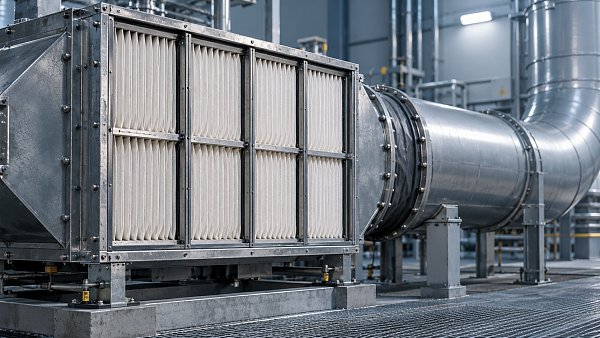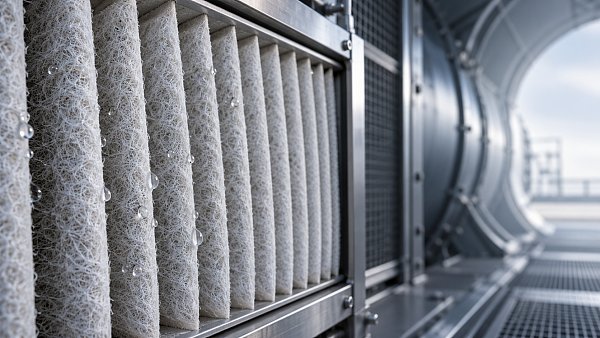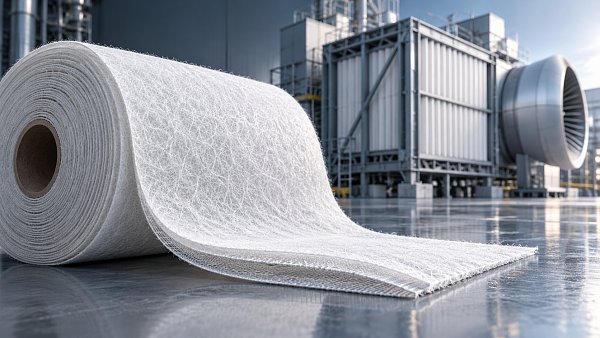





Selecting wet-laid synthetic filter media for coolant filtration
Selecting wet-laid synthetic filter media for coolant filtration starts with the cleanliness required at the machining process—not the micron rating printed on a datasheet. A suitable medium must retain the particles that affect surface finish, tool life, or equipment reliability while passing enough coolant through the available filtration area. If either requirement is missed, the result can be dirty coolant, excessive media consumption, or interrupted production.
The decisive comparison is therefore retention at operating flow, followed by loading behavior, chemical durability, and mechanical reliability in the installed filter. A finer-rated medium is not automatically the better choice: it may restrict a gravity filter before a useful contaminant cake develops, while a more permeable medium may deliver acceptable filtrate quality once the filtration cycle stabilizes.
Define the filtration duty before comparing materials
A useful specification connects the machining operation to measurable filtration requirements. Grinding fines, sharp turning chips, abrasive particles, and sludge containing tramp oil create different challenges. Particle shape matters as well as size: elongated fragments can pass through openings in one orientation, while plate-like particles can bridge the surface and rapidly reduce flow.
Establish the following operating conditions before requesting comparative samples:
- Coolant: straight oil, soluble-oil emulsion, semisynthetic fluid, or synthetic solution, including concentration and operating temperature.
- Contamination: workpiece material, abrasive content, particle-size distribution, solids concentration, and the presence of tramp oil or sticky residues.
- Hydraulic duty: normal and peak flow, effective wetted filtration area, available liquid head or differential pressure, and maximum acceptable restriction.
- Equipment: gravity bed, vacuum belt, pressure filter, or another configuration, including support geometry and media-advancement controls.
- Acceptance criteria: filtrate cleanliness, allowable media consumption, minimum throughput, and acceptable cycle or indexing behavior.
Use the flow actually reaching the filter rather than pump nameplate capacity. Intermittent discharge from several machines can produce a short peak that exceeds the medium’s drainage capacity even when average flow appears manageable. Likewise, upstream magnetic separation or settling changes the solids burden and should remain consistent during comparisons.
The required particle control should come from the process. A finishing operation sensitive to scratching may need tighter control of a particular hard-particle fraction, whereas another operation may be limited mainly by bulk solids accumulation. Specifying unnecessarily fine filtration can increase operating cost without improving the machined result.
Read micron ratings as test results, not universal properties
A nominal micron rating is incomplete unless the supplier explains what it measures. It may refer to a retention percentage under a particular challenge test, a pore-size characterization, or an internal grading convention. These are not interchangeable. Two materials carrying the same nominal rating can produce different filtrate quality and pressure-drop behavior.
Ask for retention efficiency across the particle sizes relevant to the process, together with the test liquid, challenge contaminant, flow conditions, and loading state. Initial efficiency on a clean sheet should be distinguished from efficiency after a cake has formed. A medium that relies on cake filtration may perform well during established operation but pass more particles immediately after fresh material advances.
Where particle counting is suitable, size-specific retention can be expressed through an upstream-to-downstream count ratio:
βx = upstream particle count at or above size x ÷ downstream particle count at or above size x
The corresponding efficiency is (1 − 1/βx) × 100%. This allows clearer comparison than an unexplained “micron” label, but only when sampling and test conditions are comparable. A rating obtained in a hydraulic-fluid test should not be assumed to describe coolant performance unchanged.
Coolant emulsions create an additional measurement problem: optical instruments can count droplets or bubbles as particles. The sampling and analysis method must distinguish the target contamination from the fluid structure. Gravimetric solids measurements, microscopic examination, and particle counting can provide complementary evidence; none alone describes every filtration problem.
Match permeability to the filter’s available driving force
Wet-laid synthetic media are formed from fibers dispersed in water and deposited into a sheet. Fiber diameter, blend, distribution, bonding, and finishing determine the resulting pore network. The manufacturing route does not, by itself, guarantee a particular filtration efficiency, wet strength, or coolant compatibility.
For a clean, wetted medium under approximately laminar flow, pressure drop increases with liquid viscosity and flow per unit area. The medium’s thickness and permeability also influence resistance. During use, deposited solids add another resistance that can become greater than the resistance of the sheet itself.
This distinction is especially important in gravity equipment, where only limited liquid head is available. A medium may appear attractive in a pressure-assisted laboratory test yet drain too slowly on a shallow gravity bed. Vacuum and pressure systems offer a greater driving force, but that does not remove the need to check support, sealing, and loaded-media strength.
Air permeability is useful for manufacturing control and preliminary comparison, but it is not a direct substitute for coolant-flow testing. Wetting behavior, liquid viscosity, sheet compression, and interactions with the coolant affect liquid performance. Even water-flow data can misrepresent performance with a more viscous oil or a formulated emulsion.
Compare candidates at the same coolant temperature, flow per effective area, and pressure or head. Record both clean-medium resistance and the resistance increase during loading. Where fluid temperature varies substantially, include the colder, higher-viscosity operating condition rather than qualifying the medium only under favorable warm conditions.
Evaluate the cake and indexing cycle, not just the clean sheet
The best-performing medium is not necessarily the one with the highest clean-sheet permeability or finest initial retention. Its practical value depends on how contamination builds up and how the filter removes or advances the loaded section.
Abrasive fines can form a relatively permeable cake under one set of conditions and a dense, flow-restricting layer under another. Oily sludge can blind the surface before much dry solids mass has accumulated. Fine particles may also enter the sheet and block internal pathways, reducing the benefit of a surface cake.
A loading trial should therefore track filtrate quality and throughput over the complete operating cycle. For an indexing filter, include the period immediately after advancement, the stable loading period, and the condition that triggers the next advance. An acceptable average can conceal repeated bursts of dirty filtrate or short periods of inadequate flow.
Holding-capacity results are meaningful only when the endpoint is stated. Capacity measured to a high laboratory differential pressure may not be available in a gravity filter that advances at a much lower liquid head. Compare solids captured per unit area at the actual equipment limit.
Check the entire construction for coolant compatibility
“Fully synthetic” does not mean universally resistant. Polymer fibers, binders, surface treatments, and any laminated layers must all tolerate the fluid. A durable fiber can still produce an unsuitable medium if the bonding system softens, swells, or loses adhesion.
For water-miscible coolants, compatibility assessment should include the formulated fluid at operating concentration, relevant pH, temperature, and service exposure. Additives such as cleaners, corrosion inhibitors, and biocides can change the chemical environment. For straight oils, test the actual oil formulation rather than relying only on a general oil-resistance statement.
Evaluate strength and dimensional stability after exposure, not merely visual appearance. Relevant changes include loss of tensile strength, stretching, shrinkage, delamination, increased fiber release, or altered flow resistance. Polyester-based constructions, for example, require attention to the combined effects of alkalinity, temperature, and exposure duration; polymer identity alone cannot establish service life.
Compatibility also works in the other direction. Extractable constituents or surface treatments could affect coolant foaming, wetting, or emulsion behavior. Where those effects would disrupt the process, compare exposed coolant with an unexposed control. Fine-particle filtration should not be treated as a substitute for controlling dissolved contaminants or microbial condition.
Mechanical reliability depends on the installed support and transport system
Dry tensile strength provides only part of the mechanical picture. The medium must survive while saturated, loaded with solids, and subjected to transport tension or differential pressure. Machine-direction and cross-direction properties can differ, so both matter where the sheet spans supports or encounters uneven loading.
Check saturated tensile strength, elongation, and resistance to tearing or puncture under representative conditions. Sharp swarf can initiate a failure that a smooth laboratory fixture does not reproduce. Support openings and drainage edges can also concentrate stress, particularly in vacuum equipment.
Excessive elongation can cause problems without a complete break: the sheet may wrinkle, track poorly, or pull away from a seal. Thickness, stiffness, and compressibility affect seating and transport. Roll width, edge quality, winding consistency, core dimensions, and splice construction therefore belong in the qualification specification, not only in purchasing documentation.
Bypass must be excluded before rejecting a candidate for poor retention. A highly efficient sheet cannot compensate for coolant flowing around its edges, through a damaged section, or across a poorly seated joint.
Qualify performance against a controlled baseline
Laboratory screening should eliminate unsuitable candidates before a machine trial. Use representative coolant to compare clean flow, particle retention, loading behavior, and post-exposure strength. Preserve enough test detail to reproduce the comparison; a supplier’s single headline value is insufficient for qualification.
During the equipment trial, keep coolant concentration, production mix, upstream separation, and control settings as consistent as practical. Record operating changes that cannot be held constant. Include peak-flow periods, fresh-media transitions, and the contaminant types that create the most demanding conditions.
Assess consumption by area used per operating hour or per production output, alongside filtrate quality and throughput. Roll life alone is misleading when roll lengths or widths differ. Similarly, a lower price per square meter does not establish a lower operating cost if more frequent advancement increases consumption or interrupts filtration.
Set acceptance limits before the trial: required cleanliness at the relevant particle sizes, sufficient flow at the available head or pressure, acceptable media usage, and no unacceptable loss of mechanical integrity. Keep process outcomes such as surface finish separate from filtration measurements so that changes can be investigated rather than automatically attributed to the medium.
Once a grade is qualified, retain its construction specification and agreed test methods as the production reference. Control limits for permeability, basis weight, thickness, wet strength, and roll dimensions should reflect their demonstrated effect on performance. Changes to fiber blend, bonding, or finishing should trigger a review of the affected properties. The defensible choice is the medium that repeatedly meets the cleanliness requirement within the equipment’s hydraulic and mechanical limits—not the one with the finest label.
Recommendation
 Oct 30, 2026
Is F9 Filter Media Suitable for Gas Turbine Air Intakes?
Explore Ltd. custom filter media options for gas turbine air intakes, and learn how F9 performance, pressure drop, and site conditions guide your choice.- Oct 30, 2026
How Moisture Resistant Is Hangzhou Super Material's Filter Media?
Explore Hangzhou Chaocai Materials Co., Ltd. gas turbine filter media moisture resistance and learn what test data to request for humid inlet conditions. - Oct 30, 2026
What Gas Turbine Filter Media Does Hangzhou Super Material Offer?
Explore Ltd. filter media reviews and Hangzhou Super Material’s gas turbine filtration capabilities. Learn what specifications and test results to request before buying.