Which Performance Data Matters Most When Selecting Filter Media?
The performance data that matters most when selecting filter media is the data that describes behavior under the actual contaminant load, airflow or liquid flow, temperature, chemistry, and service life of the application. Filtration efficiency is important, but it cannot be interpreted alone. A medium with high particle capture may create an excessive pressure drop, lose strength after pleating, release fibers into a clean process, or degrade after exposure to heat, oil mist, humidity, disinfectants, or reactive gases.
For critical filtration duties, selection should begin with a performance profile rather than a single rating. The most useful profile connects particle-removal efficiency, resistance to flow, capacity to retain contaminants, structural durability, chemical compatibility, and consistency after aging. These values reveal whether the medium will perform as intended after installation, not merely when it is first tested in a flat sample.
Efficiency Must Be Matched to Particle Size and Test Conditions
Efficiency data indicates how much particulate matter a filter medium captures, but the reported value only becomes meaningful when the particle size, challenge aerosol or liquid, face velocity, and test method are known. A statement such as “high efficiency” does not show whether the medium is effective against coarse debris, fine dust, submicron particles, droplets, or a mixed contaminant stream.
Particle size is especially important because filtration mechanisms change across the size range. Larger particles are often retained through interception and inertial effects. Very fine particles may be captured through diffusion, electrostatic attraction, or the tortuous path formed by small fibers. Between these regions, some media have a particle size at which collection efficiency is lower than at either larger or smaller sizes. Selecting media from a single efficiency point can therefore leave an unrecognized weakness in the most penetrating particle range.
For air filtration, compare efficiency at the intended airflow or face velocity. Raising velocity can reduce residence time and alter capture behavior, while also increasing resistance. For liquid filtration, flow rate, viscosity, temperature, and contaminant shape influence the result. A nominal micron rating should not be treated as an absolute particle cutoff. It is a useful screening descriptor, but it does not by itself establish retention performance under fluctuating flow or a broad particle distribution.
Pressure Drop Shows the Energy and Stability Cost of Filtration
Initial pressure drop measures resistance to flow through clean media. It affects fan energy, pump demand, system balance, and available process capacity. Yet the lowest initial pressure drop is not automatically the best result. An overly open structure may allow unwanted particles to pass, load rapidly at depth, or provide insufficient support for pleating and sealing. Conversely, a very dense medium may meet an efficiency target while forcing the system to operate outside its intended pressure range.
The relationship between pressure drop and flow should be reviewed as a curve, not only as one test value. A medium that appears acceptable at low flow may develop a sharp resistance increase near the upper end of normal operation. This is relevant where starts, pulses, fan modulation, or changing fluid viscosity produce temporary high-flow conditions.
Pressure-drop behavior during loading is equally valuable. Some media build resistance gradually and predictably as particulate accumulates. Others show a rapid rise because contaminants form a surface cake, clog pore entrances, or bridge across a fibrous structure. A steep rise may be acceptable when short replacement intervals are planned, but it is unsuitable where long unattended service periods or stable airflow are required.
Initial Resistance and Final Resistance Are Different Decisions
Initial resistance concerns the condition at installation. Final resistance concerns the point at which the filter should be changed or regenerated. These values should be considered alongside the available pressure margin of the housing, duct, fan, pump, or process line. If the system has little pressure reserve, a medium that loads slowly may be preferable even if its clean-state efficiency is modestly lower. Where contamination cannot be tolerated, higher efficiency may take priority, provided the system is designed for the resulting resistance.
Dust-Holding Capacity Needs a Defined Failure Point
Dust-holding capacity describes how much contaminant a medium retains before reaching a specified terminal pressure drop, efficiency change, bypass condition, or other end-of-life criterion. The definition matters. A capacity value measured to a high terminal resistance cannot be compared directly with one measured to a lower limit. Nor does gravimetric mass alone show the full loading behavior.
Fine, dry dust may penetrate deeply into a depth medium, while sticky aerosols and oily mists can coat fibers near the upstream surface. Fibrous debris can mat across the media face. Hygroscopic particles may absorb moisture and change shape, causing resistance to rise faster than expected. The same total contaminant mass can therefore produce very different service life.
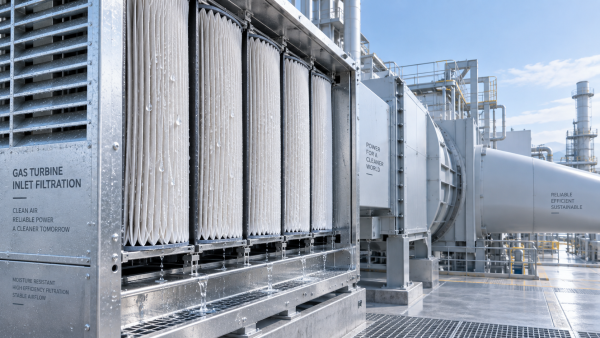
Loading tests should resemble the actual contaminant as closely as practical. A gas-turbine intake exposed to mixed atmospheric dust, moisture, and salt-laden conditions presents a different challenge from an automotive air intake with road dust and soot. Semiconductor and biopharmaceutical environments may demand control of fine particulate release as well as particle capture. In battery-related production, the critical concern may include dust type, electrolyte-adjacent chemical exposure, or the cleanliness of the converting process itself.
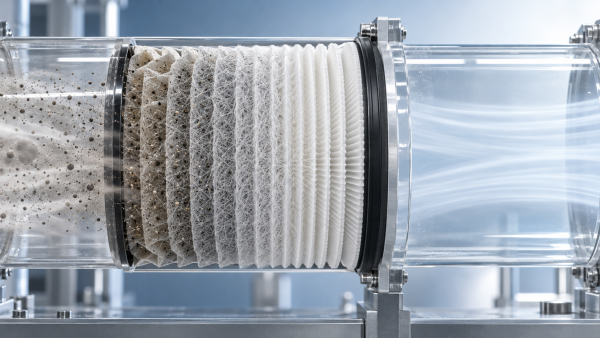
Where real loading data is unavailable, compare media construction. Fiber diameter, basis weight, pore structure, gradient density, surface treatment, and electrostatic charge all influence how contaminants distribute through the thickness. A medium designed for depth loading can retain particles throughout its structure, while a surface-oriented layer may offer high initial efficiency but reach terminal resistance earlier under certain dust conditions.
Mechanical Strength Must Survive Conversion and Service
Filter media is rarely used as a flat sheet. It may be pleated, corrugated, bonded to a support layer, laminated, welded, framed, potted, or exposed to repeated pressure pulses. Mechanical data must therefore cover both raw-media properties and the stresses introduced during filter construction.
Tensile strength, elongation, tear resistance, burst resistance, stiffness, and thickness uniformity each answer a different question. Tensile strength helps indicate resistance to pulling during web handling and conversion. Tear resistance is more relevant when a notch, edge defect, or local damage could propagate. Burst resistance becomes important where differential pressure can rise suddenly. Stiffness affects pleat geometry, but excessive stiffness may cause cracking at fold lines or make close pleat spacing difficult.
Wet strength deserves separate attention where humidity, condensate, water splash, or liquid contact is possible. Some media retain their general appearance after wetting while losing enough tensile or bond strength to deform under differential pressure. A filter can then show apparent efficiency loss because pleat spacing changes, channels form, or sealing areas are stressed.
Media laminations require their own evaluation. A substrate, reinforcement, membrane, scrim, adhesive layer, or protective facing may improve a specific property while reducing permeability or flexibility. Delamination can occur through thermal cycling, oil exposure, hydrolysis, solvent contact, or repeated flexing. Testing only the individual layers does not establish the durability of the finished composite.
Chemical and Thermal Compatibility Cannot Be Inferred from Fiber Type Alone
Base polymer identity provides a starting point, not a final answer. Resistance depends on the entire media construction, including binders, coatings, adhesive systems, electrostatic treatments, reinforcement layers, and seal-interface materials. A chemically stable fiber network can still fail if a binder softens, a coating swells, or a lamination bond weakens in the process environment.
Relevant exposures may include hydrocarbons, plasticizers, cleaning agents, acids, alkalis, oxidizing agents, salt aerosols, coolant mist, and high humidity. Temperature should be evaluated as both a steady-state condition and a cycling condition. Repeated heating and cooling may create shrinkage, embrittlement, curl, or loss of pleat stability even when short exposure at the maximum temperature appears acceptable.
For high-cleanliness applications, compatibility also includes extractables, odor, volatile residues, loose fibers, and particle shedding. A medium may retain incoming contamination effectively while becoming a source of contamination itself. This distinction is often missed when performance evaluation focuses only on upstream challenge particles and downstream count reduction.
Long-Term Stability Includes Efficiency Drift
Some filtration media rely partly on electrostatic charge to improve fine-particle capture without a large pressure-drop penalty. That benefit can change after exposure to humidity, certain aerosols, solvents, elevated temperature, or repeated cleaning cycles. Initial efficiency may therefore overstate performance over the actual service interval.
Where charge-based capture is part of the design, review conditioned efficiency data rather than relying only on the fresh-media result. The useful question is whether performance remains above the required level after credible exposure conditions. A reduction in electrostatic contribution does not necessarily make the medium unsuitable; it changes the selection basis toward its mechanical filtration performance and its stability after conditioning.
Dimensional stability is another long-term factor. Shrinkage, expansion, curl, and thickness change can affect pleat pitch, adhesive contact, gasket compression, and frame fit. These effects become more important in large-area filters, compact pleat packs, and assemblies exposed to temperature or moisture cycling.
Read Performance Data as a Connected Set
A useful selection process starts by defining the contaminant, required cleanliness level, normal and peak flow, allowable differential pressure, expected exposure conditions, and intended replacement interval. The data can then be screened for internal consistency. High efficiency paired with low pressure drop may be credible, but it warrants closer review of test velocity, media thickness, charge contribution, and conditioning state. Strong loading capacity paired with very low basis weight may also require confirmation of the actual dust type and terminal resistance.
Finished-filter performance should remain distinct from media performance. A suitable filter medium can still underperform after pleating, bonding, or installation if the media is damaged, compressed unevenly, poorly supported, or bypassed at the seal. Conversely, a filter assembly may use reinforcement or geometry to compensate for limitations that are visible in the raw material data. The performance data should identify which claims apply to the media sample and which apply to the completed filter element.
When two media appear similar, the most revealing comparison is often the conditioned loading curve at the intended operating range. It connects capture efficiency, pressure development, and durability in a way that isolated values cannot. That comparison exposes whether a medium is genuinely suited to the application or simply optimized for a favorable initial test result.
Recommendation
 Oct 10, 2026
How Can Air Filter Media Increase Dust Holding Capacity Without Higher Pressure Drop?
Which liquid filter media is suitable for hydraulic oil fine-particle filtration? Discover how advanced air filter media increases dust holding capacity with low pressure drop.- Oct 10, 2026
Which Liquid Filter Media Is Suitable for Fine Hydraulic Oil Filtration?
Can synthetic filter media replace glass fiber in high-humidity gas turbine intakes? Explore media choices for fine hydraulic oil filtration, balancing efficiency, moisture resistance, pressure drop, and service life. - Oct 10, 2026
Can Synthetic Filter Media Replace Glass Fiber in Humid Turbine Intakes?
Is ePTFE filter media suitable for pulse-cleaned construction equipment air filters? Explore synthetic vs. glass fiber performance in humid turbine intakes.