Which automotive air filter media suits high-dust driving conditions
High-dust driving conditions do not automatically call for the highest-efficiency automotive air filter media. The more appropriate choice is the medium that maintains acceptable engine-airflow restriction while holding a large mass of coarse and fine dust without rapid surface plugging, pleat collapse, loss of water resistance, or dust release under pulsating intake flow.
For most engine intake applications exposed to unpaved roads, construction zones, agricultural environments, quarry traffic, or frequent dry-road dust, a resin-impregnated cellulose-synthetic composite or a properly engineered multilayer synthetic medium is generally a stronger starting point than conventional low-basis-weight cellulose paper. The final selection depends less on the material name than on how fiber structure, pore distribution, basis weight, stiffness, pleat geometry, and seal compatibility work together in the completed filter.
High dust is a loading problem before it is an efficiency problem
Engine air filters face two competing requirements. They must prevent harmful particulate from reaching the intake system, cylinders, turbocharger, compressor wheel, sensors, and lubrication oil. At the same time, they must allow sufficient airflow with limited restriction. In dusty service, the filter’s usable life is determined by the rate at which restriction rises as dust accumulates.
A medium with very small surface pores may achieve strong initial particle capture, particularly for fine dust, but it can form a dense surface cake early in its life. Once that cake develops, pressure drop can increase sharply. In a vehicle operating under sustained load, excessive restriction can affect air availability, fuel consumption, engine response, and service intervals. A media selection based only on initial filtration efficiency can therefore produce an apparently high-performing filter that reaches its replacement threshold too quickly.
The relevant question is not simply “How much dust can the medium stop?” It is “How much contaminant can the complete element retain before restriction, mechanical stability, or filtration integrity becomes unacceptable?” This is the reason dust-holding capacity and pressure-drop growth need to be assessed together.
High-dust conditions also change the particle-size distribution that the media encounters. Road dust is rarely uniform. It may contain large mineral particles, fine siliceous dust, organic debris, tire and brake wear, fibers, soot-containing agglomerates, and moisture-affected material. Coarse particles are more likely to block the outer surface and pleat entrances, while finer particles can penetrate deeper into the media structure. A good high-dust medium must manage both loading mechanisms rather than optimize for only one fraction.
Why conventional cellulose may be insufficient
Cellulose remains relevant in automotive engine filtration because it can offer useful dust loading, pleatability, and cost efficiency when correctly impregnated and matched to the application. Its fiber network can create a depth-filtration effect, allowing some particles to be retained below the surface instead of forming an immediate external cake.
Its limitations become more visible when the environment combines severe dust with humidity cycles, water splash, temperature variation, vibration, or long service intervals. Cellulose fibers are hygroscopic. Resin treatment improves wet strength and dimensional stability, but the media’s response to moisture still requires careful evaluation. If stiffness changes materially after moisture exposure, pleats can deform, spacing can narrow, and effective filtration area can be lost. Water exposure can also alter local pore structure and increase flow resistance.
Pure cellulose designs can also have a narrower performance window when an application requires both high fine-particle efficiency and prolonged loading life. Increasing basis weight or tightening the fiber structure may raise initial efficiency, but it can also increase initial pressure drop. Lowering basis weight can improve flow but may reduce stiffness, burst resistance, or durability during pulse loading. Those trade-offs are manageable, but they should not be treated as a simple material substitution exercise.
Cellulose-synthetic composite media: often the practical middle ground
For demanding engine air intake service, cellulose-synthetic blends are frequently considered because synthetic fibers can modify pore structure, moisture response, and mechanical behavior without abandoning the useful dust-loading characteristics of cellulose. The exact result depends on fiber diameter, fiber length, blend ratio, binder system, and manufacturing method; “cellulose-synthetic” is not a performance grade by itself.
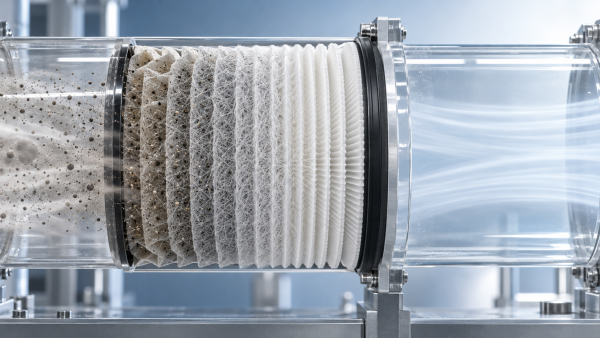
A well-designed composite can provide a more graduated internal structure than a single-fiber paper. Larger pores on the upstream side admit air and distribute larger particles, while progressively finer regions deeper in the sheet capture smaller contaminants. This kind of controlled pore architecture can delay rapid surface blocking and spread contaminant through a greater portion of the media thickness.
Synthetic content may also improve wet strength and reduce sensitivity to repeated humidity exposure. This matters in vehicles that move between dry dust, rain, washdown exposure, and high under-hood temperatures. However, synthetic addition should not be assumed to improve every characteristic. Certain constructions can become too closed, too stiff for a given pleat process, or insufficiently compatible with the selected plastisol, polyurethane, or hot-melt sealing system. Validation must therefore include the finished element, not only the raw media.
When fully synthetic media deserves priority
Fully synthetic media is worth close consideration when moisture resistance, chemical resistance, extended service life, or stable performance under variable environmental conditions is more important than using a conventional paper-like medium. Synthetic fiber systems can be engineered with fiber diameters and bonding methods that support high porosity while retaining structural integrity. They are also less prone to moisture absorption than cellulose-based materials.
For high-dust applications, the strongest synthetic designs often rely on depth loading rather than a very tight surface layer. A more open upstream structure helps prevent rapid blinding by coarse dust, while a finer downstream layer contributes to particle retention. Some configurations use gradient density through the media thickness; others use distinct laminated layers. The beneficial design is the one that provides a gradual loading curve, not merely the one with the greatest apparent thickness.
There are limits. Very open synthetic media can provide excellent airflow and dust-holding capacity but may not meet the required initial or fractional efficiency without an additional fine-fiber layer. A fine-fiber layer can improve capture, yet if it is too dense or poorly bonded, it may become the dominant restriction point. In high-dust service, the position of that layer matters: an upstream fine layer may load rapidly, whereas a downstream fine layer can protect efficiency while allowing coarser material to distribute through the upstream depth structure.
Surface treatment and fine-fiber layers should solve a defined problem
Surface treatments, resin systems, and fine-fiber coatings are sometimes treated as universal upgrades. They are not. Their value depends on the expected contaminant, target efficiency, moisture exposure, and allowable restriction rise.
A hydrophobic or water-resistant treatment can be useful where splash, condensation, or humid dust is expected. The treatment must preserve permeability and maintain adhesion through thermal cycling. A coating that improves initial water repellency but changes pore geometry excessively may shorten loading life. Likewise, a fine-fiber layer can improve fine-particle capture, but its durability must be checked under vibration, airflow pulsation, and dust loading. Fiber shedding, cracking, or delamination can compromise both filtration and downstream component protection.
Media intended for engine intake filtration should also be distinguished from materials developed for liquid filtration. Fiber combinations involving cellulose, synthetic fibers, glass fibers, or PBT can be engineered for very different fluid, temperature, and contaminant conditions. For example, GF1218 is identified for liquid and new-energy liquid filtration applications. Its listed material options illustrate how formulation can be tailored, but a liquid-filtration specification cannot be transferred directly to automotive air intake duty without air-flow, dust-loading, mechanical, and sealing validation.
Media choice cannot be separated from pleat design
Even a well-selected Automotive Air Filter Media can perform poorly if the pleat pack is not designed for the dust environment. In high dust, usable media area is not simply the flat-sheet area installed in the element. It is the area that remains accessible after dust begins accumulating.
Very tight pleat spacing can increase nominal area but may create narrow channels that bridge with dust. Once bridging occurs, airflow is forced through a reduced portion of the pack, accelerating localized restriction. Pleat tips and valleys can then load unevenly. A lower pleat count with wider spacing may deliver longer practical service life, especially where coarse dust predominates. The trade-off is element size and initial resistance, which must be resolved at assembly level.
Stiffness is equally important. Under intake pulsation or vibration, weak pleats can flex, touch, or permanently deform. A collapsed section does not merely lose area; it can create abnormal velocity zones that increase local dust penetration or loading. Media stiffness should be assessed in both dry and conditioned states, because humidity and temperature can alter the behavior of cellulose-containing constructions and certain binder systems.
The adhesive bead pattern, end-cap attachment, pleat separators, and curing conditions also affect service behavior. A media sheet that tests well on a laboratory sample may show unacceptable pack deformation after pleating, potting, or thermal exposure. This is why raw-media data should be treated as screening information rather than final qualification evidence.
What to compare during technical evaluation
A meaningful comparison begins with the vehicle’s actual restriction budget and expected service environment. The following questions produce more useful results than comparing a single efficiency figure:
- What is the particle profile? Separate predominantly coarse road dust from fine mineral dust, soot-rich urban contamination, agricultural debris, and mixed seasonal exposure. A medium optimized for one profile may not be optimal for another.
- What is the allowable initial and final pressure drop? The system requirement should define the target, rather than selecting a medium first and accepting its restriction curve afterward.
- How does restriction rise during loading? A gradual pressure-drop curve is often more valuable than a low initial pressure drop followed by abrupt plugging.
- What efficiency must be retained across the service interval? Initial efficiency alone does not establish protection during vibration, thermal cycling, moisture exposure, or extended loading.
- Does the media retain pleat geometry after conditioning? Wet strength, tensile behavior, stiffness, and bond integrity must be considered in the form used in production.
- Is the selected media compatible with manufacturing? Pleat formation, embossing, adhesive curing, urethane or plastisol bonding, and storage conditions can all change the finished filter’s performance.
ISO 5011 is widely referenced for testing engine air cleaners and filter elements, including performance parameters such as restriction and filtration behavior under specified test conditions. It provides a useful framework, but the test dust, airflow, element geometry, and pass/fail criteria still need to reflect the intended vehicle application. Passing a general test condition does not prove that a filter will achieve the desired replacement interval on a heavily dusted route.
Avoid selecting by basis weight alone
Basis weight is useful for production control and initial comparison, but it cannot predict high-dust performance by itself. Two media sheets with similar basis weight can differ substantially in permeability, pore-size distribution, thickness, resin content, fiber composition, and stiffness. One may offer deeper dust penetration and longer loading life; the other may have a denser surface and higher initial efficiency but plug more quickly.
The same caution applies to thickness. Greater thickness can provide more depth for dust retention, but only if the internal structure remains open enough for airflow and particle distribution. A thick medium with compacted pores can exhibit high resistance without proportionate dust-holding benefit. Conversely, a thinner gradient medium may use its available depth more effectively than a thicker uniform sheet.
Rather than setting a basis-weight target in isolation, it is more defensible to define a performance envelope: initial resistance at the required flow rate, efficiency at relevant particle sizes, dust capacity to the defined restriction limit, conditioned mechanical stability, and manufacturability in the intended filter geometry.
The most defensible selection for severe dust
Where dust loading is heavy and service intervals matter, the preferred solution is usually a media architecture that combines open upstream loading capacity with controlled fine-particle capture downstream, while preserving pleat stiffness and moisture resistance. That architecture may be a cellulose-synthetic composite, a multilayer synthetic medium, or a specialized treated cellulose construction. No one material category is automatically correct.
Conventional cellulose can remain appropriate for moderate dust exposure and cost-sensitive designs when its wet strength, restriction growth, and pleat stability meet the application requirement. Cellulose-synthetic media is often a balanced option where higher durability and better environmental stability are needed without moving to a fully synthetic construction. Fully synthetic or multilayer synthetic media becomes more compelling when moisture cycling, long maintenance intervals, severe fine dust, or demanding structural requirements dominate the decision.
The decision should be made from loaded-element behavior, not catalog language. A filter that starts with an attractive efficiency number but exhibits rapid restriction growth, pleat bridging, or conditioned weakness is not suited to severe dust. The appropriate media is the one that protects the engine consistently until the defined service limit is reached, under the actual airflow, contaminant mix, temperature, humidity, and filter geometry of the vehicle.
Recommendation
 Oct 10, 2026
How Can Air Filter Media Increase Dust Holding Capacity Without Higher Pressure Drop?
Which liquid filter media is suitable for hydraulic oil fine-particle filtration? Discover how advanced air filter media increases dust holding capacity with low pressure drop.- Oct 10, 2026
Which Liquid Filter Media Is Suitable for Fine Hydraulic Oil Filtration?
Can synthetic filter media replace glass fiber in high-humidity gas turbine intakes? Explore media choices for fine hydraulic oil filtration, balancing efficiency, moisture resistance, pressure drop, and service life. - Oct 10, 2026
Can Synthetic Filter Media Replace Glass Fiber in Humid Turbine Intakes?
Is ePTFE filter media suitable for pulse-cleaned construction equipment air filters? Explore synthetic vs. glass fiber performance in humid turbine intakes.