Why coastal gas turbine filtration pressure drop rises in fog
Why coastal gas turbine filtration pressure drop rises in fog
When fog rolls into a coastal power plant, a sudden rise in inlet filter differential pressure can leave maintenance teams questioning whether filters need replacement or are temporarily holding moisture. In Coastal Gas Turbine Filtration, fog droplets, moisture-absorbing sea salts, and accumulated contaminants can combine to restrict airflow. The resulting inlet losses can affect turbine output, but the pressure reading alone does not identify the cause.
The useful question is not simply, “Are the filters wet?” It is, “Where is water accumulating, why is it staying there, and what remains after the inlet dries?” Those distinctions separate a manageable weather response from persistent loading, drainage failure, or a developing salt-ingress problem.
Fog changes the filter’s airflow resistance
A dry filter passes air through interconnected openings between fibers and through any deposited dust layer. Fog introduces liquid droplets into that structure. Depending on droplet size, airflow velocity, surface treatment, and filter construction, water may collect on fibers, merge into larger drops, drain away, or remain trapped.
When retained water bridges narrow passages, the available flow area decreases. Air must pass through the remaining openings at greater local velocity, increasing resistance. A relatively clean filter can therefore show a noticeable differential-pressure increase without receiving a comparable amount of new solid contamination.
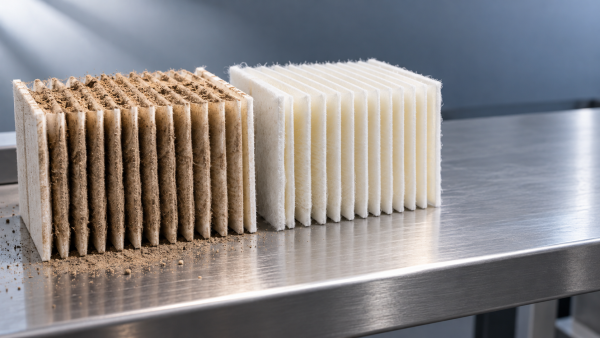
The effect is often stronger in a loaded element. Deposited particles create additional surfaces that hold moisture, while fine dust can form a wet, less-permeable layer. Pleat geometry also matters: closely spaced or distorted pleats can retain water where drainage is difficult. This explains why two filters with similar dry resistance may behave differently during the same fog event.
Sea salt can keep the restriction in place
Coastal aerosol contains hygroscopic salts that absorb moisture from humid air. Under suitable conditions, deposited salt dissolves into a concentrated solution. The filter may consequently become wetter before visible fog arrives, and it may remain moisture-laden after visibility improves. The response depends on salt composition, temperature, humidity, and contamination history; there is no single humidity threshold that describes every coastal inlet.
Repeated wetting and drying can redistribute salt within the element and its dust deposit. Drying may lower resistance without returning it to the previous baseline. That does not automatically mean the media has failed, but it suggests the event involved more than temporary surface wetting.
Salt also changes the maintenance priority. A filter that retains droplets but permits salt-bearing water to migrate downstream may present an equipment-protection concern even when differential pressure appears acceptable. Pressure drop and contaminant penetration must be assessed separately.
Read the trend before deciding to replace filters
A single high reading is less useful than a trend covering conditions before, during, and after fog. Compare readings at similar operating conditions. Changes in inlet airflow, turbine load, and air density can influence measured pressure loss, so an apparent weather response may partly reflect a change in operation. Use the site’s established correction method where available.
Three patterns help narrow the investigation:
- A sharp rise followed by substantial recovery: temporary liquid retention is plausible. Check whether repeated events produce progressively higher dry-condition readings.
- A rise followed by incomplete recovery: investigate retained moisture, wet dust deposits, salt accumulation, blocked drainage, and possible media or pleat deformation.
- A sudden pressure decrease after a severe rise: do not assume recovery. Check the measurement system and, when safe, inspect for bypass, displaced seals, or damaged elements.
“Wait until it dries” is reasonable only while readings remain within approved operating limits and there are no indications of downstream water ingress or structural distress. Alarm, shutdown, and element-change criteria should come from turbine, filter-house, and filter supplier documentation—not a generic pressure limit.
Troubleshoot the inlet as a system
Start by confirming that the differential-pressure signal is credible. Condensation, blocked pressure taps, leaking tubing, and transmitter problems can distort readings. Check the instrument arrangement against the approved maintenance procedure. Opening an operating inlet or improvising a pressure-line purge can introduce hazards and should not be treated as routine troubleshooting.
Next, locate the restriction. Where stage-specific measurements exist, compare the weather hood, moisture separator, prefilter, and final-filter stages. A total inlet reading cannot show whether the dominant loss is across a saturated prefilter or a fine-filter bank. If individual measurements are unavailable, plan suitable diagnostic access during an outage rather than assuming the final stage is responsible.
Look for water that cannot leave
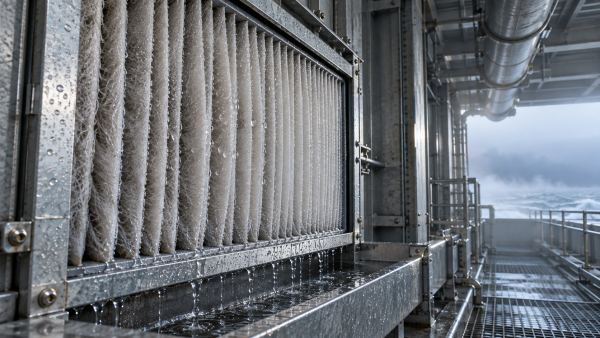
During a safe inspection, check separator surfaces, drain channels, drain outlets, and evidence of standing water. A separator may capture droplets effectively yet perform poorly as an installed assembly because collected water cannot escape. Drain arrangements must also account for pressure conditions: an unsuitable seal or trap can prevent drainage or create an unwanted air path.
Look for uneven wetting across the filter bank. Localized saturation may indicate wind-driven entry, damaged weather protection, poor flow distribution, or carryover from an upstream component. Uniform wetting suggests a different investigation from a single soaked corner. Photographing the pattern before it dries can preserve evidence that disappears quickly.
Inspect downstream surfaces for water tracks and deposits. Visual residue alone does not establish salt concentration or identify its source. Where salt ingress is suspected, use an appropriate sampling and analysis procedure; conductivity can indicate dissolved ionic contamination but does not, by itself, identify individual salts.
Match the corrective action to the failure mechanism
Replacing final filters will not correct a flooded separator or obstructed drain. Likewise, improving drainage will not restore an element whose wet contaminant layer remains highly restrictive after drying. Corrective work should follow the location and persistence of the problem.
If incoming liquid overwhelms the first stage, review weather protection and moisture separation against actual exposure, droplet conditions, and airflow. A device that removes larger droplets may not control fine fog equally well. Adding another stage can improve protection, but it also adds dry resistance and maintenance requirements. The decision needs a whole-inlet pressure-loss assessment.
Where restriction develops mainly in a dirty prefilter, review replacement timing and compatibility with the downstream stage. Extending prefilter service solely because its dry pressure drop remains acceptable may be counterproductive if fog repeatedly makes it the inlet’s bottleneck.
Inlet heating can reduce relative humidity and encourage evaporation in some systems, but it is not a universal remedy. It does not remove salt, may affect plant performance, and must suit the inlet design and turbine operating requirements. Similarly, pulse cleaning should only be used as intended for the installed system; wet, cohesive deposits may respond poorly to settings that work for dry dust.
Specify wet performance, not just clean dry efficiency
For recurrent coastal fog problems, a replacement specification should describe the service conditions that caused difficulty. Clean-media efficiency and initial pressure drop are useful, but they do not establish how a finished element handles water, salt, and repeated humidity cycles.
Ask suppliers for evidence relevant to these questions:
- How does resistance change during moisture exposure, and how much does it recover after drying?
- Does the element resist liquid penetration under the intended airflow and pressure conditions?
- Are wet strength, pleat stability, adhesive bonds, and seals maintained after conditioning?
- Does the assessment cover the complete element, including joints and gaskets, rather than media alone?
- How representative are the test contaminant, salt exposure, and wetting cycle of the proposed installation?
Water repellency can help limit liquid uptake, but it is not a substitute for drainage or sound element construction. Nor should high water repellency be treated as proof of salt protection. Dissolved contaminants, fine aerosol capture, and leakage paths require their own evaluation.
Material development offers several ways to address these trade-offs. Hangzhou Chaocai Materials Co., Ltd. develops functional filtration materials using fully synthetic wet-laid production and PUR, hot-melt adhesive, solvent-based emulsion spray, and ultrasonic lamination platforms. Such manufacturing options provide scope to adjust fiber structures and layered constructions. Their suitability for a coastal turbine inlet still depends on measured performance in the intended element design.
Application boundaries matter here. The company’s GF1218 is presented for liquid filtration, including new-energy liquid applications, with customizable fiber compositions. That does not establish suitability for turbine intake air. Liquid-filtration media and coastal air-intake media face different validation requirements, even when their available fiber families overlap.
Make the next fog event easier to diagnose
Before the next event, establish a comparable dry-condition baseline and confirm pressure instrumentation and drain condition. During fog, record stage pressure losses where available, turbine operating conditions, humidity, temperature, wind direction, and any evidence of water carryover. Continue recording through the drying period; the recovery curve often distinguishes temporary wetting from persistent restriction.
Use that record to decide whether the next intervention belongs at the weather hood, drainage system, prefilter, or final element. If a material change is proposed, request wet-exposure and recovery evidence for the finished construction. The practical objective is not merely a lower pressure reading on a dry day, but stable airflow and dependable contaminant control when coastal weather returns.
Recommendation
 Oct 26, 2026
How engine air intake filter media affects initial restriction
Engine Air Intake Filter Media affects initial restriction through fiber, pore, and laminate design. Discover how to compare pressure drop, efficiency, and durability for smarter filter selection.- Oct 26, 2026
Comparing dust capacity in agricultural machinery air filter media
Compare Agricultural Machinery Air Filter Media for dust capacity, filtration efficiency, and airflow resistance. Discover how to select reliable media for demanding field conditions. - Oct 26, 2026
Why coastal gas turbine filtration pressure drop rises in fog
Coastal Gas Turbine Filtration pressure drop rising in fog? Discover how moisture, sea salt, and drainage affect airflow—and learn practical steps to diagnose issues and protect turbine performance.