Selecting offshore gas turbine filtration for fine salt aerosols
For offshore projects, select inlet filtration by demonstrated salt control under realistic humidity and airflow conditions, then assess pressure losses, maintenance access, and lifecycle costs.
Fine salt aerosols can penetrate poorly matched filters, increasing compressor fouling, corrosion risk, and unplanned downtime. Nominal efficiency alone cannot establish adequate turbine protection offshore.
Effective Offshore Gas Turbine Filtration combines suitable intake positioning, moisture management, efficient particulate capture, and reliable sealing. Each element must suit the platform’s operating environment.
Project managers should therefore compare complete systems against an agreed exposure profile and turbine manufacturer requirements, supported by evidence covering both dry and wet operation.
What makes fine salt aerosols difficult to control?
Offshore air carries a changing mixture of sea spray, fine saline particles, industrial contaminants, and moisture. Their proportions vary with weather, location, and platform activity.
Large spray droplets respond well to inertial separation. Fine aerosols can follow airflow through these devices, making downstream filtration essential when turbine cleanliness requirements demand it.
Salt also changes behavior with humidity. Hygroscopic deposits can absorb moisture, form concentrated solutions, and redistribute within media as environmental conditions change during platform operation.
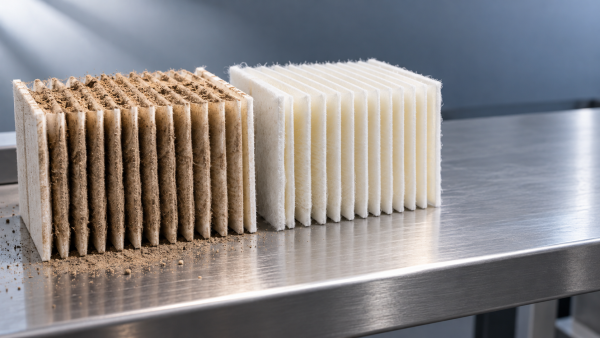
A filter that captures dry particles effectively may behave differently after salt loading and wetting. Retention, drainage, pressure resistance, and mechanical stability all need evaluation.
Hydrophobic surfaces can help resist liquid penetration, but water repellency does not demonstrate complete salt protection. Dissolved contamination may travel through leakage or liquid carryover.
The selection question is consequently broader than initial capture efficiency: how much salt reaches the compressor throughout the intended operating and maintenance cycle under changing conditions?
Define the site conditions before requesting quotations
A useful specification starts with the intake environment. Generic descriptions such as “marine duty” leave suppliers to assume exposure conditions that may differ substantially from reality.
Record prevailing winds, storm exposure, intake elevation, nearby exhaust outlets, and the likelihood of direct spray. Include seasonal humidity, fog, temperature changes, and maintenance constraints.
Where practical, characterize airborne salt concentration and particle size distribution near the proposed intake. Record measurement duration and weather conditions so suppliers understand the evidence.
Short monitoring campaigns can miss severe events. Combine available measurements with operating history from comparable installations, while documenting uncertainty and the conditions requiring additional protection.
Confirm rated and maximum airflow, allowable inlet losses, operating hours, and turbine manufacturer cleanliness guidance. Specify whether limits refer to components or the complete intake.
Agree on the protection objective early: permissible contaminant exposure, pressure limits, availability expectations, and replacement access. These requirements establish a consistent basis for commercial evaluation.
Choose filtration stages according to their actual roles
A multistage inlet should assign a clear function to every component. Adding stages without understanding their contribution can increase pressure losses without delivering useful protection.
Weather protection and suitable intake geometry reduce direct exposure. Droplet separators remove entrained liquid within their operating range, provided airflow distribution and drainage remain effective.
A coalescing stage can collect smaller droplets into larger ones for removal. Its performance depends on droplet characteristics, face velocity, liquid loading, and drainage arrangements.
Prefilters can reduce downstream particulate loading where site conditions justify them. Their value should be assessed against added resistance, replacement frequency, and available installation space.
The final particulate stage addresses aerosols escaping upstream equipment. Select its efficiency using the expected particle distribution and required compressor protection, supported by relevant test data.
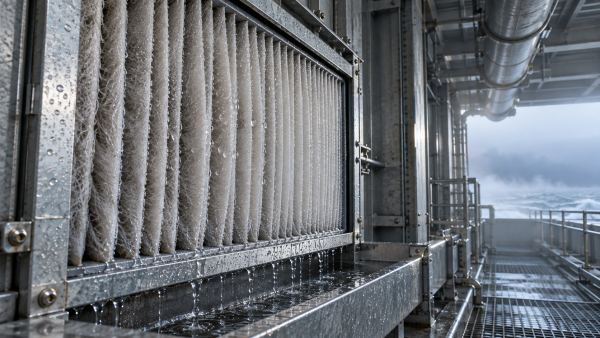
Check performance during wind-driven rain, fog, and changing airflow. Water trapped upstream, overloaded drains, or poorly distributed flow can undermine otherwise capable filtration components during operation.
Which supplier evidence supports a reliable decision?
Request complete test reports identifying the filter construction, test airflow, conditioning procedure, aerosol characteristics, and measured results. A headline efficiency percentage provides insufficient context for selection.
Size-resolved fractional efficiency helps reveal performance across particle sizes relevant to the application. Where electrostatic capture contributes, ask how efficiency changes after suitable conditioning procedures.
ISO 29461-1 provides a relevant framework for evaluating static filter elements used in rotary machinery intake systems. Confirm the applicable edition and reported classification details.
A classification under that standard does not independently establish offshore salt retention, drainage performance, or resistance to wet loading. Those questions require additional supporting evidence.
For saline exposure testing, ask suppliers to describe salt composition, concentration, humidity, exposure duration, airflow, and wetting cycles. These conditions determine whether comparisons are meaningful.
Distinguish particle counting from salt mass measurement. Both can inform selection, but neither should be presented as measuring the other without a clearly explained method.
Compare equivalent constructions and operating conditions. Media coupon results support material screening; full-element and assembly evidence is needed to assess pleats, seals, drainage, and installation effects.
Evaluate wet pressure drop and salt retention together
Clean, dry resistance establishes a baseline, but offshore reliability depends on behavior after contamination and moisture exposure. Request pressure-drop curves across the proposed airflow range.
Ask how resistance changes during saline loading, fog exposure, drainage, and subsequent drying. Temporary pressure peaks can matter even when average operating resistance appears acceptable.
Require suppliers to explain how retained salt behaves during repeated humidity changes. Capture at the beginning of a test does not establish retention throughout service.
Assess downstream contamination alongside pressure drop. A pressure reduction after wetting may reflect drainage, deposit movement, damage, or leakage; interpretation requires additional observations and measurements.
Specify acceptance criteria before testing begins, including maximum resistance, permitted downstream salt under defined conditions, and acceptable structural condition. Base limits on project and turbine requirements.
Where site evidence is limited, a representative trial can reduce uncertainty. Define its operating envelope and success criteria so favorable weather does not create misleading confidence.
Match media properties to the complete filter design
Media selection should consider fine-particle capture, moisture behavior, strength, and compatibility with the support structure. No single material description establishes suitability for every offshore intake.
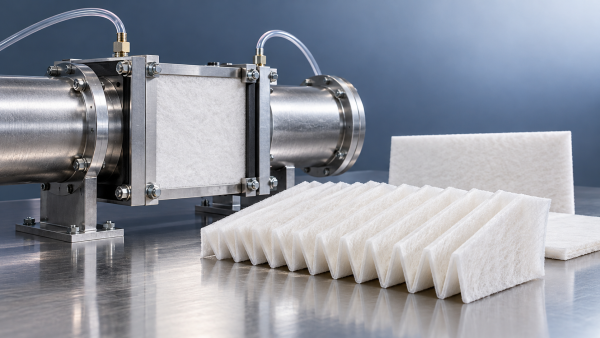
Synthetic wet-laid materials and membrane composites offer different design possibilities. Their performance depends on formulation, pore structure, lamination quality, pleat geometry, and the finished element.
Review adhesive compatibility and bond integrity under expected moisture and temperature conditions. Delamination, pleat collapse, or damaged supports can compromise filtration despite promising initial measurements.
Hangzhou Chaocai Materials Co., Ltd. develops functional filtration materials using synthetic wet-laid production and several lamination processes, supporting application-specific material development and evaluation for demanding environments.
Its Construction Machinery Intake Filtration Solutions illustrate capabilities in nano composite and ePTFE laminated media, with moisture-resistant treatments and reinforced structures for demanding machinery applications.
These features provide starting points for discussing durability and moisture management. Offshore turbine use still requires application-specific qualification; construction machinery performance cannot establish marine salt protection.
Similarly, suitability for backwashing in one application does not establish suitability for turbine pulse cleaning. Verify cleaning compatibility, retained efficiency, and mechanical durability for the proposed element.
Check installation details that can bypass good media
Even highly efficient media cannot protect a turbine when contaminated air bypasses the elements. Housing integrity deserves the same procurement attention as the selected filtration grade.
Examine gasket materials, compression control, frame tolerances, access doors, and element retention. Specify installation checks that confirm consistent sealing after routine filter replacement and inspection.
Drainage needs particular attention offshore. Confirm drain capacity, discharge arrangements, blockage access, and behavior under pressure differences so collected liquid cannot accumulate or re-enter the airflow.
Review corrosion protection for housings, fasteners, and drainage components. Material compatibility and coating selection should reflect actual exposure, inspection access, and the project’s maintenance strategy.
Check airflow distribution through the housing. Local velocities above design assumptions can increase resistance, affect droplet separation, and expose individual elements to disproportionate contamination loads.
Include inspection access, safe handling space, and replacement procedures in design reviews. An arrangement that is difficult to service can undermine otherwise sound maintenance plans.
Compare lifecycle cost using realistic operating assumptions
The lowest purchase price may produce higher operating costs through resistance, frequent replacements, or contamination-related maintenance. Compare bids over the same operating period and duty profile.
Use turbine manufacturer performance information to translate inlet pressure losses into output or fuel implications. Avoid applying a universal penalty across different machines and operating conditions.
Include filter purchases, offshore transport, storage, labor, disposal, inspection, and planned outages. Offshore logistics can make replacement frequency more consequential than the element price suggests.
Treat compressor washing and contamination-related downtime as scenario-dependent costs. Filtration may reduce these burdens, but predicted savings require support from operating evidence or justified assumptions.
Compare expected, favorable, and severe exposure scenarios. Show how service life, resistance growth, and replacement access affect the outcome, rather than presenting one precise forecast.
Evaluate stock availability and replacement compatibility alongside performance. A technically suitable filter creates operational risk if qualified spares cannot reach the platform within required timeframes.
Turn the selection into an enforceable project specification
Award decisions should connect each critical requirement to evidence and an acceptance method. This makes technical differences visible before procurement and reduces ambiguity during commissioning.
- Define site exposure, airflow range, turbine requirements, and the complete intake pressure budget.
- Identify each stage’s function and require evidence for the proposed element construction.
- Set agreed criteria for efficiency, saline exposure, wet resistance, drainage, sealing, and structural integrity.
- Establish inspection procedures, replacement triggers, spare requirements, and responsibility for resolving performance deviations.
At commissioning, record baseline differential pressure at known airflow conditions and verify installation, instrumentation, and drainage. Preserve these records for comparison as operating conditions change.
During service, trend pressure by stage where practical and inspect after significant weather events. Combine resistance trends with physical condition and turbine observations when planning replacements.
Make the decision around demonstrated protection
The strongest Offshore Gas Turbine Filtration choice controls fine salt under relevant operating conditions while meeting the project’s pressure, access, maintenance, and lifecycle cost requirements.
Prioritize representative exposure data, verified wet performance, dependable sealing, and maintainable drainage. These factors make supplier claims easier to assess and operating expectations more defensible.
When evidence remains incomplete, identify the gap and qualify the proposed solution before deployment. A clear acceptance plan helps turn material capability into reliable turbine protection.