




Can EPA filter media alone establish an E11 filter rating?
No—EPA Filter Media alone cannot establish an E11 rating for a finished filter. A media test describes the performance of a material sample under specified conditions. An E11 classification under EN 1822 concerns the complete filter element, which must achieve at least 95% overall efficiency at its most penetrating particle size (MPPS), at the airflow used for classification.
For quality control and safety personnel, that distinction matters when approving a supplier, releasing a production batch, or assessing filtration equipment. A sheet of media may perform well in a laboratory holder, yet the filter made from it can lose efficiency through damaged pleats, incomplete bonding, or air bypass. The acceptance question is therefore not simply, “Is this E11 media?” It is, “What evidence supports the E11 claim for the filter we are purchasing?”
What an E11 classification actually means
EN 1822 distinguishes EPA, HEPA, and ULPA filters. E11 belongs to the EPA group—Efficient Particulate Air filters—not the HEPA group. Calling an E11 product “HEPA” can create confusion in purchasing specifications and safety documentation, even if the supplier uses that term informally.
For E11, the relevant classification threshold is an integral efficiency of at least 95% at MPPS, equivalent to a maximum integral penetration of 5%. Integral efficiency describes the overall upstream-to-downstream particle removal performance of the complete filter, rather than the efficiency at one small location.
Another distinction is important: EN 1822 does not assign E11 the same individual local leakage requirements used for H- and U-group filters. Do not automatically demand a HEPA-style scan certificate as a universal E11 classification requirement. Additional leakage testing may nevertheless be appropriate when required by the application, customer specification, or risk assessment.
Why the particle size and airflow cannot be left out
A report stating “95% efficiency” is incomplete without the test conditions. Filter efficiency varies with particle size, air velocity, and the filtration mechanisms involved. MPPS is the particle size, or size region, at which the filter exhibits its lowest efficiency under the relevant conditions.
That is why a result measured only at 0.3 micrometres does not automatically demonstrate E11 compliance. Nor does an efficiency result obtained using a different aerosol, measurement method, or operating airflow. The report must show that the test basis supports classification under the applicable standard.
For media, face velocity is particularly important. A flat sheet tested at a low velocity may not represent the velocity through the media in the finished pleat pack. Although adding media area generally reduces average media velocity, tight pleat spacing and uneven flow distribution can prevent the entire nominal area from working equally.
Pressure drop should be reviewed alongside efficiency, but it is not the E11 classification threshold. It affects fan selection, energy demand, airflow delivery, and the mechanical loading on the filter. Two filters meeting E11 can therefore behave quite differently in the same machine.
Where EPA Filter Media performance can be lost during conversion
Media selection provides the starting point. Conversion determines whether that performance survives manufacturing.
Pleating changes the physical structure
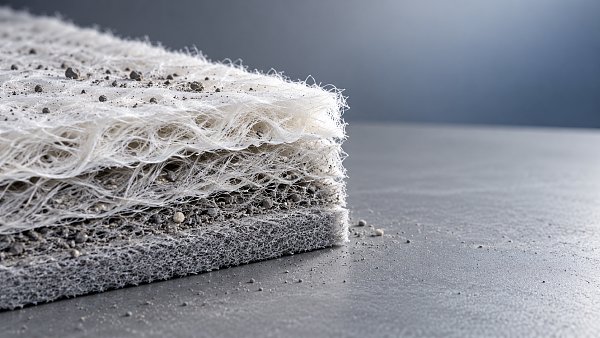
Sharp folds, unsuitable tooling, or excessive tension can damage a filtration layer. In composite media, different layers may respond differently to bending, creating local separation or stressed areas. Closely packed pleats may also restrict access to the media surface and increase resistance.
For production control, pleat height and spacing are not merely dimensional checks. They help establish whether the manufactured pack remains consistent with the design used in qualification testing.
Bonding and sealing create—or close—bypass routes
Incomplete potting, adhesive discontinuities, frame distortion, and poorly bonded pack edges can allow air to avoid the filtration layer. Because bypass air receives little or no filtration, even a small leak can consume a narrow efficiency margin.
Consider a simplified example. If the media removes exactly 95% of particles at the relevant size, but 1% of the total airflow bypasses it completely, overall efficiency becomes approximately:
0.99 × 95% = 94.05%
This is an illustration, not a substitute for testing. It assumes uniform challenge conditions and completely unfiltered bypass. Its practical message is straightforward: selecting media at the classification threshold leaves no allowance for assembly losses.
Lamination must be evaluated as part of the material design
Support layers and lamination can improve handling and pleat stability, but the bonding method may also affect permeability, stiffness, and usable filtration area. Adhesive distribution and process consistency therefore belong in material qualification—not just in visual inspection.
Hangzhou Chaocai Materials Co., Ltd. develops functional filtration materials using capabilities that include fully synthetic wet-laid production, PUR and hot-melt adhesive lamination, solvent-based emulsion spray lamination, and ultrasonic lamination. For filter manufacturers, the relevant consideration is how a selected construction performs after conversion. A production capability or material description is not, by itself, proof of a finished-filter classification.
What to request before accepting an E11 claim
A useful acceptance file connects the supplied product to the tested construction. It should allow a reviewer to follow the evidence without relying on an unqualified statement such as “made with certified media.”
- The classification basis. Identify the standard and edition used. If documentation references ISO 29463 or another framework, confirm the applicable classification and test requirements rather than assuming that the terminology is interchangeable.
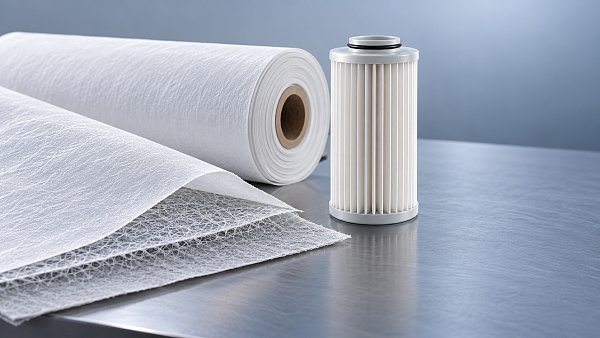
- The tested filter identity. Check the model, dimensions, media construction, pack configuration, frame, and sealing arrangement. The report should clearly distinguish a complete filter from a media coupon.
- The test airflow. Confirm the volumetric airflow at which the filter was evaluated and its relationship to the intended operating duty.
- The efficiency result and MPPS basis. Look for integral efficiency or penetration, together with enough methodological information to establish how the relevant particle size was determined and assessed.
- Resistance at the stated airflow. Verify that the measured pressure drop is compatible with the equipment specification, independently of whether the efficiency threshold is met.
- Traceability and report authority. Check the report number, date, laboratory identity, and connection to the supplied design. Where accredited testing is required, verify that the laboratory’s accreditation scope covers the relevant work.
A supplier declaration can be part of this package, but its value depends on the supporting evidence. Conversely, a laboratory logo does not resolve a mismatch between the tested item and the delivered filter.
Also distinguish design qualification from routine production verification. E11 does not automatically imply that every delivered unit has received the individual testing associated with higher filter groups. The purchasing specification should state whether acceptance relies on design testing, batch sampling, unit testing, or an agreed combination.
A practical approval route for QC teams
Start by checking the evidence boundary. If the only report concerns EPA Filter Media, record the material as evaluated under the stated conditions—not the finished filter as E11. This avoids turning a useful material result into an unsupported product claim.
Next, compare the proposed filter with the qualified design. Changes in media grade, lamination, pleat geometry, adhesive, frame dimensions, or edge sealing may affect performance. Not every change requires the same level of testing, but each needs a documented assessment and a clear decision on requalification.
For ongoing production, inspection should focus on variables that can undermine the qualified construction: material identification, pleat damage, bond continuity, potting coverage, frame integrity, and dimensional fit. Airflow resistance can help reveal manufacturing variation, although a normal pressure-drop result does not prove adequate efficiency or freedom from leaks.
If evidence is missing, separate technical clarification from product release. Request the relevant report or arrange appropriate finished-filter testing before approving the classification claim. Where the filter supports a safety-critical process, unresolved documentation should not be treated as a minor administrative issue.
Material suitability is a separate decision from E11 classification
A candidate material can be suitable for development without having established a finished-filter rating. For example, EP1020WBU is identified for air filtration and industrial dust and oil mist filtration applications. Those application descriptions provide a starting point for technical discussion; they do not establish E11 efficiency, operating resistance, or certification.
Before using any candidate in an E11 design, request its relevant efficiency and permeability data, test conditions, physical properties, and conversion guidance. Then evaluate the assembled construction. For oil mist service, also consider whether liquid loading affects resistance, drainage, material stability, and service behaviour. A particulate classification alone does not establish suitability for prolonged oil exposure.
The same caution applies across demanding manufacturing environments. Semiconductor processes, biopharmaceutical operations, gas turbines, and automotive systems may impose different cleanliness, durability, or equipment requirements. E11 answers a defined filtration-performance question; it does not automatically satisfy every application specification.
Keep three acceptance decisions separate
Reliable approval depends on three distinct conclusions: the media is suitable for the design, the finished filter has evidence supporting its claimed classification, and the installed system meets the application’s requirements.
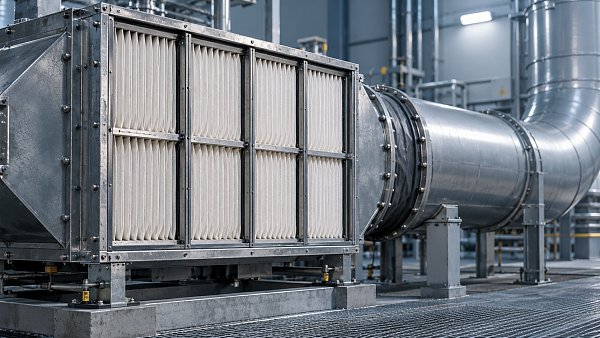
A qualified filter can still be compromised by a damaged gasket, an unsuitable mounting interface, or bypass around the housing. Likewise, an E11 rating does not by itself establish compliance with occupational exposure limits or prove adequate control of gases and vapours. Safety personnel must assess the actual contaminant, airflow arrangement, and required control performance.
The defensible conclusion is simple: EPA Filter Media can support an E11 filter design, but it cannot establish the finished-filter rating alone. Accept the claim when the classification evidence identifies the relevant assembled filter, uses the appropriate MPPS-based test basis, and applies to the airflow and construction being supplied. That is the difference between buying a promising material and approving a documented filtration product.
Recommendation
 Oct 30, 2026
How Can Air Filter Media Hold More Dust Without Increasing Pressure Drop?
Explore Ltd. filter media lead time and discover how depth loading, layered media, and pleat design can increase dust capacity while controlling pressure drop.- Oct 30, 2026
How to Evaluate an ePTFE Laminated Filter Media Supplier
Explore Ltd. moisture resistant media and learn how to evaluate ePTFE laminated filter suppliers for performance, consistency and long-term value. - Oct 30, 2026
Is F9 Filter Media Suitable for Gas Turbine Air Intakes?
Explore Ltd. custom filter media options for gas turbine air intakes, and learn how F9 performance, pressure drop, and site conditions guide your choice.