Is Hangzhou Super Material’s Filter Media Suitable for Gas Turbines?
Is Hangzhou Super Material’s filter media suitable for gas turbines? It may be a candidate, but suitability cannot be established from manufacturing capabilities alone. For engineers and procurement teams searching for “Ltd. filter media reviews,” the useful answer lies in verified filtration performance, environmental resistance, and compatibility with the finished inlet filter.
The supplied company information identifies Hangzhou Chaocai Materials Co., Ltd., while the question uses “Hangzhou Super Material.” Their relationship should be confirmed before technical documents or supplier reviews are attributed to either name. This assessment considers the manufacturing capabilities described for Hangzhou Chaocai Materials Co., Ltd.; it does not assume that an unverified product has passed gas turbine qualification.
That distinction matters. A material can look convincing on a specification sheet yet behave differently after pleating, dust loading, or exposure to humid inlet air. The questions below explain what buyers need to establish before moving from a promising material sample to an approved filtration solution.
What makes filter media suitable for a gas turbine inlet?
Gas turbine inlet filtration protects compressor components from airborne contamination while limiting resistance to incoming airflow. Both objectives matter: inadequate particle capture can contribute to fouling or erosion, while excessive inlet pressure loss can affect turbine performance.
Suitability therefore depends on a combination of properties rather than a single efficiency figure:
- Particle capture: efficiency across relevant particle sizes, including the range where the filter performs least efficiently.
- Airflow resistance: pressure drop at the intended operating conditions, both initially and as contamination accumulates.
- Environmental stability: resistance to moisture, temperature variation, and contaminants expected at the installation.
- Mechanical integrity: adequate strength for converting, installation, and service without tearing, shedding, or layer separation.
- Finished-element performance: reliable pleats, seals, support structures, and housing interfaces.
No universal media specification fits every site. A coastal combined-cycle plant and an inland installation exposed to seasonal dust storms may require different filtration arrangements, even if their turbines have similar airflow requirements.
Do Chaocai’s manufacturing capabilities support this application?
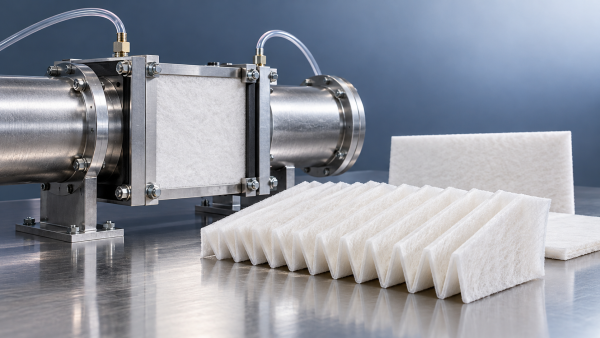
They provide relevant manufacturing context. Hangzhou Chaocai Materials Co., Ltd. describes a focus on functional advanced materials and production platforms that include fully synthetic wet-laid processing, PUR lamination, hot-melt adhesive lamination, solvent-based emulsion spray lamination, and ultrasonic lamination.
Synthetic wet-laid processing can support control over fiber distribution and sheet structure. Depending on the formulation and process settings, those characteristics influence permeability, filtration behavior, thickness uniformity, and handling strength. Lamination offers ways to combine filtration layers with support or protective layers.
These are useful capabilities when developing gas turbine filtration materials. They are not, however, evidence that every material produced on those lines is appropriate for turbine service.
The qualification question is product-specific: which media grade, made to which specification, has demonstrated the required performance? Buyers should request an identifiable grade and its supporting data rather than accept a general statement that the company serves the gas turbine industry.
What should buyers look for in “Ltd. filter media reviews”?
Supplier reviews can reveal practical issues such as roll consistency, communication, packaging, and delivery reliability. Their technical value is much more limited when they do not identify the material, test conditions, or application.
A comment saying that media has “high efficiency and low resistance” leaves essential questions unanswered. Was resistance measured on a flat sheet or a finished element? At what face velocity? Was efficiency measured only when new, or after conditioning and loading?
A credible assessment should connect each claim to evidence:
No independent reviews, product-level test reports, or field results were supplied here. Consequently, a positive or negative performance verdict would go beyond the available evidence.
Which filtration standards matter—and what do they actually prove?
The ISO 29461 series is relevant to air intake filter systems for rotary machinery, including gas turbines. Buyers should identify the applicable part, edition, and test scope rather than accept an unspecified reference to “ISO testing.”
Other classifications may appear in supplier documents, including ISO 16890 or EN 1822/ISO 29463, depending on the filter type and intended performance level. These references can provide useful information, but they are not interchangeable. A classification under a general ventilation standard does not, by itself, demonstrate suitability for a particular turbine inlet duty.
It is equally important to distinguish flat-sheet media testing from finished-filter testing. Media results help developers select materials and design elements. Finished-filter tests evaluate the assembled product, where pleat geometry, adhesive application, frame construction, and leakage can change performance.
Ask whether the report covers the exact product being proposed, whether testing was independent, and whether the laboratory’s relevant testing activities fall within its accreditation scope. A report for a similar grade is supporting context, not automatic approval.
How should efficiency and pressure drop be compared?
Compare them together, under matched conditions. A pressure-drop number without airflow information is not a meaningful purchasing benchmark. Likewise, a single efficiency percentage may conceal weak capture at important particle sizes.
For flat media, face velocity is particularly important. For a finished element, airflow, available media area, pleat spacing, and flow distribution all influence resistance. A tightly packed pleat arrangement may add nominal media area without making all of it equally effective.
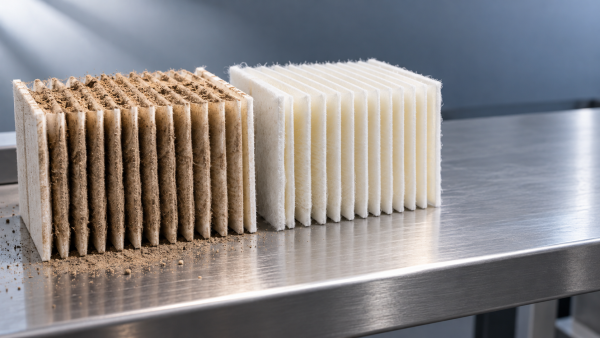
Ask for clean-condition results and loading behavior. Two candidates with similar initial resistance can diverge considerably as dust accumulates. One may develop a restrictive surface cake quickly; another may accommodate contamination more gradually under the same test conditions.
The practical objective is not simply the lowest initial pressure drop. It is an acceptable balance between contaminant protection, resistance over time, and replacement requirements. Any estimate of operating savings should use the turbine’s performance information and site operating profile, not a generic percentage.
Will synthetic laminated media withstand humidity, fog, and coastal salt?
That cannot be determined from the word “synthetic.” Fiber chemistry matters, but so do surface treatments, pore structure, adhesive selection, support layers, and finished-filter drainage.
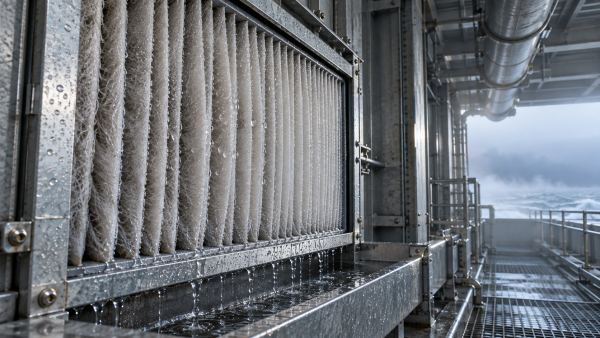
Moisture may increase resistance, alter dust deposits, or weaken a poorly matched laminate. In coastal service, salt presents an additional challenge because it can absorb moisture and form solutions under humid conditions. Capture of dry salt particles does not establish control of every wet salt exposure.
For a humid or coastal installation, ask about:
- Water-repellent behavior and resistance to liquid penetration under defined conditions.
- Pressure-drop response during and after representative moisture exposure.
- Laminate bond strength and dimensional stability following wetting.
- Potential contaminant transport or release during wet and dry cycling.
- Compatibility with the inlet system’s droplet separation and drainage provisions.
Hydrophobic media may be useful, but it does not replace appropriate weather protection or moisture management. Nor should a particulate filter be assumed to remove gaseous contaminants without a separately specified treatment mechanism.
Does the lamination method make one product better than another?
Not on its own. Chaocai’s different lamination platforms offer development options, but the best process depends on the required layer combination and service conditions.
Adhesive coverage can affect airflow and local stiffness. Bond strength influences whether layers remain stable during pleating and operation. Thermal and chemical compatibility also matter. Ultrasonic bonding changes how layers are joined, but it still requires validation for the chosen materials and construction.
Rather than rank processes by name, request results for the actual laminate: permeability, pressure drop, thickness variation, tensile properties, and resistance to delamination. Where relevant, examine those properties after environmental exposure as well as in the as-manufactured condition.
A useful sample trial should also include converting feedback. Media that performs well as a laboratory sheet may crack at a fold, distort during pleating, or bond poorly to the filter manufacturer’s sealing system.
Can the same media be used in pulse-cleaned and static filters?
Do not assume so. Static and pulse-cleaned systems impose different demands, even when they operate at the same site.
A static filter must maintain useful capture and resistance characteristics as contamination builds toward replacement. Pulse-cleaned media must additionally tolerate repeated cleaning events and release dust effectively enough to recover usable airflow.
For pulse-cleaned applications, evaluation should include residual pressure drop after cleaning, dust release behavior, efficiency over repeated cycles, and mechanical durability. The finished element’s supports and seals also need to tolerate the operating cycle.
Before requesting a material recommendation, tell the supplier which cleaning arrangement is used. A supplier cannot make a defensible selection from turbine model and nominal filtration efficiency alone.
What information should be exchanged before a qualification trial?
A productive qualification starts with a clear duty specification. Otherwise, the supplier may optimize for the wrong problem—for example, dry dust capacity when the plant’s main concern is wet-weather resistance.
Provide the supplier with the inlet airflow range, filter dimensions, operating environment, existing filtration stages, cleaning method, and turbine manufacturer’s applicable requirements. Include known problems with the current solution, such as short replacement intervals, moisture-related pressure spikes, or evidence of downstream contamination.
In return, request the proposed media grade, controlled specification, test reports, converting recommendations, storage guidance, and batch traceability arrangements. Confirm how formulation or process changes will be communicated after approval.
Qualification can then progress from laboratory comparison to prototype-element testing and, where appropriate, a controlled field trial. Define acceptance criteria in advance. During field evaluation, record operating hours, pressure-drop trends, weather, and relevant inspections so that observations have context.
So, should buyers shortlist this filter media?
Chaocai’s stated synthetic wet-laid and lamination capabilities justify a technical discussion, but they do not establish gas turbine suitability. The available information supports considering the company as a potential material-development or supply candidate—not treating an unspecified grade as qualified.
Before shortlisting a product, confirm the supplier identity behind “Hangzhou Super Material,” obtain documentation for the exact grade, and assess it in the intended filter construction. Final selection should satisfy the site’s contamination risks, inlet-system design, and applicable turbine requirements.
For buyers comparing filter media reviews, that is the most useful dividing line: manufacturing capability opens the conversation; traceable test evidence and application validation support the purchasing decision.
Recommendation
 Oct 26, 2026
How engine air intake filter media affects initial restriction
Engine Air Intake Filter Media affects initial restriction through fiber, pore, and laminate design. Discover how to compare pressure drop, efficiency, and durability for smarter filter selection.- Oct 26, 2026
Comparing dust capacity in agricultural machinery air filter media
Compare Agricultural Machinery Air Filter Media for dust capacity, filtration efficiency, and airflow resistance. Discover how to select reliable media for demanding field conditions. - Oct 26, 2026
Why coastal gas turbine filtration pressure drop rises in fog
Coastal Gas Turbine Filtration pressure drop rising in fog? Discover how moisture, sea salt, and drainage affect airflow—and learn practical steps to diagnose issues and protect turbine performance.