



How Is Hangzhou Super Material’s Media Tested for Moisture Resistance?
A gas turbine intake filter may perform well in dry air yet behave differently when fog rolls in or condensation forms inside the intake system. Moisture can increase airflow resistance, affect particle capture, and weaken a material’s structure. For buyers evaluating Hangzhou Chaocai Materials Co., Ltd. gas turbine filter media, the important question is not simply whether the material repels water, but whether it continues to perform under the moisture conditions expected in service.
For media referred to as Hangzhou Super Material’s, a reliable assessment should combine controlled humidity exposure, liquid-water testing, structural checks, and filtration measurements before and after conditioning. However, the supplied company information does not specify a validated testing protocol or published moisture-resistance results. The following questions explain what a meaningful evaluation should cover—and what buyers should confirm in a grade-specific test report.
What does “moisture resistance” mean for gas turbine filter media?
Moisture resistance is not a single property. A material may shed droplets effectively while still losing stiffness during prolonged humid exposure. Another may retain its strength but experience a substantial pressure-drop increase when its pores contain water.
A useful evaluation separates four related characteristics:
- Humidity tolerance: whether exposure to water vapor changes the material’s dimensions, strength, or filtration behavior.
- Surface water repellency: how readily droplets spread, penetrate, or leave the surface.
- Resistance to water penetration: whether liquid passes through under a defined pressure or exposure condition.
- Wet operating performance: whether the filter maintains acceptable airflow resistance, particle capture, and structural integrity during moisture exposure.
These distinctions matter because water vapor, fog droplets, rain ingress, and condensation do not challenge a filter in the same way. A statement such as “moisture resistant” needs an accompanying test method and a defined operating context.
How should controlled humidity testing be conducted?
Controlled humidity testing typically starts with representative samples conditioned under a documented reference atmosphere. Their initial mass, thickness, air permeability, and relevant mechanical properties establish a baseline.
Samples are then exposed in a chamber where temperature, relative humidity, and duration are controlled. The chosen conditions should reflect the intended application or an agreed accelerated screening procedure. There is no universally appropriate exposure setting for every turbine intake installation.
The evaluation should distinguish measurements taken immediately after exposure from those taken after drying or reconditioning. This helps separate temporary moisture effects from persistent damage. For example, a material that recovers its original dimensions after drying may still have experienced an unacceptable loss of stiffness while wet.
Useful observations include dimensional changes, distortion, softening, surface damage, and changes in tensile strength or interlayer adhesion. Where weighing is practical, moisture-related mass change can provide additional information, provided handling and weighing procedures control evaporation and condensation.
Buyer’s question: “Were the reported properties measured while the material was moisture-conditioned, or only after it had dried?” The answer can materially change how the results should be interpreted.
How is water repellency assessed—and what does it leave unanswered?
Water-repellency assessments examine how the material interacts with liquid water. Depending on the grade and intended use, relevant methods may include droplet observation, contact-angle measurement, spray exposure, or a water-penetration test under a controlled pressure.
These methods answer different questions. A droplet that beads on the surface indicates limited wetting under those specific conditions. A pressure-based penetration test examines resistance to water passing through the material. Neither result alone proves that a finished filter will operate reliably in fog.
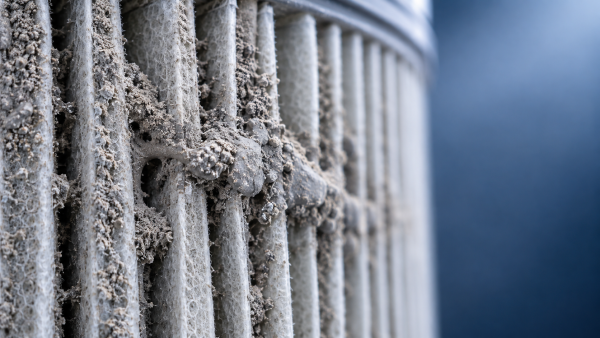
A hydrophobic surface is useful evidence, but not the whole answer. Water may accumulate between fibers, become trapped by deposited dust, or reach the downstream side through defects or assembly interfaces.
What should be measured before, during, and after moisture exposure?
The most informative comparison links moisture exposure to the filter’s actual job: capturing particles while allowing sufficient airflow.
Pressure drop at a defined airflow
Pressure drop should be compared at the same stated face velocity or airflow rate. Otherwise, an apparent change in resistance may simply reflect different test conditions. During a wet challenge, continuous or repeated readings reveal whether resistance rises gradually, reaches a stable level, or increases sharply as water accumulates.
A post-drying measurement is also valuable. Failure to return toward the baseline may indicate persistent changes, although it does not identify their cause without further examination.
Particle filtration efficiency
Efficiency should be evaluated using a documented aerosol, particle-size range, and measurement method. Where technically appropriate, comparisons can include baseline, moisture-conditioned, and recovered states. Measuring particle efficiency during a wet challenge requires particular care because water droplets can interfere with particle measurements.
If a grade relies partly on electrostatic capture, the evaluation should consider whether humid exposure affects that contribution. This should not be assumed for every synthetic medium: fiber composition alone does not establish how a particular grade captures particles.
Physical integrity and recovery
Inspect the material for cracking, fiber displacement, layer separation, and permanent deformation. For pleated samples or finished elements, check pleat spacing and stability as well. A flat sheet can appear intact even when the assembled filter has developed local collapse or bypass paths.
Why do lamination and material construction matter?
Hangzhou Chaocai Materials Co., Ltd. describes production capabilities that include fully synthetic wet-laid lines, PUR lamination, hot-melt adhesive lamination, solvent-based emulsion spray lamination, and ultrasonic lamination. These platforms support different material constructions; they should not be interpreted as features present in every gas turbine media grade.
For moisture testing, the relevant issue is how the selected construction behaves as a complete system. Fibers, functional layers, support materials, and bonding interfaces can respond differently to water and temperature.
A laminated medium therefore needs more than a surface inspection. Depending on its construction, appropriate checks may include peel strength, bond continuity, delamination after conditioning, and changes in permeability. An interface that remains secure in a dry tensile test may behave differently after repeated wetting and drying.
Buyers should request the construction description for the proposed grade and ask which moisture-related failure modes the test program addresses. Manufacturing capability is useful context, but it is not a substitute for test results on the material being purchased.
Is humidity-chamber testing enough for foggy or coastal sites?
Usually not. High relative humidity exposes media primarily to water vapor. Fog introduces suspended liquid droplets that can collect, coalesce, and obstruct airflow pathways. Coastal sites may add salt-containing aerosols, creating a different challenge again.
Where fog is a credible operating risk, an airflow-based fog or mist assessment is more representative than humidity conditioning alone. The report should identify airflow, exposure duration, water delivery rate, and droplet characteristics where these are controlled or measured.
Dust loading also matters. Clean media and dust-loaded media may respond differently because deposited particles can retain water and alter drainage. If the intake operates for long periods between filter changes, testing only clean material leaves an important uncertainty.
For coastal applications, salt exposure should be considered separately rather than treated as equivalent to freshwater fog. Hygroscopic deposits can attract moisture and affect resistance as humidity changes. A freshwater-only result should not be presented as proof of suitability for salt-laden air.
Should testing cover flat media or the finished filter element?
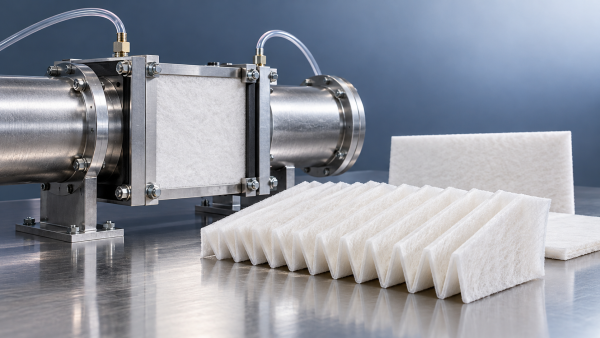
Both can be necessary, because they answer different questions. Flat-sheet testing is valuable for formulation development, grade comparison, and production consistency. It helps isolate the behavior of the filtration material without assembly variables.
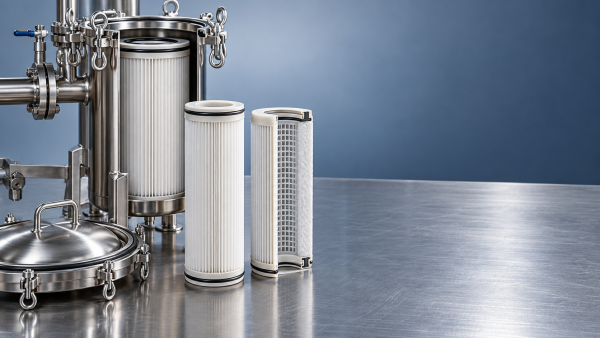
Finished-element testing adds the effects of pleat geometry, supports, seals, adhesive joints, drainage, and manufacturing workmanship. These features influence water accumulation and structural stability. A promising media result does not automatically transfer to every filter design.
For turbine intake filters, relevant parts of the ISO 29461 series may provide an appropriate framework for element-level evaluation, depending on the property being assessed. Any reference to a standard should identify the applicable part, edition, test configuration, and deviations. Flat-media screening should not be described as equivalent to a complete element test.
When comparing suppliers, confirm that the reports concern equivalent test objects. A coupon result and a finished-filter result are not directly interchangeable.
What evidence should buyers request for Hangzhou Chaocai Materials Co., Ltd. gas turbine filter media?
A useful test report should make it possible to connect the result to the exact grade under consideration. A general brochure statement is not enough for an engineering qualification decision.
- Material identity: grade code, construction, production lot, and relevant physical specifications.
- Sample details: dimensions, orientation, number of specimens, and sampling approach.
- Exposure conditions: temperature, relative humidity, duration, and whether condensation or liquid droplets were involved.
- Test procedure: standard or internal method, equipment configuration, airflow, and any deviations.
- Comparative results: baseline, exposed, and recovered values, with units and measurement timing.
- Variability: individual results or a meaningful summary of specimen-to-specimen differences.
- Acceptance criteria: the limits agreed for the intended application and the basis for those limits.
If testing is described as independent, request the laboratory identity and report reference. Also confirm whether the tested material matches the current production specification. Results from a development sample may be informative without demonstrating routine production consistency.
What counts as a satisfactory moisture-resistance result?
There is no single universal pass value. Acceptance depends on the turbine intake design, allowable resistance, filtration requirements, exposure severity, and maintenance strategy. Criteria should be agreed before testing rather than selected afterward to fit the outcome.
A practical qualification asks whether pressure drop remains within the system’s operating allowance, particle capture remains acceptable, and the material retains sufficient strength and bond integrity. Where repeated exposure is expected, wet–dry cycling can help reveal damage that a single conditioning period misses.
The strongest purchasing decision rests on a matched set of evidence: a clearly identified media grade, a representative moisture challenge, transparent measurements, and—where required—finished-filter validation. Until grade-specific reports are available, moisture resistance should remain a property to verify, not a performance claim to assume.
Recommendation
 Oct 28, 2026
What causes pulse-jet cleanable filter media to lose permeability?
Pulse-Jet Cleanable Filter Media can lose permeability due to dust, moisture, oil, or damage. Learn how to diagnose the cause, improve airflow, and avoid premature replacement.- Oct 28, 2026
When should water filter media be replaced rather than backwashed?
Water Filter Media: replace or backwash? Learn the signs of damage, exhausted capacity, and persistent fouling to make smarter maintenance decisions and protect water quality. - Oct 26, 2026
How engine air intake filter media affects initial restriction
Engine Air Intake Filter Media affects initial restriction through fiber, pore, and laminate design. Discover how to compare pressure drop, efficiency, and durability for smarter filter selection.