




How Should Buyers Evaluate F9 Gas Turbine Intake Filter Media?
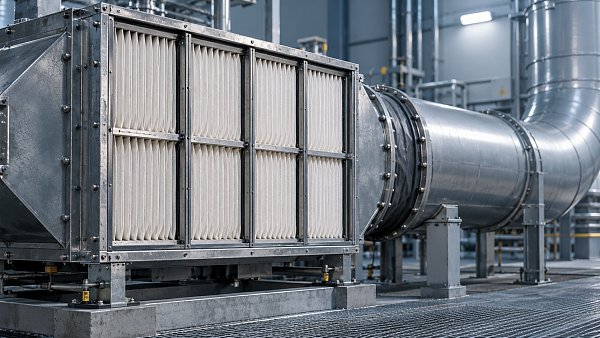
Buyers should evaluate F9 gas turbine intake filter media against three connected requirements: particle capture that remains effective in service, acceptable pressure loss as contamination accumulates, and reliable performance under the site’s moisture conditions. The F9 designation helps identify a filtration category, but it cannot establish whether a material will protect a particular turbine or deliver an acceptable operating cost.
A sound purchasing decision therefore needs two levels of evidence: controlled tests on the media and representative tests on the finished filter element. A promising sheet material can perform differently after pleating, bonding, sealing, and installation. Before comparing quotations, define the turbine’s protection requirements, the intake system’s airflow and pressure limits, and the contamination conditions the filter will face.
What does an F9 rating actually tell a buyer?
F9 is a classification associated with the legacy EN 779 framework for general ventilation filters. Under EN 779:2012, the F9 class required an average efficiency of at least 95% for 0.4-micrometer particles, with a minimum efficiency requirement of 70% under the standard’s specified assessment conditions. Those figures describe a particular test framework; they do not mean the filter removes 95% of every particle size throughout its service life.
The distinction matters because a supplier may describe either a finished filter or a filter medium as “F9.” A media sample tested at a stated face velocity does not establish the classification or installed performance of every element made from it. Ask what was tested, which edition of the standard was used, and whether the report covers the exact material construction being offered.
For turbine intake applications, ISO 29461-1 provides a more application-specific framework for assessing filter elements used in rotary machinery intake systems. ISO 16890 classifications may also appear in supplier documentation, particularly where products serve general ventilation markets. These frameworks use different assessment methods and classification structures. An F9 designation should not be converted directly into an ISO ePM1 percentage or another class through a simple equivalence claim.
Existing installations may still specify F9 because their procurement documents and operating records use that terminology. In that situation, retain the designation as a reference while requesting enough underlying data to judge performance against the turbine’s actual requirements.
Which efficiency results deserve the closest attention?
Request particle-size-resolved efficiency data, together with the test airflow, sample area, conditioning procedure, and material identification. A single headline efficiency conceals differences in how media capture particles across the measured size range.
Also examine how performance changes after the conditioning or discharge treatment required by the applicable method. Some media benefit from electrostatic capture, and their initial efficiency can exceed the efficiency measured after that contribution has been reduced. Electrostatic media can be suitable, but the buyer needs to understand how much the specified performance depends on charge and whether the evaluation addresses the intended exposure.
Laboratory conditioning is useful comparative evidence. It is not a complete simulation of years of service. For a critical intake, the purchasing specification should establish an acceptable efficiency floor and the evidence needed to demonstrate it, rather than relying only on the highest initial result.
How should buyers compare pressure drop and dust-holding capacity?
Compare efficiency and pressure drop at the same operating point. A low resistance figure has limited value if it was measured at a lower media velocity than the competing material or the proposed filter design will experience.
Media velocity depends on the airflow passing through the effective filtration area. Finished-element performance also depends on pleat spacing, pleat depth, supports, and flow distribution. Increasing the nominal media area does not guarantee a proportional reduction in resistance: tightly packed pleats can restrict access to parts of the material and change how dust accumulates.
For an initial comparison, request:
- Clean-media pressure drop at the stated test velocity, with the sample construction identified.
- Finished-element pressure drop at the intended airflow, including relevant support and frame components.
- Pressure-drop development during loading, rather than only the clean and final values.
- The test dust, loading procedure, airflow, and terminal pressure used to determine dust-holding capacity.
Dust-holding capacity is meaningful only alongside these conditions. Two reported capacities are not directly comparable if one test ends at a higher terminal resistance. Differences in test dust can also change the apparent ranking because coarse mineral dust, fine combustion particles, and other contaminants form different deposits.
Does higher dust-holding capacity mean longer service life?
It can support longer service, but it does not establish a replacement interval by itself. Laboratory loading uses controlled contamination and operating conditions. A turbine intake may encounter seasonal dust, intermittent soot, moisture, or mixtures that load the filter differently.
The shape of the loading curve can be more useful than the final capacity figure. A material that starts with low resistance but develops a steep pressure rise may create a different operating burden from one whose resistance increases more gradually. Compare the curves over the pressure range the plant can actually use.
Evaluate these results within the complete filtration arrangement. Where prefilters are installed, their performance determines much of the contamination reaching the final stage. Testing final-stage media against an unrepresentative dust challenge can mislead the selection.
The practical question is whether the proposed construction can maintain acceptable protection and intake resistance through the intended operating interval. A controlled site trial can help answer that question when laboratory data leave a material uncertainty.
What should be checked for humid, coastal, or fog-prone sites?
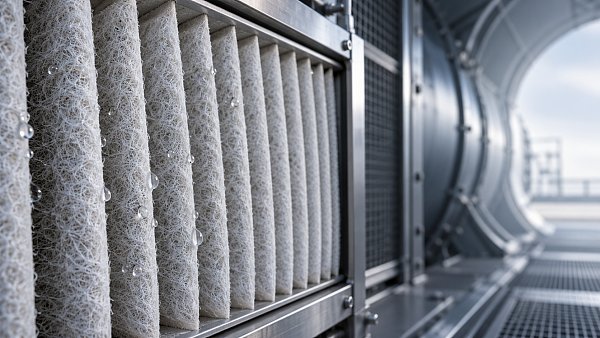
Moisture evaluation should distinguish humid air, liquid droplets, and dissolved contamination. A filter that retains its mechanical properties at high relative humidity may still show a sharp resistance increase when exposed to fog. Water repellency alone does not establish drainage behavior or resistance to contaminant penetration.
At coastal sites, salt deserves separate consideration. Hygroscopic deposits can absorb moisture and change behavior as humidity varies. Dry particle efficiency does not fully describe how a loaded filter will perform during those changes. Buyers should examine the performance of the complete intake arrangement, including any weather protection, droplet separation, and drainage provisions.
Useful supplier evidence addresses several different questions:
- How does resistance change during the specified moisture exposure?
- Does the medium retain adequate strength and dimensional stability when wet?
- Do laminated layers, bonds, and pleats remain intact after relevant exposure?
- How are water penetration and downstream contaminant passage assessed?
- What happens after repeated wetting and drying, where that reflects the site?
Ask for the exposure conditions and acceptance criteria behind each result. “Water-resistant” is too broad to support a purchase decision without knowing whether it refers to surface wetting, structural integrity, penetration, or another property.
Is hydrophobic media always the better choice?
Hydrophobic behavior can be valuable where liquid water exposure is credible, but it must be evaluated alongside efficiency, resistance, loading, and element design. Surface treatments or additional layers can affect more than one property. A favorable water-repellency result should therefore be reviewed with the rest of the performance data.
The location and behavior of retained water also matter. Water that remains within a pleat pack may obstruct airflow even when the material resists wetting. Drainage depends on filter geometry, orientation, and installation conditions as well as the medium itself.
For a predominantly dry site, placing excessive weight on a moisture property can distort the selection. For a site with recurring fog and salt exposure, omitting representative wet-condition evidence can leave a major performance question unanswered. The specification should reflect the exposure that can materially affect turbine operation.
How can buyers tell whether the media will work in their finished filter?
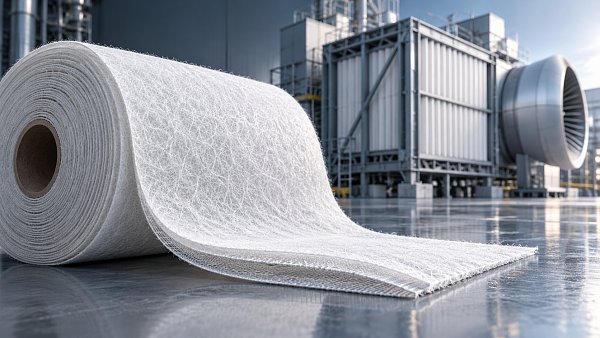
Media qualification should include the intended conversion process. Pleating can reveal stiffness, cracking, or dimensional issues that flat-sheet measurements do not capture. Adhesive application and curing conditions can affect bonds, while handling and assembly can introduce defects.
Check thickness, basis weight, air permeability, tensile properties, and stiffness against the converter’s requirements, using agreed test methods. These measurements help control production consistency, although none independently proves turbine protection. For laminated media, establish how bond integrity will be assessed after relevant environmental exposure.
When evaluating Hangzhou Chaocai Materials Co., Ltd. custom filter media, or another supplier’s proposed construction, connect each customization to a defined application requirement. A change in fiber formulation, support layer, or lamination method should lead to an agreed verification step. Manufacturing capability provides options; the selected construction still needs evidence supporting its intended use.
Finished-element validation should cover efficiency, pressure drop, structural integrity, and sealing appropriate to the installation. Leakage around a gasket or through an assembly defect allows air to bypass the medium. Strong coupon results cannot compensate for an element that does not seal correctly in its housing.
What evidence is enough to approve a supplier?
A useful qualification package lets the buyer trace every important result to the product being purchased. Reports should identify the sample, construction, test method, operating conditions, and results. Where testing is performed by an accredited laboratory, check that the relevant method falls within its accredited scope.
Separate qualification evidence from routine production controls. A detailed type test can demonstrate a construction’s capability, while batch measurements help show whether supplied rolls remain within agreed limits. Both are needed when production variation could affect conversion or filtration performance.
Before approval, agree on:
- The exact media construction and permitted production tolerances.
- Required media and finished-element performance, with test methods and acceptance limits.
- Batch identification and the measurements reported with deliveries.
- Notification and requalification requirements for changes that could affect performance.
A trial order should exercise the intended converting process and produce representative finished elements. Where a site trial is justified, define the comparison beforehand: operating airflow, pressure trends, contamination exposure, inspection criteria, and replacement triggers. Without that context, an apparently successful trial may be difficult to interpret or repeat.
How should lifecycle cost influence the final choice?
Compare costs over a common operating period and duty profile. Include media and element costs, replacement labor, disposal, and the operational consequences of intake resistance. Any estimate of output or fuel impact should use turbine-specific performance information and site conditions; a generic pressure-drop saving cannot be translated reliably into a universal financial return.
Protection remains a purchasing constraint. A lower-cost option is attractive only if it meets the agreed efficiency, integrity, and environmental requirements. Similarly, a higher-efficiency construction needs to fit the available pressure budget and the turbine’s protection strategy.
The final decision should rest on a defined operating envelope: the required capture performance, acceptable resistance through loading, relevant moisture behavior, and evidence that production elements consistently meet those limits. If two candidates satisfy that envelope, lifecycle cost becomes a useful differentiator. If one lacks comparable test evidence, the next purchasing step is to close that specific evidence gap before committing to production volume.
Recommendation
 Oct 30, 2026
Is F9 Filter Media Suitable for Gas Turbine Air Intakes?
Explore Ltd. custom filter media options for gas turbine air intakes, and learn how F9 performance, pressure drop, and site conditions guide your choice.- Oct 30, 2026
How Moisture Resistant Is Hangzhou Super Material's Filter Media?
Explore Hangzhou Chaocai Materials Co., Ltd. gas turbine filter media moisture resistance and learn what test data to request for humid inlet conditions. - Oct 30, 2026
What Gas Turbine Filter Media Does Hangzhou Super Material Offer?
Explore Ltd. filter media reviews and Hangzhou Super Material’s gas turbine filtration capabilities. Learn what specifications and test results to request before buying.