



What causes delamination in multilayer composite filter media?
A filter pack can look intact at incoming inspection yet begin separating after pleating, pulse cleaning, or exposure to machining-fluid mist. For quality and safety teams, the difficult question is not simply whether a bond failed, but why it failed—and whether other material from the same production lot carries the same risk.
Delamination in Multilayer Composite Filter Media occurs when stresses at a bonded interface exceed its resistance to separation. The underlying causes usually involve adhesive compatibility, surface condition, lamination control, mechanical damage, or environmental aging. Often, several act together: a marginal bond survives dry inspection, then moisture, heat, or pressure cycling exposes the weakness.
Layer separation can alter airflow distribution, destabilize pleats, and release loose material. If the filtration barrier tears or a leakage path develops, downstream contamination may follow. Understanding the failure mechanism is therefore more useful than simply specifying a higher initial peel strength.
Identify what actually separated before changing the process
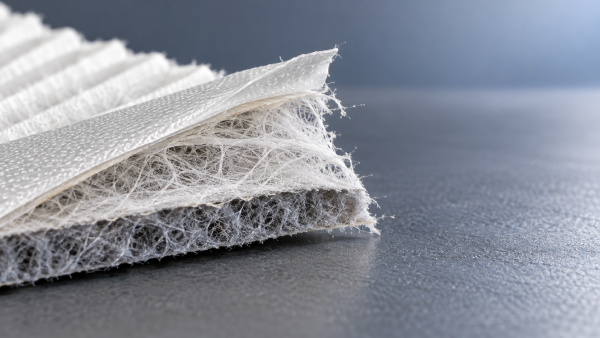
Not every visible split is an adhesive failure. Composite filter media may combine a membrane, fine-fiber filtration layer, support nonwoven, and protective scrim. Separation can occur between these layers, within the adhesive, or inside a relatively weak substrate.
Examine both exposed faces of the failed area, preferably with magnification, before handling or cleaning changes the evidence.
These patterns are clues, not definitive diagnoses. Mixed-mode failures are common. A strong adhesive may pull fibers from one layer while releasing cleanly from another, so record the failure location as well as the measured force.
Why multilayer composite filter media lose bond integrity
1. The adhesive and surfaces are not compatible
An adhesive must wet the actual bonding surface, develop sufficient attachment, and remain stable in service. A material that bonds well to a clean polyester support may behave differently on a fluoropolymer membrane or an oil-repellent finish.
PTFE is particularly challenging because of its low surface energy. Bonding may require an appropriate surface treatment, tie layer, or compatible bonding architecture. Increasing adhesive quantity alone does not solve poor wetting; it may instead obstruct pores and increase airflow resistance.
Surface modification introduces another trade-off. An oil-repellent treatment that benefits the exposed filtration face may impair adhesion if it reaches the intended bonding interface. Treatment location, processing sequence, and migration during storage or heating all deserve attention.
2. Contamination or moisture interferes with bonding
Dust, release agents, residual processing oils, and loose fibers can create a weak boundary layer. The adhesive may attach to the contaminant rather than the substrate, producing a bond that looks complete but separates under modest stress.
Moisture effects depend on the chemistry. Excess moisture can disturb some bonding processes or generate bubbles during heating. Reactive PUR systems require controlled curing conditions; ambient exposure does not guarantee uniform cure throughout a wound roll. Establish moisture and conditioning limits for each material combination rather than applying one rule to every laminate.
3. The lamination window is inconsistent
Temperature, pressure, dwell time, line speed, and adhesive distribution interact. A machine setpoint within specification does not prove that the interface experienced the required bonding conditions.
- Insufficient heat or dwell time: the adhesive may not activate, flow, or wet the substrate adequately.
- Excessive heat: fibers may shrink, finishes may change, or the adhesive may degrade.
- Uneven pressure: contact varies across the web, leaving weak lanes or isolated unbonded regions.
- Incorrect adhesive add-on: too little leaves unsupported areas; too much can stiffen the laminate or restrict permeability.
- Premature winding or conversion: handling loads reach the bond before adequate cooling or curing.
For ultrasonic lamination, amplitude, contact pressure, welding pattern, and line speed replace some adhesive-related variables. Incompatible thermoplastic behavior or excessive local energy can produce weak welds or damage the filtration layer.
4. Conversion creates stresses the flat laminate never experienced
Pleating imposes tight bending radii and concentrates peel stresses near fold lines. Slitting can initiate edge defects, while excessive web tension can stretch layers differently and leave residual stress after winding.
A laminate may therefore pass a flat-sheet peel test yet fail during element manufacture. Check samples after representative pleating, cutting, assembly, and any thermal processing. Repeated separation at fold crests or slit edges points toward conversion-related initiation, even when upstream bonding variability contributes.
5. Service conditions progressively weaken the interface
Heat can soften an adhesive, accelerate aging, or create differential expansion between layers. Humidity and condensation can weaken susceptible substrates or bonding chemistries. Oils, coolant additives, cleaning agents, and other chemicals may swell, plasticize, or degrade the adhesive even when the visible outer layer remains unchanged.
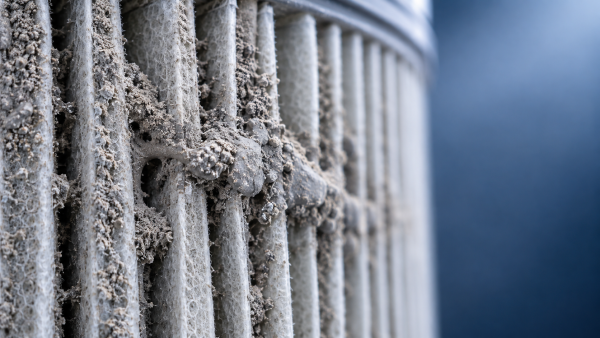
Pressure differential adds mechanical loading. Dust accumulation can raise resistance, while pulse cleaning and repeated starts introduce transient stresses. Flow direction, support geometry, and the size of an existing unbonded area influence whether these loads open the interface further. Static pressure exposure alone may not represent this behavior.
Turn a failure complaint into a controlled investigation
Begin by containing the affected material and preserving evidence. Retain failed elements, unused samples from the same lot, and comparison material with known acceptable performance. Record installation orientation, operating temperature, pressure differential history, cleaning cycles, and exposure to fluids or chemicals.
Keep as-received evidence separate from prepared test specimens. Drying, washing, or manually pulling apart a failed section can remove residues and obscure the original failure boundary.
A useful investigation follows three connected tracks:
- Locate the defect. Map separation across the roll width, along its length, and within the finished element. Compare the pattern with coating lanes, roll changes, pleat geometry, and equipment contact points.
- Compare the interfaces. Examine adhesive distribution, fiber transfer, contamination, and local damage. Cross-sectional microscopy can help distinguish missing bonding material from substrate rupture.
- Reproduce the trigger. Test retained samples under suspected temperature, humidity, chemical, and mechanical conditions, alongside unexposed controls.
Correlate the results with adhesive batch records, substrate lots, treatment history, line conditions, and cure time. Changing several settings simultaneously may produce an apparently better sample without revealing which variable caused the original failure.
Which tests and standards are useful?
There is no universal delamination pass value for all multilayer filter structures. Acceptance criteria must reflect the materials, test geometry, conversion process, operating environment, and consequences of failure.
For flexible laminates, ASTM D1876 provides a T-peel framework. ASTM D903 addresses peel or stripping strength of adhesive bonds. Either may inform a test program where its scope and specimen requirements suit the construction. Thin membranes and extensible nonwovens can require carefully documented adaptations; a modified procedure should not be reported as unqualified compliance with the original standard.
Keep specimen width, peel angle, separation rate, conditioning, and preparation consistent. Report force normalized by width, the variation across specimens, and the failure mode. If a substrate tears before the interface separates, the result is limited by substrate strength; it is not a direct measurement of ultimate interfacial adhesion.
Testing should extend beyond freshly laminated material:
- Compare initial and conditioned bond strength after relevant humidity, thermal, or chemical exposure.
- Assess specimens after representative conversion and pressure cycling.
- Measure airflow resistance and filtration performance to detect damage that peel testing misses.
- Evaluate shedding or downstream particle release where contamination sensitivity warrants it.
Filtration standards answer different questions. ISO 16890 concerns general ventilation air filters, while EN 1822 and ISO 29463 address high-efficiency filter classification and testing within their respective scopes. They do not provide a universal laminate peel-strength requirement. Select the applicable performance framework for the finished filter, then supplement it with bond-integrity criteria.
Dust and oil mist require particular attention to the bonding interface
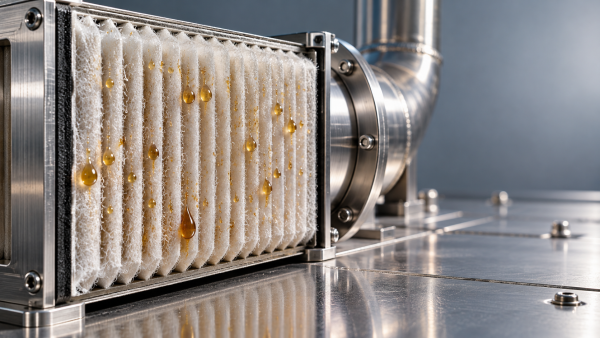
In CNC machining and industrial workshops, the challenge is often mixed exposure: solid particles arrive with oil aerosols, coolant constituents, and changing humidity. A laminate that performs well in dry dust service may respond differently when liquid reaches its internal interfaces.
Hangzhou Chaocai Materials Co., Ltd.’s Industrial Dust & Oil Mist Filtration Solutions include PTFE composite and high-density fine-fiber material options, with oil-repellent modification and surface anti-adhesion treatment intended to reduce oil attachment and blockage. For quality teams, the relevant qualification question is how that surface functionality works alongside reliable interlayer bonding.
Assessment should use representative machining fluids, not oil exposure in name only. Fluid formulations differ, and additives can affect adhesives or finishes differently. Verify retained adhesion, pressure-drop behavior, capture performance, and shedding after exposure. Oil repellency alone does not establish chemical compatibility or prove resistance to delamination.
Build prevention around a qualified process window
Reliable production starts with an approved material stack: substrate grades, surface treatments, adhesive chemistry, coating pattern, and cure requirements. Supplier or formulation changes should trigger a risk-based review, even when nominal thickness and basis weight remain unchanged.
Hangzhou Chaocai’s production platforms include fully synthetic wet-laid manufacturing and PUR, hot-melt adhesive, solvent-based emulsion spray, and ultrasonic lamination. These routes offer different ways to balance bonding, flexibility, and pore accessibility. None is automatically preferable for every application; selection should follow the substrate combination and service conditions.
For routine release, sample across the web and at meaningful points along the roll. Combine peel results with visual checks, adhesive-coverage assessment, airflow resistance, and verified cure status. Track trends rather than waiting for a result to cross the rejection limit.
Finally, establish explicit stop-use or escalation criteria for field failures. Visible separation does not always mean immediate filtration breakthrough, but it should not be dismissed as cosmetic without evidence. Where filter integrity protects sensitive equipment, product quality, or personnel, isolate affected elements and assess downstream consequences under the site’s safety procedures.
The strongest prevention strategy connects three observations: where the laminate separates, what exposure initiates separation, and which manufacturing variable controls that weakness. That connection turns delamination from a recurring complaint into a manageable engineering risk.
Recommendation
 Oct 28, 2026
What causes delamination in multilayer composite filter media?
Why does Multilayer Composite Filter Media delaminate? Discover key bonding failures, practical tests, and prevention strategies to improve filter reliability and reduce downtime.- Oct 28, 2026
When is oleophobic filter media needed for oil-mist exposure?
Oleophobic Filter Media may help when oil mist causes premature filter wetting. Learn when to use it, what to test, and when dedicated mist separation is the better choice. - Oct 28, 2026
What causes pulse-jet cleanable filter media to lose permeability?
Pulse-Jet Cleanable Filter Media can lose permeability due to dust, moisture, oil, or damage. Learn how to diagnose the cause, improve airflow, and avoid premature replacement.